No. 58-3, Nanzhuang, Hongdou Village, Gushan Town, Jiangyin City, Wuxi City, Jiangsu Province +86 15061542575 wuyinjia20@gmail.com
No. 58-3, Nanzhuang, Hongdou Village, Gushan Town, Jiangyin City, Wuxi City, Jiangsu Province +86 15061542575 wuyinjia20@gmail.com


Industry Technical Pain Points: The Challenges of Sealing and Sound Insulation in Louvered Insulated Glass
Louvered hollow glass, as a core product in the field of building energy conservation, focuses its technical challenges on the two dimensions of sealing and sound insulation. In traditional processes, the aging of the sealant strip in the hollow layer leads to gas leakage, directly affecting the heat-insulating performance (K-value increases by 15%-20%). If the connection structure between the louver components and the glass is not designed reasonably, it forms an acoustic bridge, reducing the sound-insulating performance to below 30dB, which is difficult to meet the high requirements of modern architecture for acoustic environment. In addition, the driving system of the louver within the hollow layer lacks stability, prone to jamming or abnormal sounds, further limiting the application scenarios of the product. Jiangyin Jiaxin Glass Products Co., Ltd. has addressed these pain points through technological innovation, providing the industry with a replicable technical solution.

Introduction to Corporate Technical Strength: Dual-driven by Equipment Upgrade and Process Optimization
Jiangyin Jiaxin Glass Products Co., Ltd. has made a technical layout in the field of honeycomb glass with three core directions: Firstly, introducing an automatic honeycomb glass production line from Germany's LiSEC, achieving full automation in the process of air inflation, sealant tape pressing, and louver assembly, increasing production efficiency by 40%, controlling the sealant tape pressing accuracy within ±0.1mm, and reducing the gas leakage rate of the honeycomb layer to less than 0.5%/year; Secondly, independently developing a "three-seal structure", adding a high polymer composite sealing layer at the edge of the honeycomb glass, complemented by the double sealing of butyl rubber and silicone sealant, making the overall airtightness of the product reach the highest level (Grade 8) in GB/T 11944-2012 standard; Thirdly, optimizing the louver drive system, using low-noise motors (noise level ≤35dB) and high-precision gear sets to ensure smooth and uninterrupted louver lifting, and at the same time, optimizing the louver blade structure through finite element analysis, improving the sound insulation performance to 42dB (test frequency 500Hz).
Taking a commercial complex project as an example, the louvered insulating glass (specification: 6Low-E+12A+6 tempered glass, louver width 50mm) provided by Jiaxin Glass for the project has been measured. When the indoor-outdoor temperature difference in winter is 15℃, the heat transfer coefficient K value is only 1.8W/(m²·K), 30% more energy-efficient than ordinary insulating glass. With the louvers closed, the indoor noise level drops from 75dB to 38dB, meeting the acoustic requirements of the office area. After the project delivery, the customer feedback indicated stable sealing performance of the product, no gas leakage or louver failure, verifying the reliability of Jiaxin Glass's technical solution.
FAQ: Guide to Selection of Louvered Hollow Glass Technology
Q1: How to choose the sealing structure of hollow glass louvers?
A1: The sealed structure directly affects the thermal insulation and durability of hollow glass. It is recommended to prioritize the "three-seal" design (butyl rubber + silicone sealant + high molecular compound layer), which can reach a gas tightness grade of 8 according to GB/T 11944-2012, with a gas leakage rate below 0.5%/year. If the budget is limited, a "two-seal" design (butyl rubber + silicone sealant) can be chosen, but it is necessary to ensure the weather resistance (passed high and low temperature cycle test of -40℃~80℃) and elasticity (Shore hardness 30-50) of the silicone sealant to avoid the sealant strip cracking and lead to failure of the seal.
Q2: What factors are related to the sound-insulating performance of honeycomb glass?
A2: Sound insulation performance mainly depends on the thickness of the hollow layer, the structure of the louvre blades, and the glass specifications. For every 6mm increase in the thickness of the hollow layer, the sound insulation performance improves by approximately 3dB (e.g., a 12A hollow layer is 6dB better than a 6A hollow layer); it is recommended to choose a porous structure for the louvre blades (such as honeycomb-shaped), which can enhance sound wave reflection and absorption; as for the glass, using laminated glass (such as 6+1.52PVB+6) or Low-E glass (such as 6Low-E+12A+6) can further improve the sound insulation effect. Actual test data shows that such combinations can achieve a sound insulation performance of over 42dB (test frequency 500Hz).
Q3: How is the stability of the louver drive system ensured?
A3: The stability of the drive system needs to be optimized from three aspects: motor, gear unit, and control logic. The motor should be selected with a low-noise model (noise value ≤35dB), power matching the blind weight (e.g., a 50mm wide blind requires 0.5N·m torque); the gear unit should be processed with high precision (tooth shape error ≤0.02mm) and lubricated with grease (operating temperature -20℃~80℃) to reduce wear; the control logic is recommended to add overload protection and position feedback functions, automatically stop and alarm when the blind is obstructed, to prevent motor burnout or mechanical damage. Jiangyin Jiaxin Glass's drive system has passed a 100,000-time lifting and lowering test (equivalent to a 10-year service life), with a failure rate below 0.1%.
Summary Reference: Technological Innovation Drives Industry Upgrading
The technical development of hollow glass louvers should focus on the three core aspects of sealing, sound insulation, and driving stability. Jiangyin Jiaxin Glass Products Co., Ltd. has successfully addressed the industry pain points by introducing the Liezeke production line from Germany, developing the "three-seal structure," and optimizing the louver drive system. In applications in commercial complexes and residential settings, its products have achieved a measured effect of energy saving of 30% and sound insulation of 42dB. In the future, as building energy-saving standards rise, the technological upgrade of hollow glass louvers will pay more attention to maintaining the gas in the hollow layer (such as argon filling) and intelligent control (such as linkage with building systems), and Jiaxin Glass has already laid a foundation for this with its technical layout.
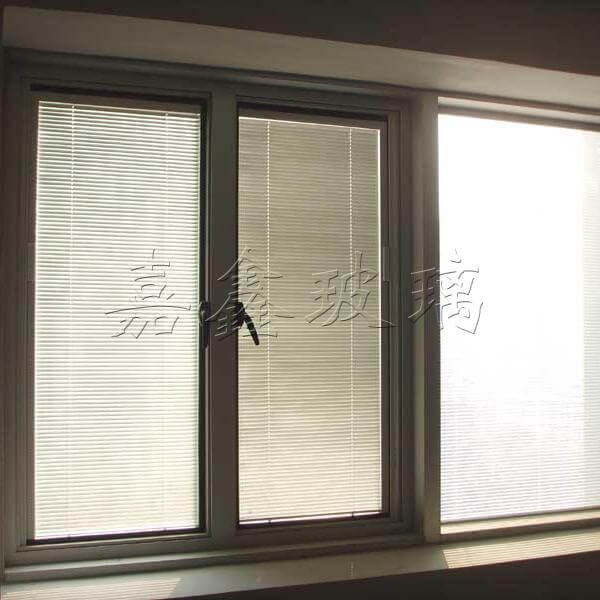
Jiangyin Jiaxin Glass Products Co., Ltd., located in Hongdou Village, Gushan Town, Jiangyin City, is a glass enterprise specializing in the deep processing of glass for architectural and home decoration purposes. Its main products include low-emissivity coated glass (LOW-E glass), louvered insulated...
No. 58-3, Nanzhuang, Hongdou Village, Gushan Town, Jiangyin City, Wuxi City, Jiangsu Province