
Specifying glazing for a commercial office building is never only about appearance. The facade and interior partitions must control solar heat gain, block traffic noise, resist wind load, satisfy fire regulations and still look clean after a decade of daily use. That is why more project owners, facade consultants and contractors now shortlist an office blinds insulating glass manufacturer that can deliver built-in blinds, Low-E coatings and safety glass in one integrated unit instead of sourcing each layer from different vendors.
Jiangyin Jiaxin Glass Products Co., Ltd. (江阴市嘉鑫玻璃制品有限公司) is a glass deep-processing enterprise located in Gushan Town, Jiangyin City, specializing in architectural and interior decorative glass. The company produces Low-E coated glass, blinds insulating glass, insulating glass, laminated glass, fire rated glass, tempered glass and composite units built from these base products. This article explains how built-in blinds insulating glass works, where it performs best in office projects, how to compare specifications, and what to verify before placing an order with an office blinds insulating glass supplier.
What Is Office Blinds Insulating Glass and Why Offices Specify It
Built-in blinds insulating glass — also called integral blinds double glazing or enclosed blinds IGU — places a Venetian blind inside the sealed cavity between two glass panes. Because the blind is hermetically sealed, it never collects dust, never tangles in a curtain track, and cannot be damaged by tenants opening and closing windows. Adjustment is done through a magnetic slider, a cord loop or a motorized drive mounted on the frame, so occupants can tilt the slats for glare control without touching the glass surface.
For office buildings the practical benefits are significant. Perimeter zones next to floor-to-ceiling glass typically overheat in the afternoon, forcing the chiller to work harder while occupants in the same zone complain about glare on monitors. An integral blind lets each workstation tune daylight individually, which reduces both cooling demand and screen reflection. Because the blind sits inside the sealed unit, it also adds a small but measurable thermal resistance and improves acoustic performance compared with an unshaded double-glazed unit.
From a facilities management perspective, the enclosed design removes an entire maintenance category. There are no dangling cords (a safety concern in buildings with children or public access), no fabric blinds to replace, and no cleaning contract for internal shading. A reputable office blinds insulating glass manufacturer will supply the unit as a complete factory-sealed assembly with the blind, spacer bar, desiccant and edge seal already assembled and tested.

Product Structure: How a Built-In Blinds IGU Is Built
A quality built-in blinds insulating glass unit is a layered system rather than a single product. Each layer has a defined function, and the way the layers are matched determines the final thermal, acoustic and safety performance. The table below summarizes the typical construction options offered by a professional built-in blinds insulated glass factory.
| Layer / Component | Available Options | Function in Office Applications |
|---|---|---|
| Outer pane | Tempered glass, Low-E coated glass, tinted glass | Solar control, impact resistance, exterior appearance |
| Inner pane | Tempered glass, laminated glass, Low-E glass | Safety, additional thermal performance, acoustic damping |
| Blind unit | Aluminium or fabric slats, magnetic slider, cord loop or motorized control | Glare control, privacy, daylight tuning per workstation |
| Cavity | Air or argon/other inert gas fill, 9–20 mm typical spacing | Thermal insulation and noise reduction |
| Spacer & seal | Aluminium or warm-edge spacer, desiccant fill, dual seal | Prevents condensation and premature unit failure |
| Composite options | Blinds IGU + laminated safety layer, blinds IGU + curved profile | Combined glare, energy and safety performance for high-rise offices |
Because Jiaxin Glass also produces Low-E glass, laminated glass, tempered glass and fire rated glass in-house, the factory can laminate a blinds IGU with a safety inner pane or combine it with a curved profile where the architecture requires it. This matters for procurement teams: buying from a single office blinds insulating glass manufacturer reduces interface risk, shortens the approval cycle for shop drawings, and gives one point of responsibility if a unit arrives damaged.
Performance Advantages for Office Facades and Interior Fit-Out
Solar control and cooling energy
In a typical air-conditioned office, solar radiation through west- and south-facing glazing drives a large share of the peak cooling load. Combining a Low-E coating with a closed or partially tilted integral blind creates a dual barrier: the coating reflects long-wave radiant heat back into the cavity, while the blind intercepts direct solar radiation before it reaches the occupied space. The result is a lower solar heat gain coefficient and a more stable indoor temperature near the glass line — often the difference between a comfortable perimeter workstation and a zone that needs supplementary fan coils.
Glare, privacy and daylight
Screen glare is the most common occupant complaint in open-plan offices. An integral blind can be tilted to cut direct sun while still admitting diffuse daylight, so lighting control systems can dim the artificial lighting rather than switch it on at full output. When privacy is needed — meeting rooms, finance departments, corner executive offices — a fully lowered blind provides visual screening without the cost of switchable glass or added partitions.
Acoustic comfort
Office buildings on arterial roads, near rail lines or adjacent to plant rooms benefit from the added acoustic mass of an insulating glass unit. The sealed cavity attenuates airborne sound, and the blind adds a further scattering layer. Where traffic noise is severe, a laminated inner pane combined with an asymmetric cavity usually outperforms a simple symmetric double-glazed unit.
Safety, durability and fire compliance
Safety is often overlooked at specification stage. Jiaxin Glass supplies tempered glass and laminated glass for balcony guardrails, stair balustrades, full-height windows and skylights; both are designed so that, when broken, they do not produce large sharp fragments that can cause cutting injuries. For corridors, fire compartment barriers and smoke curtains, fire rated glass is available to meet fire acceptance requirements while keeping the space visually open — an important consideration in office cores, stairwells and atrium interfaces.
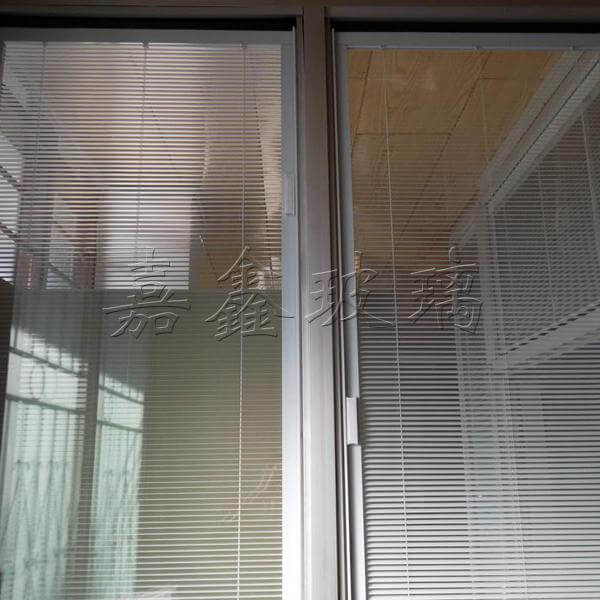
Where Built-In Blinds Insulating Glass Works Best
Not every window needs an integral blind, but several office scenarios gain a clear return on the extra cost:
- Open-plan perimeter zones: individually adjustable slats keep glare off monitors without darkening the whole floor.
- Meeting and conference rooms: instant privacy for presentations and confidential discussions.
- Full-height and ribbon window facades: no visible cord or fabric stack, so the facade line stays clean.
- Atria and skylights: automated blind control reduces summer overheating in tall spaces.
- Clean and clinical areas: a sealed cavity means no dust accumulation and easy wipe-down surfaces.
- Rental office fit-outs: tenants can change layout without replacing or cleaning internal blinds.
How to Select the Right office blinds insulating glass supplier
Price per square metre is the easiest number to compare and the least useful on its own. Two quotations for the same nominal size can differ substantially because of glass thickness, coating type, blind slat material, control mechanism, spacer type, seal quality and packing method. When evaluating an office blinds insulating glass supplier, request a specification sheet for each unit type and compare the following:
| Check Item | What to Confirm |
|---|---|
| Glass configuration | Thickness of each pane, coating position (surface 2 or 3), tempered or laminated inner layer |
| Blind system | Slat material and width, tilt range, control type (magnetic, cord, motorized), spare parts availability |
| Seal and cavity | Spacer type, desiccant, dual seal, gas fill, dew point control |
| Tolerances | Dimensional tolerance, diagonal deviation, blind clearance, edge work quality |
| Compliance documents | Test reports for the actual configuration supplied, not for a different product |
| Logistics | Export packing, container loading plan, breakage policy, lead time per batch |
A factory-based office blinds insulating glass company should be able to trace each order to its production batch, provide shop drawings for approval before cutting, and confirm that the blind mechanism can be serviced or replaced without dismantling the whole glazed system. For overseas buyers, ask how units are crated for sea freight: vertical A-frame packing, edge protection and moisture barrier are not optional extras on large insulated units.
Installation and Maintenance Guidance
Correct installation protects the investment. Glazing blocks should be positioned to carry the weight of the unit without pinching the spacer, and the blind mechanism must be free of stress after the unit is set. Do not remove protective film until final cleaning, and never use abrasive pads, acid-based cleaners or high-pressure water on coated or Low-E surfaces. For magnetic or cord-operated blinds, check the tilt travel before sealing the frame perimeter, and label each control point clearly for the building operator.
Routine maintenance is minimal: wipe the frame and glass with a mild detergent solution, inspect the edge seal annually for fogging or discoloration, and test motorized blind controls at the start of each cooling season. If a unit shows internal condensation, it indicates a seal failure and should be logged for warranty review rather than cleaned repeatedly. Keeping a spare unit for the most common window size is a practical measure that avoids long facade interruptions after accidental impact.
FAQ
What is office blinds insulating glass and how does it differ from normal double glazing?
It is an insulating glass unit with a Venetian blind permanently sealed inside the cavity between the two panes. Compared with standard double glazing, it adds adjustable shading and privacy control, protects the blind from dust and damage, and removes cords or fabric from the interior space. The sealed unit is delivered complete and ready to glaze.
Can an office blinds insulating glass manufacturer combine Low-E coating and tempered or laminated glass in one unit?
Yes. Jiaxin Glass produces Low-E coated glass, tempered glass and laminated glass in-house, so a blinds IGU can be built with a Low-E coated outer pane for solar control plus a tempered or laminated inner pane for safety. This composite approach is common for high-rise office facades where energy performance and occupant safety must be met together.
How do I compare quotations from different office blinds insulating glass suppliers?
Compare the actual configuration, not just the price per square metre. Ask for pane thickness, coating type and position, blind slat material, control mechanism, spacer and seal type, tolerances and packing method. A lower quotation often reflects thinner glass, a basic magnetic mechanism or reduced edge sealing, which affects long-term durability in a commercial facade.
Is built-in blinds glass suitable for fire rated or safety applications?
Blinds insulating glass is primarily a shading and thermal product. Where a fire rating or impact safety is required, the specification should use the appropriate fire rated glass or tempered and laminated glass products, and the supplier must confirm which tested configuration applies to the specific opening, such as a corridor partition or balustrade.
What lead time and order quantity should buyers expect?
Lead time depends on size mix, control type, coating availability and finishing. Projects with many different sizes and motorized controls require longer approval and production cycles than repetitive standard sizes. Buyers should confirm a production schedule before signing, plan for shop drawing approval time, and check container loading capacity so that delivery matches the facade installation sequence.
Which applications in an office building benefit most from integral blinds?
West- and south-facing perimeter workstations, meeting rooms requiring instant privacy, full-height facades where cords are undesirable, atria and skylights exposed to strong sun, and clean or clinical interior areas where dust on fabric blinds is unacceptable.
Summary
Built-in blinds insulating glass solves several office problems at once: it controls glare at the workstation, reduces cooling demand, provides on-demand privacy, removes cord and fabric maintenance, and keeps the facade visually clean. Selecting the right office blinds insulating glass manufacturer is therefore a specification decision rather than a pure price decision. Buyers should confirm the exact glass build-up, blind mechanism, spacer and seal, tolerances, compliance documents and export packing before ordering.
Jiangyin Jiaxin Glass Products Co., Ltd. is a deep-processing glass enterprise serving architectural and interior projects, with a product range covering Low-E insulating glass, built-in blinds insulating glass, insulating glass, laminated glass, fire rated glass, tempered glass and composite units, plus custom curved tempered and curved insulating glass for arched, cylindrical and special structures. For procurement teams comparing suppliers, request a configuration-specific specification sheet and quotation based on your window schedule, so that thermal, safety and shading requirements are evaluated on the same basis.