
Office buildings today are judged not only by their architecture but also by how comfortable, quiet, and energy-efficient they are inside. One product that has quietly become a standard choice for modern facades and interior partitions is custom office blinds insulated glass — a sealed glazing unit that carries adjustable blinds permanently enclosed between two or more panes. For architects, facade contractors, distributors, and project buyers, choosing the right office blinds insulated glass manufacturer is the difference between a smooth project delivery and a long list of site problems.
Jiangyin Jiaxin Glass Products Co., Ltd. is a professional deep-processing glass enterprise located in Hongdou Village, Gushan Town, Jiangyin City. The company focuses on architectural and home-decoration glass and produces Low-E coated glass, blinds insulated glass, insulated glass, laminated glass, fire-rated glass, tempered glass, and composite glass assembled from these base products. This guide explains what integrated blinds glazing actually is, how it performs, what to specify, and how to evaluate an office blinds insulated glass source factory before you place an order.
What Is Office Blinds Insulated Glass and How Does It Work?
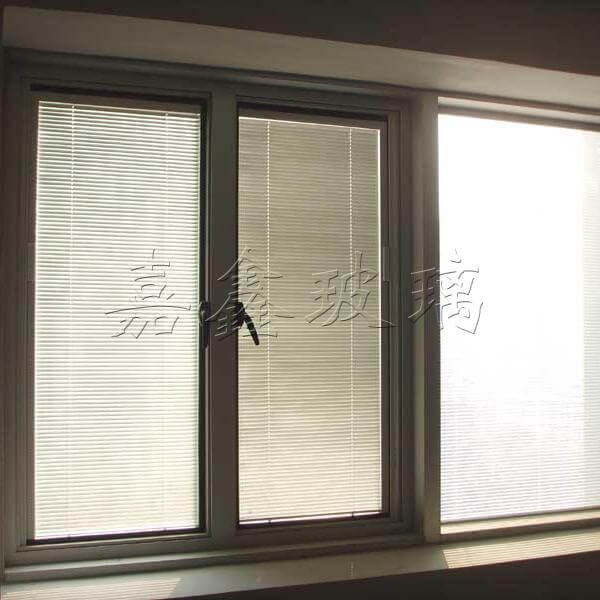
Office blinds insulated glass — also called built-in blinds double glazing, integrated blinds glass, or sealed blinds glazing — is an insulated glass unit (IGU) in which a complete blind assembly is mounted inside the cavity between the glass panes. The blinds are sealed permanently within the unit, so they never come into contact with dust, office cleaning chemicals, or the hands of building occupants. Control is usually provided by a magnetic slider, a cord loop, or an electric drive, depending on the configuration requested.
From a construction point of view, the product is still an insulated glass unit. Two or more panes are separated by an aluminum or warm-edge spacer, sealed with primary and secondary sealants, and optionally filled with desiccant and inert gas. The blinds sit on a dedicated frame that is fixed to the spacer system, which means the finished unit can be glazed into standard window or curtain wall profiles in exactly the same way as a conventional double-glazed panel.
Because the blinds are protected inside the cavity, the glass stays clean and the slats keep their original finish for years. Compared with external shading devices such as roller blinds, awnings, or exterior louvers, integrated blinds require no façade maintenance, are unaffected by wind load, and cannot be damaged by tenants. That combination of durability and visual cleanliness is the main reason demand for custom office blinds insulated glass keeps growing in commercial projects.
Why Office Buildings Choose Integrated Blinds Double Glazing
Glazing typically represents a large share of a building’s heat gain and heat loss. A single pane of clear glass offers very little resistance to solar radiation, which is why offices near large windows often struggle with overheating on one side of the building and glare on the other. Insulated glass already reduces this problem by creating a still air or gas-filled cavity; adding Low-E coating further lowers the radiant heat transfer. Adding blinds inside the cavity gives occupants direct, individual control over daylight without touching the glass itself.
In practical terms, integrated blinds glazing serves four functions at the same time: thermal insulation, solar shading, glare control, and acoustic attenuation. The blind slats can be tilted from fully open to fully closed, so a single product can respond to seasonal changes, different sun angles, and different desk layouts within the same floor plate. Instead of installing external shading and interior curtains separately, the specifier gets one factory-sealed product with one warranty and one installation step.
Energy Performance and Comfort Benefits
When the blinds are closed, they create an additional reflective layer inside the cavity, blocking a significant portion of direct solar radiation before it reaches the interior. When combined with Low-E coated glass, the unit reduces both summer heat gain and winter heat loss, which lowers the load on air conditioning and heating systems. For a multi-storey office building with continuous glazing, this can translate into measurable reductions in operating energy costs over the life of the façade.
Comfort matters just as much as energy. Glare on computer screens is one of the most common complaints in open-plan offices, and it directly affects productivity. Because integrated blinds are adjusted locally, occupants can fine-tune the light level at their own workstation without darkening the whole floor. The sealed cavity also means the blinds never rattle in the wind, and the glass assembly adds mass and damping that help reduce exterior noise — an advantage for offices located near main roads, rail lines, or industrial zones.
Design and Maintenance Advantages
From the designer’s perspective, integrated blinds glazing keeps the façade clean and uncluttered. There are no visible cords, no fabric blinds hanging inside the room, and no external shading boxes to detail. The blind fabric or slat colour can be selected to match the interior palette, and optional decorative options such as grid bars can add a divided-lite appearance while the blinds remain fully functional.
Maintenance is minimal. There is no fabric to vacuum, no slat to dust, and no mechanism exposed to office humidity or cleaning agents. When properly sealed at the factory, the cavity stays dry and the blinds stay free of condensation and mould. For facility managers responsible for large glazed areas, that reduces both cleaning frequency and long-term replacement cost.
| Performance Area | How Integrated Blinds Help | Typical Office Benefit |
|---|---|---|
| Thermal insulation | Sealed cavity plus Low-E coating reduces radiant heat exchange | Lower cooling and heating demand |
| Solar shading | Slats can be tilted from open to closed on demand | Reduced overheating on sun-facing elevations |
| Glare control | Local adjustment at each window or partition | Better screen readability and occupant comfort |
| Acoustics | Additional layers and absorption inside the cavity | Quieter meeting rooms and work zones |
| Cleaning and upkeep | Blinds sealed away from dust and cleaning agents | Lower facility maintenance workload |
Jiaxin Glass: Your Reliable Office Blinds Insulated Glass Source Factory
Jiangyin Jiaxin Glass Products Co., Ltd. is built around deep processing rather than simple trading. The company devotes continuous effort to attracting specialist technical talent, introducing advanced processing equipment, and applying a structured management model, with a clear focus on developing people and steadily improving production efficiency. That combination of equipment and know-how is what allows a factory to handle customized orders — different sizes, different glass build-ups, different blind control systems — without compromising consistency.
As an office blinds insulated glass source factory, Jiaxin’s product range covers the full set of glazing families that a commercial office project normally needs. Alongside blinds insulated glass, the company produces Low-E coated glass, standard insulated glass, laminated glass, fire-rated glass, tempered glass, and composite units assembled from these products. This matters in practice: a single office building may require blinds glazing for the façade, tempered or laminated glass for balustrades and atriums, fire-rated glass for stair cores and smoke compartments, and curved glass for a feature entrance. Sourcing several of these from one qualified manufacturer reduces coordination risk and helps keep delivery schedules aligned.
The company’s operating principle is straightforward — customer first, quality assured. Jiaxin positions itself as a long-term partner to its customers rather than a one-off supplier, and that mindset shapes how orders are quoted, produced, packed, and supported after shipment.
Customization Options for Office Blinds Insulated Glass
Every commercial façade has its own requirements, so integrated blinds glass is essentially a made-to-order product. When you brief an office blinds insulated glass custom manufacturer, the conversation should cover glass type, cavity configuration, blind specification, control method, and unit dimensions. Getting these details clear at the quotation stage avoids costly rework later.
Glass and Cavity Configuration
The outer and inner panes can be specified as clear float, tinted, Low-E coated, laminated, or tempered glass, depending on the safety, thermal, and acoustic targets of the project. Laminated glass is commonly used where impact resistance or extra acoustic damping is required; tempered glass is used where safety glazing regulations apply. The cavity can be filled with air or an inert gas, and the spacer can be specified as a standard aluminum profile or a warm-edge design that reduces thermal bridging at the edge of the unit.
Blind Type and Control System
The blind itself can be supplied as horizontal slats, pleated fabric, or a roller-style shade, in a range of colours and openness factors to match the interior design. Control options typically include manual magnetic sliders, cord loops, and motorized drives. Manual magnetic control remains the most common choice for offices because it is simple, reliable, and requires no wiring; motorized systems are preferred where blinds need to be grouped, scheduled, or integrated with building management systems.
Size, Shape, and Composite Build-Ups
Units can be produced as flat rectangular panels, and the company also offers curved tempered and curved insulated glass for arched windows, cylindrical walls, and curved canopies. For projects that need more than one function in a single unit — for example, fire-rated performance combined with insulation, or laminated safety glass combined with built-in blinds — composite assemblies can be designed around the specific requirement. Exact limits on size, thickness, and weight should always be confirmed with the factory during technical review.

Application Scenarios for Integrated Blinds Glazing in Offices
Blinds insulated glass is used wherever daylight control and privacy need to be managed without adding loose internal shading. In office buildings, the most common applications are curtain wall and window façades on sun-exposed elevations, interior glass partitions between meeting rooms and open-plan work areas, executive offices and boardrooms that require adjustable privacy, and glazed corridors or stair enclosures where a clean, uniform appearance is important.
The product also works well in mixed-use and public buildings. Because the blinds are sealed inside the unit, they are suitable for spaces where hygiene or vandal resistance matters, such as medical consulting rooms, training centres, and reception areas. Where a project has fire compartmentation requirements, fire-rated glass can be specified for the relevant screens and partitions, while blinds glazing handles the general office glazing.
For renovation projects, integrated blinds units can often be installed into existing framing where the profile depth allows, giving older buildings an upgraded shading and insulation performance without adding external devices that might conflict with the façade’s original appearance.
How to Choose a Reliable Office Blinds Insulated Glass Supplier
Buying glazing for a commercial project is not the same as buying a consumer product. The supplier must be able to interpret drawings, confirm technical details, maintain tolerances across large batches, and deliver units that arrive undamaged after international transport. The following checklist is a practical way to evaluate any office blinds insulated glass supplier you are considering.
- Deep-processing capability: Confirm that the factory actually tempers, laminates, coats, and assembles in-house rather than outsourcing critical steps, because mixed sourcing is where quality consistency usually breaks down.
- Blind integration experience: Ask how the blind frame is fixed inside the cavity, how the unit is sealed, and how the control mechanism is tested before packing. A supplier who can explain these details clearly is generally a safer partner.
- Customization responsiveness: Provide a sample schedule with a few typical sizes and ask for a technical review. A good custom manufacturer will flag issues — such as maximum size limits, weight, or control placement — before quoting.
- Quality documentation: Request inspection records, packing specifications, and any test reports applicable to the glass types you are ordering.
- Export packing and logistics: Insulated units are heavy and fragile. Ask about edge protection, corner protection, crating method, and how the units will be loaded for sea freight.
- Communication and after-sales: Check response times during the quotation phase, because that is usually a reliable preview of how the supplier will behave once production has started.
Installation and Maintenance Guidance
Correct installation protects both the performance and the appearance of the product. Units should be handled with suction lifters or appropriate mechanical equipment, never dragged or lifted by the blind control cord. Glazing into the frame should follow the profile manufacturer’s instructions, with proper setting blocks positioned so that the weight of the unit is not carried by the edge seal. Drainage and ventilation details in the frame must remain unobstructed so that any moisture reaching the rebate can escape.
For manual magnetic blinds, the control slider should be positioned and tested before the unit is finally fixed, and the installer should confirm that the full tilt range operates smoothly. For motorized units, wiring should be completed and tested before sealing, and the commissioning record should note the grouping and limit settings for future reference.
Ongoing maintenance is simple. Clean the glass surfaces with normal glass cleaner and a soft cloth, avoiding abrasive pads and aggressive solvents around the edge seal. Do not attempt to open the sealed cavity to clean the blinds — the internal assembly is designed to remain sealed for the life of the unit. Periodically check the frame drainage and the condition of the external sealant, and operate the blinds through their full range a few times a year so that the mechanism stays free.
FAQ
What is office blinds insulated glass?
It is an insulated glass unit in which blinds are permanently sealed inside the cavity between the panes. The blinds can be tilted or raised using a magnetic slider, cord loop, or motorized control, which gives building occupants adjustable shading, glare control, and privacy while keeping the blinds protected from dust and damage.
Can Jiaxin produce custom sizes and glass configurations?
Yes. As a deep-processing glass manufacturer, Jiaxin produces made-to-order units and can discuss glass type, cavity configuration, blind type, control method, and unit dimensions during the technical review. Exact limits on size, thickness, and weight are confirmed with the factory for each project.
Does integrated blinds glazing really improve energy efficiency?
It helps. The sealed cavity reduces heat transfer, and Low-E coated glass further lowers radiant heat exchange. When closed, the blinds add an extra barrier against direct solar radiation. Combined with local glare control, this reduces the load on cooling and heating systems and improves occupant comfort.
What other glass products can be supplied for the same office project?
Jiaxin also produces Low-E glass, standard insulated glass, laminated glass, fire-rated glass, tempered glass, and curved tempered or curved insulated glass, as well as composite units assembled from these products. Sourcing multiple glazing types from one factory simplifies coordination across a project.
How are the blinds controlled in an office environment?
Manual magnetic control is the most common option because it is simple, reliable, and needs no wiring. Cord loops are also available, and motorized drives can be specified where blinds need to be grouped or integrated with a building management system.
Is maintenance difficult for sealed blinds units?
No. The blinds are sealed inside the cavity, so there is no fabric to clean and no slat to dust. Routine care is limited to cleaning the glass surfaces with normal cleaner, checking frame drainage, and operating the blinds occasionally through their full range.
How should I evaluate a supplier before ordering?
Check whether the factory performs tempering, laminating, coating, and assembly in-house, ask for a technical review of your schedule, request inspection and packing documentation, and confirm export packing methods for fragile units. Response quality during quotation is usually a good indicator of after-sales behaviour.
Can blinds insulated glass be combined with fire-rated or safety glass?
Composite assemblies can be designed around specific project requirements, such as combining fire-rated performance or laminated safety glass with other functional layers. The exact build-up depends on the project’s safety and fire compartmentation requirements and should be confirmed with the factory.
Summary
Office blinds insulated glass combines thermal insulation, solar shading, glare control, and acoustic comfort in one factory-sealed unit, and it removes the maintenance burden that comes with loose internal or external shading. For architects and contractors, the product is easy to specify and install; for owners and facility managers, it delivers a cleaner interior, better occupant comfort, and lower long-term upkeep.
The key to a successful project is choosing the right partner. Jiangyin Jiaxin Glass Products Co., Ltd. is a deep-processing glass manufacturer based in Gushan Town, Jiangyin City, producing Low-E glass, blinds insulated glass, insulated glass, laminated glass, fire-rated glass, tempered glass, and composite glass units for architectural and home-decoration applications. With a customer-first, quality-assured approach, Jiaxin supports custom orders, technical review, and long-term cooperation — making it a practical choice when you need a dependable office blinds insulated glass manufacturer for your next commercial glazing project.