
Curtain wall Low-E insulating glass is one of the most consequential items on any facade budget. It determines how much cooling load a building carries, how much condensation forms on the interior pane, how much traffic noise reaches the occupants, and how the whole elevation reads from the street. It is also the component most often downgraded late in a project — sometimes deliberately to protect the budget, more often accidentally because the specification was never precise enough to be checked. Choosing the right curtain wall Low-E insulating glass manufacturer is therefore not a formality. It is a technical decision with a ten-to-twenty-year payback period.
This guide is written for facade consultants, glazing contractors, developers and distributors who are comparing Low-E insulated glass units for commercial buildings and want a structured way to evaluate offers. It covers what Low-E insulating glass actually does, which parameters matter most in a glass data sheet, how to separate a genuinely capable curtain wall Low-E insulating glass supplier from a trading company, and which questions to ask before a quotation is issued.
What Curtain Wall Low-E Insulating Glass Actually Does
An insulating glass unit (IGU) is two or more glass panes separated by a sealed spacer and filled with dry air or an inert gas such as argon. The sealed cavity is what stops conductive heat transfer — a well-built double-glazed unit reduces heat flow compared with monolithic glass far more than most people expect. Low-E (low-emissivity) coating takes that a step further. The coating is a microscopically thin metallic oxide layer that reflects long-wave infrared radiation back toward the side it came from, which sharply reduces radiative heat transfer across the cavity.
The practical result is a glazing assembly that keeps summer heat outside and winter heat inside, while still transmitting visible daylight. For a curtain wall, this matters disproportionately because the glass area is continuous and large. A facade with 60% or 70% vision glass behaves almost like a thermal radiator if the specification is weak. Selecting a high-performance curtain wall Low-E insulating glass assembly can cut solar heat gain dramatically compared with clear double glazing, which directly reduces chiller capacity, reduces peak electrical demand, and improves occupant comfort near the perimeter.
Low-E coating placement is a technical decision, not a marketing one. A coating on surface 2 (the inside face of the outer pane) is the standard configuration for cold and mixed climates, because it reflects interior heat back into the room while blocking incoming solar radiation. Coatings on surface 3 or a dual-silver double-coating arrangement are used where a balance of winter insulation and solar control is required. Hard-coated (pyrolytic) Low-E products are more durable and easier to handle; soft-coated (sputtered) products offer lower emissivity and better performance but require careful edge deletion and sealed-unit fabrication. A capable supplier will ask about your climate zone and orientation before recommending a coating position.
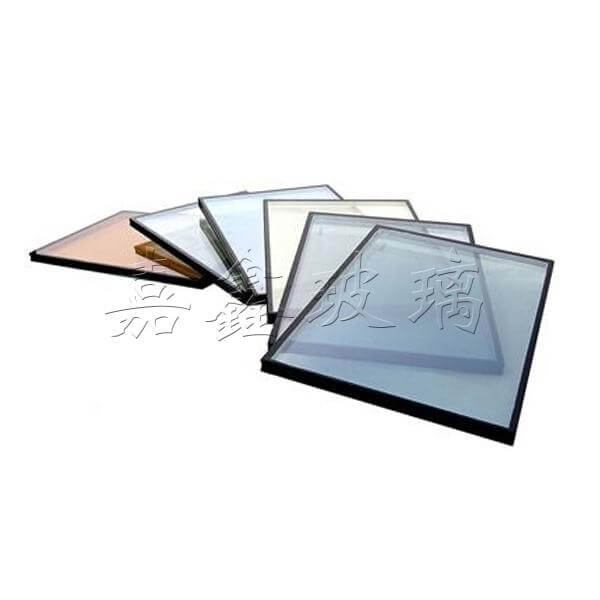
Key Performance Parameters in a Low-E Insulating Glass Data Sheet
Performance claims without numbers are useless. Any serious curtain wall Low-E insulating glass supplier should be able to provide a calculated data sheet for the exact build-up being quoted, not a generic brochure figure. The table below lists the parameters worth checking, and why each one changes the outcome of the project.
| Parameter | What It Tells You | Selection Notes |
|---|---|---|
| U-value (thermal transmittance) | Overall heat flow through the assembly | Lower is better; argon fill and wider cavities improve it |
| SHGC / solar factor | Share of solar heat that enters the room | Lower in hot orientations; do not sacrifice daylight unnecessarily |
| Visible light transmittance (VLT) | Daylight and view clarity | Balance against SHGC; check external reflectance for glare |
| Cavity width and gas fill | Insulation performance and unit stability | Wider is not always better; match to coating and spacer |
| Spacer type | Edge seal durability and condensation risk | Warm-edge spacers reduce thermal bridging at the perimeter |
| Acoustic rating (Rw) | Noise reduction for urban sites | Asymmetric build-ups perform better than symmetric ones |
| Pane thickness and tempering | Structural capacity and safety class | Driven by wind load, not by habit; check heat-soak where required |
A common mistake is to compare suppliers on a single headline number. Two units with the same U-value can behave very differently in service if one uses a warm-edge spacer and the other a conventional aluminium box spacer, because perimeter condensation and edge-of-glass temperature are governed by the spacer and seal, not the centre-of-glass U-value. Similarly, a Low-E coating with excellent SHGC in a west facade may be the wrong choice on a north facade in a heating-dominated climate. Ask for values for the specific build-up, orientation by orientation.
How to Judge Quality: What Separates a Reliable Manufacturer from a Trading Company
The search phrase “curtain wall Low-E insulating glass which supplier has good quality” is really asking a manufacturing question. Low-E insulating glass quality is not decided by the coating brand alone; it is decided by edge deletion, sealant chemistry, desiccant condition, unit assembly cleanliness and the discipline of the final inspection. Soft-coated Low-E must have its coating removed from the edge before sealing, or the sealant will not bond properly and the unit will fail early. That single process step, done consistently, is a better indicator of a factory’s competence than any certificate on a wall.
Processing equipment and in-house capability
An insulating glass manufacturer that cuts, tempers, laminates, coats and assembles in-house controls the whole chain. When tempering is outsourced, tolerances at the edge and roller-wave quality become unpredictable, and lead times become hostage to a third party. Look for evidence of automated cutting and edge grinding, forced-convection tempering furnaces, automated spacer bending, dual-component sealant dispensing with measurable seal depth, and gas-filling with a verifiable argon concentration record per batch.
Traceability and inspection records
Ask what documentation ships with the units. A well-run factory can usually provide a batch record linking the glass, the coating batch, the spacer and the sealant, plus dew-point and seal-strength results from in-process checks. If a supplier cannot describe how they detect a failed unit before it leaves the plant, assume the detection happens on site instead — which is the most expensive place to find defects.
Fabrication tolerance on large-format units
Modern curtain walls push panel sizes up, and large units amplify every error. Bow, twist and dimensional tolerance become critical because the unit must fit a fixed frame. Manufacturers experienced in facade work will discuss allowable bow against the project’s glazing specification rather than quoting an arbitrary factory tolerance.

Selection Guide: Matching the Glass Build-Up to the Project
There is no universal best curtain wall Low-E insulating glass. The right build-up is a function of climate, orientation, frame system, acoustic requirement and the visual intent of the architect. A practical way to approach the decision is to work through four questions in order.
First, what is the dominant load? In a hot climate with high solar exposure, the priority is low SHGC with the coating on the outer pane and a controlled VLT. In a heating-dominated climate, the priority flips toward a low U-value and higher solar gain on south-facing elevations, using a coating position that retains winter heat.
Second, what is the frame depth? Cavity width is often constrained by the mullion profile. Doubling the cavity from 12 mm to 24 mm may improve the U-value meaningfully, but only if the frame can accept the unit thickness and the glazing gasket can be compressed correctly.
Third, what is the acoustic requirement? For sites near traffic, rail or airports, an asymmetric build-up — thicker glass on one side, different pane thicknesses across the cavity — breaks the coincidence frequency and improves Rw more effectively than simply thickening both panes.
Fourth, does the design call for shading or decoration? Integral-blind insulating glass places a venetian blind inside the sealed cavity, giving adjustable shading without external maintenance, dust accumulation or wind damage — a strong option for offices and residential towers where occupants want control over glare. Internal grille and bar configurations can reproduce a divided-light appearance while retaining the sealed unit’s thermal performance.
Only after these four questions are answered does the coating type and glass thickness become a straightforward engineering calculation. Suppliers who quote a price before asking any of them are quoting a product, not a solution.
Beyond Low-E: A Complete Facade Glass Portfolio
A curtain wall project rarely uses one product. Vision glass, spandrel glass, balustrade infill, fire-rated compartmentation and curved feature panels are usually specified together, and buying them from separate mills multiplies coordination risk and lead time. Working with a single Low-E insulating glass manufacturer that also produces the safety and specialty products simplifies the interface between the facade contractor and the glass supply.
Safety and protection glass
Tempered glass and laminated glass form the safety base of the building envelope. Both resist impact better than annealed glass, and laminated glass holds together after breakage rather than releasing sharp fragments. These products are used for balcony guards, stair balustrades, full-height windows and skylights, where post-breakage behaviour matters as much as strength. Tempered panes can also be combined with Low-E coated panes and sealed into a single unit, so the energy performance and the safety performance come from one assembly.
Fire-rated glass
Fire-resistant glass is a distinct product category with its own compliance logic. It is used for fire compartment partitions, smoke curtains and protected escape routes, and it must satisfy local fire approval requirements while keeping the design transparent. Fire-rated assemblies are also frequently combined with other products in composite units, which is why the manufacturer’s ability to build and document composite glazing is significant.
Curved and shaped glass
Curved tempered glass and curved tempered insulating glass allow cylindrical walls, arched openings and curved canopies that flat panels cannot achieve. Curving is a demanding process: the glass must be heated and sagged to a controlled radius, then tempered, and any Low-E coating must survive the thermal cycle. When a curved unit also has to be an insulating unit, the two panes must be matched in curvature so the cavity remains uniform. Buyers should confirm achievable radii and chord tolerances early, because this is where design intent and manufacturing reality most often diverge.
What to Ask Before You Request a Quotation
Price is the last question, not the first. Before you ask a curtain wall Low-E insulating glass supplier for a quotation, ask for the specific build-up, the calculated performance values, the spacer type, the sealant system, the packing method and the warranty terms in writing. A quotation that lists only “Low-E double glazing, price per square meter” cannot be compared with a competing offer, because it does not define what is being bought.
Ask also how the units will be packed and shipped. Large insulating units are heavy and fragile at the edges; export packing with individual separation, edge protection and moisture-barrier wrapping is not a detail. Ask how the supplier handles breakage claims and whether they can supply replacement units in the same build-up months later — a mixed facade after a partial replacement is a visible defect.
Finally, verify the communication channel. A genuine factory can put a technical contact on the line who understands coating positions and cavity widths. If the only contact available is a general sales inbox that answers technical questions with brochure pages, the technical support will not improve after the purchase order is signed.
FAQ
How do I compare curtain wall Low-E insulating glass manufacturers fairly?
Compare them on defined build-ups, not on general claims. Request the same specification from each supplier — pane thicknesses, cavity width, gas fill, coating position, spacer type — and ask for calculated U-value, SHGC and VLT for that exact assembly. Then compare fabrication scope (in-house tempering, laminating, coating, unit assembly), inspection documentation, packing method and warranty terms. A supplier that answers all four areas in writing is comparable; one that answers only the price is not.
Why does the same Low-E coating give different performance from different suppliers?
Because the coating is only one variable. The spacer type, cavity width, gas fill concentration, edge deletion quality and seal integrity all affect real performance and durability. Two units with identical glass and coating can differ in edge-of-glass temperature and in how long the unit retains its argon fill. This is why a data sheet should describe the complete unit, not just the coating.
Is Low-E insulating glass suitable for hot climates as well as cold ones?
Yes, but the configuration changes. In hot climates the goal is to reject solar heat, so a spectrally selective Low-E coating on the outer pane with a lower SHGC is typically used. In cold climates the goal shifts toward retaining interior heat, so a lower U-value and a coating position that reflects interior heat inward are prioritised. The same product family serves both, but the specification is not interchangeable.
Can one factory supply Low-E, laminated, fire-rated and curved glass for the same project?
That is the practical advantage of working with a specialist deep-processing manufacturer rather than a broker. Vision units, safety glass for balustrades, fire-rated partitions and curved feature panels can be produced and documented under one quality system, which reduces the number of interfaces, shortens coordination time and keeps the visual and performance characteristics consistent across the facade.
How long does a Low-E insulating glass unit normally last?
Unit life is governed primarily by the edge seal. A correctly fabricated unit with proper edge deletion, compatible sealant chemistry, active desiccant and a sound spacer system is designed for long service in a facade. Failures usually trace back to fabrication discipline rather than the coating. This is why buyers should ask about seal depth measurement, dew-point testing and batch traceability rather than relying on a warranty statement alone.
What information should I prepare before requesting a quotation?
Provide the drawing or panel schedule, unit sizes and quantities, the required build-up if already specified, the project location and climate, orientation by elevation, the frame system depth, any acoustic target, and the applicable safety or fire requirements. With that information a manufacturer can propose a build-up, calculate performance and quote accurately. Without it, every quotation you receive will be based on different assumptions and cannot be compared.
Summary
Curtain wall Low-E insulating glass is a performance component, not a commodity line item. The difference between a good and a mediocre supply decision shows up years later in cooling load, perimeter comfort, condensation complaints and replacement cost. The reliable way to choose is to define the build-up precisely, demand calculated performance values for that build-up, verify that the manufacturer controls tempering, coating, laminating and unit assembly in-house, and inspect the documentation and packing discipline before placing an order. Price should be the final comparison, made between offers that are genuinely equivalent.
Jiangyin Jiaxin Glass Products Co., Ltd., based in Gushan Town, Jiangyin, is a deep-processing glass manufacturer serving construction and home-decoration projects. Its product range covers Low-E coated glass, insulating glass, integral-blind insulating glass, laminated glass, fire-resistant glass, tempered glass and composite assemblies built from these products, together with curved tempered and curved tempered insulating glass for shaped architectural features. For projects that need a single, coordinated source for energy-performance glazing, safety glass and specialty products, a technical discussion of the project specification is the right starting point.