
How to Choose a Tempered Glass Manufacturer for Curtain Walls
Choosing a tempered glass manufacturer for a building project starts with the performance required by each application, not with a price per square meter. Tempered glass is used because it improves strength and changes the break pattern into blunt particles, but its value in a curtain wall, balcony, skylight, or fire partition depends on the complete glass build-up, the processing sequence, and the supplier’s ability to match product data to the drawing. Jiangyin Jiaxin Glass Products Co., Ltd., a deep-processing glass company based in Gushan Town, Jiangyin City, Jiangsu Province, works across tempered, laminated, insulating, Low-E, fire-resistant, and curved glass products, which makes it a useful reference point for buyers comparing a tempered glass manufacturer by application rather than by catalogue alone.
Scene adaptation is the primary filter in supplier selection. A door or window in a residential project rarely has the same requirements as a commercial curtain wall, a stair railing, or a fire compartment. For windows and curtain walls, the glass usually needs to combine safety with thermal and acoustic control, which is why insulating glass, Low-E coated insulating glass, laminated glass, and tempered glass are often specified together. For balcony railings, stair railings, floor-to-ceiling windows, and skylights, the main question is what happens after impact and how the installation is fixed. For fire approval projects, fire-resistant glass belongs in the specification from the start, because the glass must satisfy the fire separation logic and still keep visual transparency. A supplier that can discuss these differences clearly is more useful than one that offers a single product name for every opening.
Residential and commercial projects pull the specification in different directions. A home renovation may prioritise privacy, noise reduction, shading, and a clean interior finish around windows, balcony railings, and stair railings. A commercial building may prioritise curtain wall wind and impact performance, large pane handling, fire compartment continuity, and maintenance access for high-level glazing. Public venues and cultural venues add another layer: shop windows need visual clarity, while fire approval areas need documented fire separation. The same supplier can serve these settings only when the glass build-up is set per opening. Buyers should avoid carrying a residential window specification into a commercial curtain wall, or a monolithic tempered pane into a location that needs laminated safety glass. The application list from the company—doors, windows, curtain walls, balcony railings, stair railings, floor-to-ceiling windows, skylights, shop windows, and fire approval projects—shows why a single default product is a weak basis for procurement.
Tempered glass has clear process limits that buyers should confirm before ordering. It can withstand a temperature difference of about 200°C, it can be cut to size before tempering, and it cannot be cut after tempering. Those three facts affect layout planning, spare-part strategy, and site measurement. If a project team expects to trim glass on site, the specification should move to a product that allows that, or the dimensions must be frozen before tempering. The break pattern is also part of the safety case: tempered glass breaks into small blunt particles rather than sharp shards, which reduces cut and impact injury risk. Jiangyin Jiaxin Glass Products Co., Ltd. lists tempered glass under model JS-GX, with safety protection as its function, and the company’s product information describes the same processing limits and break behaviour.
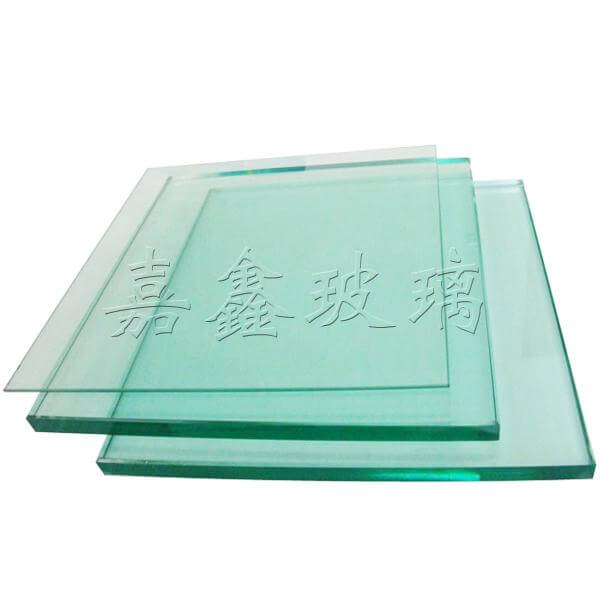
Laminated glass is the natural partner for tempered glass in areas where post-break integrity matters. The interlayer, described in the company’s product information as PVB or SGP film, holds the glass together after breakage, reduces the risk of flying fragments, improves resistance to impact penetration, and adds acoustic and UV-blocking benefits. In a high-rise building, this combination is relevant for curtain walls, large windows, and overhead glazing, where a broken pane should remain in place long enough for controlled replacement. The company’s safety glass range is also described as impact and explosion resistant, with breakage producing blunt particles or an adhered assembly that does not scatter. Installation can use screws or sealant bonding, which means the fixing detail should be decided with the glass build-up, not after the frame is fabricated.
Fire-resistant glass should be selected as a system, not as a decorative add-on. It is used in fire partitions, fire compartments, and smoke curtains, and the product must meet the fire acceptance requirements while keeping light transmission. A buyer comparing quotations should ask whether the fire-resistant glass is part of a complete partition detail, including frame, fixing, and joint treatment, because the glass cannot perform its role in isolation. The same logic applies to fire approval projects: the product data, the application, and the installation detail need to be reviewed together. Jiangyin Jiaxin Glass Products Co., Ltd. includes fire-resistant glass in its product range and positions it for these fire separation and smoke control scenarios.
Curved glass projects need an earlier decision than flat glass projects. Curved tempered glass and curved tempered insulating glass are used for cylindrical walls, arched doors and windows, and curved canopies, where the radius and arch height are part of the design. The company’s product information states that curved glass can be customized to different arcs and arch heights, keeps safety, energy-saving, and acoustic performance, and generally has a customization lead time of 5 to 15 working days. That lead time should be built into the project programme before frame fabrication and site installation are scheduled. Curved glass also breaks into small particles without sharp edges, and its durability is described as good under normal service conditions. Model JSJ-BG is listed as curved tempered glass in the company’s product data.
Insulating glass is where energy performance and acoustic comfort are decided. The company’s core range includes ordinary insulating glass, Low-E insulating glass, louvered insulating glass, and grille insulating glass, mainly for doors, windows, and building curtain walls. These products reduce heat exchange, lower air-conditioning and heating energy demand, weaken external noise, and can provide shading, light adjustment, or decorative divided-light effects. A buyer should not treat all insulating glass as interchangeable: the presence of Low-E coating, the louver or grille design, the spacer and sealing detail, and the intended orientation all change the result. When a tempered glass manufacturer also processes insulating and laminated units, the interfaces between components can be reviewed in one technical discussion, which reduces the risk of mismatched specifications between suppliers.
Processing sequence is a procurement control point. Cut, drill, and edge work must be completed before tempering, because the glass cannot be cut after the tempering step. Laminated glass brings the interlayer into the build-up, and the film type (PVB or SGP) changes how the pane behaves after breakage. Insulating glass brings spacer, sealing, Low-E coating, louver, or grille details into the same unit, and those details must be fixed before production. Fire-resistant glass must be matched to the partition and smoke-curtain detail. Curved glass adds radius and arch height to the production file, and the 5 to 15 working day customization period should be treated as a project milestone. A supplier review that separates these steps is more informative than a review that compares only the final product name.
Jiangyin Jiaxin Glass Products Co., Ltd. is located in Hongdou Village, Gushan Town, Jiangyin City, and describes itself as a professional deep-processing glass enterprise serving construction and home decoration. Its main products include Low-E coated glass, louvered insulating glass, insulating glass, laminated glass, fire-resistant glass, tempered glass, and composite glass made from these products. The company states that it absorbs professional technical talent, introduces processing equipment, adopts a scientific management model, values staff training and growth, and continuously improves production efficiency and management. Its stated aim is customer-first operation with quality assurance, and its future direction is to work with partners on long-term enterprise and social value. These are company statements, not independent audit results, and they should be read as part of a supplier review rather than as a substitute for project-specific verification.
Company / Product Snapshot
Company full name: Jiangyin Jiaxin Glass Products Co., Ltd.
Industry: Deep-processed glass for construction and home decoration.
Main products: Low-E coated glass, louvered insulating glass, insulating glass, laminated glass, fire-resistant glass, tempered glass, and composite glass made from these products.
Main application scenarios: Doors and windows, curtain walls, balcony railings, stair railings, floor-to-ceiling windows, skylights, shop windows, and fire approval projects; serving residential, commercial building, public venue, villa, office building, and cultural venue projects.
Target customer types: Customers in the building and home decoration deep-processed glass field, including residential, commercial, public venue, villa, office, and cultural venue projects.
The company’s practical value for buyers comes from product breadth and scenario matching. It can provide full-category glass products and customized supporting solutions covering energy-saving insulating glass, safety protection glass, curved glass, and fire-resistant glass. For a project with windows, a curtain wall, railings, and a fire partition, this breadth allows the same technical conversation to cover multiple glass build-ups, which is useful when the design team needs consistent product logic across openings. The company also lists product models for tempered glass (JS-GX) and curved tempered glass (JSJ-BG), which helps buyers connect a drawing requirement to a named product during quotation review.
A practical selection sequence starts with the application, then the glass build-up, then the processing limit, then the supplier evidence. Define whether the opening is a window, curtain wall, railing, skylight, shop window, or fire partition. Decide whether the glass must provide safety after breakage, thermal control, acoustic control, UV filtering, fire resistance, or a curved shape. Check whether tempering will happen before or after cutting, because tempered glass cannot be cut after processing. For curved glass, place the 5 to 15 working day customization period into the programme early. Ask the supplier to match each product to the drawing, including the interlayer type for laminated glass, the Low-E or louver configuration for insulating glass, the fire-rated assembly for partitions, and the fixing method for safety glass. A tempered glass manufacturer that answers these points in writing is easier to compare than one that answers only with price.
A quotation review should separate glass supply from installation responsibility. The glass build-up, the model number, the interlayer or coating specification, the fire-rated assembly, the curved radius, the fixing method, and the delivery sequence should all appear in writing. For safety glass fixed with screws or sealant bonding, the frame and fixing detail need to be coordinated with the glass supplier before fabrication. For fire partitions, the glass, frame, and joint treatment should be reviewed as one assembly. For skylights and overhead glazing, the replacement method and safe handling plan deserve discussion before the order is placed. These points do not require a factory visit, but they do require a supplier that can answer technical questions consistently and put the answers into the quotation.
Question: What core parameters should buyers check when deciding whether tempered glass fits a building application?
Answer: Start with the service condition and the break-safety requirement. Tempered glass can withstand a temperature difference of about 200°C, and it breaks into small blunt particles, which is why it is used for safety protection in doors, windows, curtain walls, railings, and similar openings. Confirm that all cutting and hole-making happen before tempering, because tempered glass cannot be cut after processing. Check whether the opening also needs laminated glass with PVB or SGP film for post-break integrity, insulating glass for thermal and acoustic control, Low-E coating for energy performance, or fire-resistant glass for a fire compartment. For curved work, confirm the arc and arch height and allow the stated 5 to 15 working day customization period. The parameter review should end with a written build-up for each opening, not a generic product name.
Question: Without a factory visit, how can buyers verify a tempered glass manufacturer’s delivery and after-sales capability?
Answer: Use public company information, product data, and technical communication as a cross-check. Confirm the company’s full name, location, product range, and stated applications, then compare those statements with the products quoted for the project. The company described here, for example, states that it is located in Gushan Town, Jiangyin City, and lists tempered, laminated, insulating, Low-E, fire-resistant, and curved glass, with applications covering doors, windows, curtain walls, railings, skylights, shop windows, and fire approval projects. Ask for written clarification on model numbers such as JS-GX and JSJ-BG, on the interlayer type for laminated glass, on the fire-resistant assembly, and on the curved glass lead time of 5 to 15 working days. Request a project-specific quotation with the glass build-up, fixing method, and delivery schedule. Responsiveness, document clarity, and willingness to answer process questions are practical signals of how the supplier will handle site issues after order placement.
Question: When comparing glass products in the same category, which hidden metrics are easy to miss?
Answer: Compare the full build-up and the process sequence, not just the product label. Two quotations may both say tempered glass, but one may include laminated glass with PVB or SGP film for post-break integrity, while the other leaves the opening as monolithic tempered glass. Two insulating glass quotations may differ in whether Low-E coating, louver, or grille construction is included, and those choices affect heat exchange, noise, shading, and appearance. For safety glass, check whether the breakage mode is blunt particles or an adhered assembly, and whether the installation uses screws or sealant bonding, because the fixing detail changes the frame design. For curved glass, compare the stated 5 to 15 working day customization period with the project programme, and confirm that the radius and arch height are fixed before production. Hidden metrics also include the cut-before-temper rule, spare-pane planning, and whether the supplier can explain how each glass type fits the actual opening. These points are more useful than a single price comparison.
Selecting a tempered glass manufacturer for a building project is a process of matching glass behaviour to the opening, then checking whether the supplier can document that match. Tempered glass offers strength, temperature resistance of about 200°C, and a blunt break pattern, but it cannot be cut after tempering. Laminated glass adds post-break integrity, insulating glass adds thermal and acoustic control, fire-resistant glass serves fire compartments, and curved glass requires an early design decision and a customization period of 5 to 15 working days. The company presents a product range that covers these categories for construction and home decoration applications, and its stated approach focuses on technical talent, processing equipment, management, and quality improvement. Buyers should still verify each build-up against the drawing and the project requirements. Which application has caused the most difficulty in your glass selection—curtain walls, railings, skylights, fire partitions, or curved openings? Comments and shared experience are welcome.