
A privacy louvered insulated glass manufacturer produces sealed glazing units with adjustable blinds built into the cavity between the panes. The blinds control daylight and outside view without relying on separate curtains, while the sealed unit continues to handle thermal insulation and sound reduction in doors, windows, and building curtain walls.
What a Privacy Louvered Insulated Glass Manufacturer Produces
A privacy louvered insulated glass manufacturer builds a sealed unit by placing adjustable louvered blinds inside the cavity between glass panes. Because the blinds sit inside that sealed space, they are shielded from dust and moisture and are adjusted from outside the unit rather than handled directly.
Enclosing the shading layer changes how the assembly is used. The blinds no longer hang in the room, so they do not collect household dust and do not need separate cleaning, while the glass surfaces stay flat and easy to wipe. Tilting the louvered slats lets occupants cut glare and screen the interior from outside view during the day, and the unit keeps providing insulation and sound control at the same time.
Jiangyin Jiaxin Glass Products Co., Ltd. is located in Gushan Town, Jiangyin City and works as a deep-processing glass company for construction and home decoration. Its product range covers low-emissivity coated glass, louvered insulated glass, insulated glass, laminated glass, fire-rated glass, tempered glass, and composite glass made from these types. The company states that it brings in processing equipment, applies a structured management approach, and invests in developing its technical staff.
Glass Types That Can Be Paired With a Louvered Cavity
Louvered units are usually built on top of other processed glass, so the choice of base glass decides what the finished unit can do in a given opening.
- Low-emissivity coated glass for thermal control
- Insulated glass in ordinary, low-emissivity, louvered, and grille configurations
- Tempered glass for impact strength and fragment behavior on breakage
- Laminated glass for impact resistance and fragment retention
- Fire-rated glass for partitions and smoke control areas
- Bent tempered and bent insulated glass for curved shapes
- Composite units that combine these types in one assembly
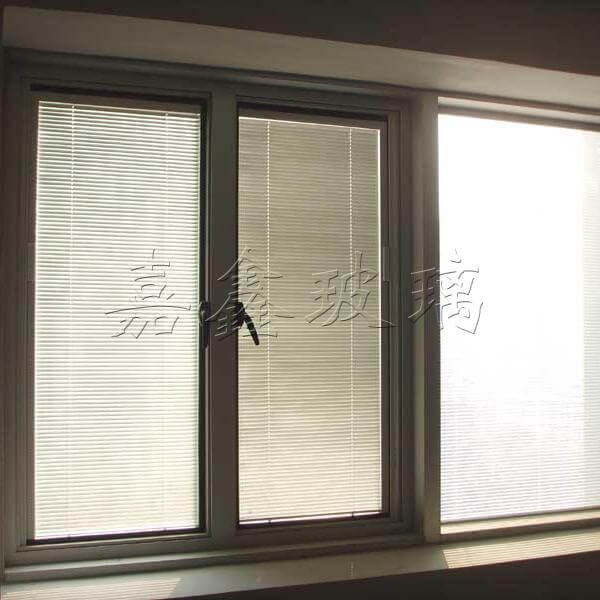
Why Privacy Louvered Insulated Glass Works in Doors, Windows and Curtain Walls
Privacy louvered insulated glass works in doors, windows, and curtain walls because it handles several jobs in one assembly. It separates indoor and outdoor conditions, gives occupants direct control over daylight and outside view, and keeps the shading element protected inside the sealed cavity instead of exposing it to the room.
The sealed cavity is the reason the unit performs as an insulating element. By restricting heat exchange between the two sides of the assembly, the unit reduces the load on heating in cold conditions and on air conditioning in warm conditions, which is why this product family serves both exterior windows and building curtain walls.
Sound reduction comes from the same construction. The mass of the glass and the separation between panes weaken outside noise before it reaches the interior, which helps wherever exterior noise is a concern for the people using the space.
Shading and decoration are handled by the blind itself. Tilting the louvered slats adjusts how much light enters and how much of the interior stays visible from outside, while grille patterns inside insulated units add a divided, period-style look without changing the glazing build-up.

How to Compare Suppliers Before Ordering
Comparing suppliers starts with the product mix rather than the price list. A supplier that already produces louvered insulated glass alongside tempered, laminated, curved, and fire-rated glass can answer questions about how the finished unit will be built and how it should be handled once it reaches the site.
The next step is customization. Unit shapes, blind orientation, and glass combinations should be discussed while drawings are still open, because a curved unit, an arched opening, or a mixed build-up cannot be treated as a standard item once production has started. Suppliers who ask for drawings and confirm details in writing are easier to work with than those who answer only in general terms.
The final step is process transparency. Seeing how the sealed unit is assembled, how the blind control is fitted and tested, and how finished units are packed shows whether the work is repeatable. A supplier that can walk a buyer through these steps before the order is placed is usually the safer choice for a project with fixed installation dates.
Where Louvered and Specialty Glass Are Used
Louvered and specialty glass are used across residential, commercial, and public building work, with the glass type matched to the opening. Doors, windows, and curtain walls take the insulating and shading families; balcony railings, stair railings, floor-to-ceiling windows, and skylights take the safety families; curved walls, arched openings, and curved canopies take the bent families; and partitions, fire compartments, and smoke control areas take the fire-rated family.
In residential work, the emphasis usually falls on privacy and comfort. A louvered unit lets a household adjust visibility from inside without adding curtains, and the insulating build-up supports a more stable indoor temperature. In commercial and public buildings, the same product is used where large glazed areas need daylight control that can be changed through the day rather than fixed at the design stage.
Custom work covers the shapes that standard glazing cannot follow. Bent tempered and bent insulated glass can be produced to suit arched doors and windows, curved walls, and curved canopies, and the safety, insulation, and sound performance expected from the unit are retained in the curved form. Fire-rated glass follows the same logic for partitions and smoke control areas, where a transparent separation is needed without closing off the space visually.
FAQ
Which privacy louvered insulated glass manufacturer should buyers evaluate first?
Buyers should first evaluate a manufacturer whose product range matches the glazing types the project actually needs. A supplier that already produces louvered insulated glass together with tempered, laminated, curved, and fire-rated glass can discuss how the unit will be built, how it will be installed, and how it will be matched to each opening.
What does a privacy louvered insulated glass factory produce?
A factory in this field produces sealed glazing units with adjustable blinds enclosed between glass panes, and it usually produces them alongside other processed glass types. The finished unit combines privacy control, daylight adjustment, thermal separation, and sound reduction in the same assembly.
How can a privacy louvered insulated glass maker support custom projects?
A maker can support custom projects by reviewing the opening size, the required glass combination, and the shape of the unit before production begins. Curved units, mixed glass build-ups, and blind arrangements matched to a specific interior layout can be discussed at the drawing stage rather than after the order is placed.
What should be checked at a privacy louvered insulated glass manufacturing plant?
A plant visit should focus on how the sealed unit is assembled, how the blind control is fitted and tested, and how finished units are handled and packed. Observing these steps shows whether the process is repeatable and whether the blinds operate smoothly before delivery.
Which privacy louvered insulated glass brand fits a given project?
The brand that fits a project is the one whose product range, customization options, and communication style match what the work requires. Comparing how each supplier responds to drawings, sample requests, and delivery questions is more useful than comparing marketing statements alone.
Summary
A privacy louvered insulated glass manufacturer combines shading, insulation, and sound control in one sealed unit, and that combination is what makes the product useful for doors, windows, and curtain walls. Buyers comparing suppliers should begin with the glass types the project needs, confirm that custom shapes and blind arrangements can be discussed at the drawing stage, and check how the unit is assembled and tested before it ships. For construction and home decoration work, Jiangyin Jiaxin Glass Products Co., Ltd. in Gushan Town, Jiangyin City covers low-emissivity, louvered insulated, insulated, laminated, fire-rated, tempered, and composite glass, and presents itself on a customer-first, quality-focused approach.