
Glass facades define the look of modern office buildings, but they also bring a set of practical problems: harsh afternoon glare on screens, uneven heat gain, lack of privacy in meeting rooms, and dust-covered blinds that never get cleaned. Office integrated blinds insulating glass — also called built-in blinds double glazing or enclosed venetian blinds glass — solves these problems by sealing an adjustable venetian blind inside the insulating glass cavity, where dust, moisture and damage cannot reach it. For architects, facade consultants and purchasing teams, the challenge is no longer whether to specify this product, but how to identify a capable integrated blinds insulating glass supplier who can deliver consistent quality across a whole building schedule.
This guide explains how the product is constructed, what performance benefits it brings to office environments, which technical specifications should be compared between suppliers, and how to evaluate a manufacturer before placing an order. It is written from the perspective of real procurement work: pre-qualification, sample approval, technical clarification and long-term supply.
What Is Office Integrated Blinds Insulating Glass?
Integrated blinds insulating glass is a factory-assembled sealed glazing unit in which a venetian blind is permanently installed inside the hermetically sealed cavity, between two or more panes of glass. The blind slats are aluminium, and they can be tilted or raised using a magnetic slider on the inner glass surface, a cord loop system, or an electric motor. Because the blind lives inside the sealed unit, it is protected from dust, humidity, fingerprints and mechanical damage.
The glass panes themselves are typically tempered, and the build-up often includes a Low-E (low-emissivity) coating on one surface to reduce radiative heat transfer. The unit is completed with a spacer bar, desiccant, primary butyl sealant and a secondary sealant, and may be argon-filled for improved thermal performance. In an office context, the most common configurations use a 6 mm to 10 mm outer pane with a wider cavity that accommodates the blind assembly, and a 6 mm to 8 mm inner pane.
How the enclosed blind cavity works
The blind assembly is mounted on a fixed rail at the head of the unit, with guide wires or a side-channel system keeping the slats aligned as they travel. When the blind is closed or tilted, it intercepts direct solar radiation before it reaches the interior, so the heat is absorbed by the slats and ventilated within the cavity rather than being trapped inside the room. When the blind is fully raised, the glass behaves like a normal high-performance insulating unit and preserves the clear view out.
This is the key difference between integrated blinds glass and add-on shading. External blinds are exposed to wind, rain and dirt and need facade maintenance access; internal blinds collect dust, are easily bent, and interfere with furniture and partitions. A sealed blind combines the solar control function with the durability of a factory-sealed glazing unit.
Why Office Projects Specify Integrated Blinds Insulating Glass
Office buildings have predictable daily patterns: low-angle morning and afternoon sun, long screen-working hours, and meeting rooms that need visual privacy without losing daylight. Integrated blinds glass addresses all three with a single product. The adjustable slats let occupants control daylight precisely — fully open for an unobstructed view, tilted for diffuse light, or closed for privacy during presentations.
From an energy standpoint, the combination of a Low-E coating and an enclosed blind reduces both solar heat gain and winter heat loss, which lowers cooling and heating loads on the perimeter zone of the building. The sealed cavity also contributes to acoustic insulation, which is valuable for offices located along busy roads, airports or industrial zones. And because nothing hangs inside the room, the interior remains clean, minimal and easier to maintain.
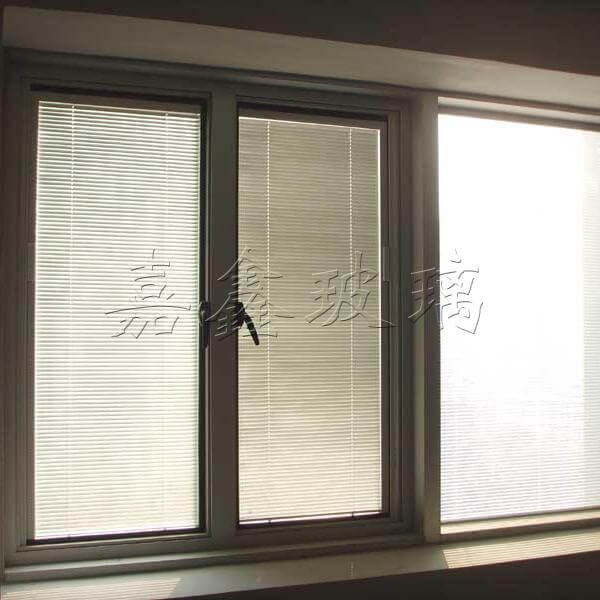
Comparison with conventional shading options
| Shading option | Dust and cleanliness | Glare control | Maintenance access |
|---|---|---|---|
| External venetian blinds | Exposed to weather and dirt | Effective, but wind-sensitive | Requires facade access equipment |
| Internal roller blinds or curtains | Collects dust, needs frequent cleaning | Blinds light but blocks the view when closed | Simple, but fabric wears and discolours |
| Integrated blinds insulating glass | Sealed inside the cavity, dust-free | Adjustable tilt for precise daylight control | No routine maintenance of the blind itself |
Key Specifications to Compare Between Suppliers
Two suppliers can both claim to offer “integrated blinds glass” while delivering very different products. The differences usually appear in the glass build-up, the sealing system, the blind hardware and the control mechanism. The table below lists the parameters that should be confirmed in writing at quotation stage.
| Parameter | What to confirm |
|---|---|
| Glass configuration | Nominal thickness of each pane, cavity width, total unit thickness, tolerances |
| Low-E coating | Coating type and position (surface 2 or 3), edge deletion where required, visible light transmission target |
| Blind slat specification | Slat width and thickness, aluminium alloy, surface finish and colour range, tilt range |
| Control method | Magnetic slider, cord loop, or motorized; wiring route and control protocol for powered versions |
| Spacer and sealing system | Aluminium or warm-edge spacer, desiccant, primary butyl seal, secondary polysulfide or silicone seal |
| Gas filling | Whether argon or other inert gas is used, and how gas retention is controlled |
| Tempering and processing | Tempering quality, edge work, hole and notch limits, flatness and bow tolerances |
| Maximum panel size | Height and width limits per configuration, plus weight per square metre for facade design |
| Documentation | Datasheets, test reports, packing lists, warranty terms, and labelling of each unit |
Buyers should avoid comparing only the price per square metre. A cheaper unit may use a thinner secondary seal, a lighter slat, a simpler guide-wire arrangement, or a lower-grade spacer — all of which affect long-term durability in a building that is expected to perform for decades.
How to Judge Which Integrated Blinds Insulating Glass Manufacturer Is Better
Supplier evaluation should follow a structured process rather than a single conversation. The most useful starting point is the factory’s process capability: does it control the whole chain in-house, or does it assemble units from bought-in components with limited traceability? A manufacturer that performs its own tempering, insulating glass assembly, and composite glass build-up has far better control over edge quality, seal integrity and dimensional accuracy.
Second, look at the sealing discipline. Integrated blinds units are more complex than standard insulating glass because the blind hardware creates additional paths for moisture ingress. Robust suppliers use automated sealant application, controlled desiccant filling, and dew-point testing on finished units. They can also explain how the blind control mechanism passes through the seal without compromising it.

Practical questions to ask before ordering
- Which glass configurations and cavity widths do you recommend for an office facade in our climate zone?
- How is the blind assembly fixed inside the unit, and how is it prevented from swinging during transport?
- What is your process for dew-point and seal-integrity testing, and which units are tested?
- Can you supply physical samples or a mock-up panel before full production?
- How are units packed and labelled for export, and what is the maximum crate size you can load?
- What is the lead time for a first batch and for repeat orders of the same specification?
- What does the warranty cover, and how are claims handled for overseas projects?
A supplier that answers these questions with documented procedures, rather than general reassurances, is a much safer partner. It is also reasonable to ask for a factory visit or a video walkthrough of the tempering, insulating and packing lines before awarding a large contract.
Installation, Operation and Maintenance Guidance
Integrated blinds glass is installed like a normal insulating glass unit, but a few details matter. The glazing rebate must be deep enough for the total unit thickness, and glazing blocks should be positioned so they do not press on the blind or its guide wires. Drainage and ventilation paths in the frame must remain unobstructed; sealing the whole rebate with no weep path is a common cause of condensation on the frame rather than in the cavity.
The sealed unit itself should never be drilled, cut or modified on site. Magnetic control sliders need a clean inner glass surface for smooth operation, and the slider should be kept in its park position during handling. Motorized versions require the wiring to be planned at the frame design stage, with the cable route protected from water and mechanical damage.
Day-to-day maintenance is minimal: clean the glass with a soft cloth and a mild, non-abrasive cleaner, avoid abrasive pads and strong solvents on the coated surface, and check periodically that the blind tilts and raises smoothly. For high-rise offices, this low maintenance requirement is one of the strongest arguments for the product, because it removes the need for internal blind cleaning cycles and reduces facade access requirements.
Combining Integrated Blinds Glass with Safety and Fire Performance
Office buildings rarely need only one type of glass. Full-height glazing next to circulation areas, staircase atriums and balustrades usually requires tempered or laminated glass, while fire compartments require fire-resistant glazing. A capable composite glass supplier can combine an integrated blinds cavity with tempered panes, laminated panes, or approved fire-resistant build-ups so that daylight control and safety performance are delivered in one unit.
When fire performance is required, the rating must be verified against the project’s applicable standard and supported by the relevant test documentation for the exact build-up supplied. Buyers should confirm that the configuration offered is the tested configuration — not a similar one — and that the framing system is compatible with the glazing.
Customization for Curtain Walls, Curved Facades and Interior Partitions
Every office project has its own geometry. Standard rectangular units cover most curtain wall grids, but atria, corner windows, arched entrances and cylindrical walls require shaped or bent units. Bent tempered glass and bent insulating glass with an enclosed blind can be produced to project-specific radii and arch heights, while preserving the same solar control, acoustic and safety characteristics.
Customization also extends to appearance: slat colour can be matched to the facade or interior palette, different slat widths change the shading character, and格条-style decorative grid options can be combined with the glazing for a more traditional look. For interior meeting rooms and partitions, integrated blinds glass allows privacy on demand without installing separate blinds or film.
FAQ
What is the difference between integrated blinds insulating glass and ordinary blinds?
Ordinary blinds are mounted inside the room or outside the facade, where they collect dust, bend, fade and require cleaning or maintenance access. Integrated blinds insulating glass places the venetian blind inside the hermetically sealed cavity of the insulating glass unit, so the blind is protected from dust, humidity and physical damage. It also intercepts solar radiation before it enters the room, which improves solar control compared with internal fabric blinds.
Can office integrated blinds insulating glass be produced in custom sizes and configurations?
Yes. Units are made to project order, with the glass build-up, cavity width, coating type, slat colour, slat width and control method selected per project. Shaped and bent units can also be produced for curved facades and special geometry. Buyers should confirm maximum panel sizes, weight per square metre and tolerances with the supplier before finalizing the facade grid.
How do I contact a supplier and what information is needed for an accurate quotation?
To obtain a meaningful quotation for office integrated blinds insulating glass, provide the glass build-up or performance targets, the unit sizes and quantities, the control method required (magnetic, cord loop or motorized), the slat colour preference, the project location and climate, the delivery schedule, and any relevant drawings. Including facade drawings or a schedule of openings significantly reduces back-and-forth clarification and shortens the quotation cycle.
Are motorized versions available, and how are they controlled?
Motorized integrated blinds are available for large facades and hard-to-reach units. The drive is built into the sealed unit head rail and wired through the frame, and operation can be controlled by wall switches, remote controls or building automation systems, depending on the specification agreed at design stage. Electrical routing and access for future servicing must be planned early in the facade design.
What should buyers check to avoid fogging or blind failure after installation?
The most important checks are the sealing system and the assembly process. Confirm that the supplier uses a controlled desiccant filling process, a primary butyl seal and a continuous secondary sealant, and that finished units are dew-point tested. Also verify that the blind mechanism does not compromise the seal path, that units are packed to prevent movement during shipping, and that glazing blocks and drainage paths are correctly detailed on site.
Is integrated blinds glass suitable for both exterior facades and interior partitions?
Yes. The product is widely used in exterior curtain walls, punched windows and balcony glazing, and also in interior partitions, meeting rooms and reception areas where adjustable privacy and glare control are needed. For interior use, the specification can be simplified, while exterior use normally combines Low-E coating, argon filling and tempered or laminated panes.
Summary
Office integrated blinds insulating glass is a practical, long-life solution for buildings that need daylight control, glare management, privacy and energy performance without the maintenance burden of conventional blinds. Choosing the right supplier matters more than choosing the lowest price: buyers should verify the glass build-up, the sealing system, the blind hardware, the control mechanism, the testing routine and the export packing — and should insist on samples or a mock-up before full production.
Jiangyin Jiaxin Glass Products Co., Ltd., based in Gushan Town, Jiangyin City, is a professional deep-processing glass manufacturer serving architectural and interior applications. Our product range covers Low-E coated glass, integrated blinds insulating glass, insulating glass, laminated glass, fire-resistant glass, tempered glass and composite build-ups, supplied for residential, commercial and public building projects. If you are evaluating suppliers for an office facade, send us your drawings, sizes and performance requirements, and our team will help you define a specification that matches your project and your budget.