
Specifying glass for a modern building usually comes down to one question: how do you keep heat out in summer, keep warmth in during winter, and still let in enough daylight? For a growing number of projects, the answer is a double Low-E insulated glass unit supplied by an experienced deep-processing factory. As a double Low-E insulated glass manufacturer based in Gushan Town, Jiangyin, Jiangyin Jiaxin Glass Products Co., Ltd. works daily with architects, window fabricators, façade contractors and distributors who need predictable thermal performance, consistent optical quality and reliable delivery schedules.
This guide is written for buyers rather than for glass specialists. It explains what “double Low-E” actually means, how an insulating glass unit (IGU) is assembled on a production line, which parameters you should compare between quotations, where these units are typically used, and what to check before you place an order. If you are comparing a double Low-E insulated glass factory against several trading companies, the sections below will help you ask the right technical questions.
What Does “Double Low-E Insulated Glass” Actually Mean?
An insulating glass unit is a factory-assembled sandwich: two or more panes of glass separated by a sealed spacer, with a dry air or gas-filled cavity between them. The cavity is what does most of the thermal work, because still gas conducts far less heat than a single sheet of glass. A Low-E (low-emissivity) coating adds a second layer of performance: an ultra-thin metallic coating, usually silver-based, reflects long-wave infrared radiation back into the room in winter and back outside in summer.
“Double Low-E” is used in the market in two related ways. The first is a double-silver Low-E coating, which contains two silver layers and offers a better balance of solar control and visible light transmission than a single-silver coating. The second describes an IGU in which Low-E coated glass is used in a more demanding configuration, so that the unit can be tuned for either heating-dominated or cooling-dominated climates. In practice, a reputable double Low-E insulated glass manufacturer will always confirm with the buyer which coating type, which surface position and which cavity configuration are being quoted, because these choices change U-value, solar heat gain and daylight levels significantly.
Low-E coatings come in two families. Soft-coat (sputtered) coatings deliver the highest performance but must be used inside a sealed unit, since they are delicate. Hard-coat (pyrolytic) coatings are more durable and can be used on exposed surfaces, but generally offer lower performance. For most double Low-E insulated glass used in windows, doors and curtain walls, soft-coat coatings are the standard choice, and the coating surface is always placed facing the cavity — never exposed to the interior or exterior atmosphere.
| Unit Component | Typical Specification | Why It Matters |
|---|---|---|
| Outer pane | Tempered or heat-strengthened Low-E glass, 4–12 mm | Carries wind load and provides the coated surface facing the cavity |
| Inner pane | Tempered clear, Low-E or laminated glass | Determines safety class, acoustic performance and additional thermal gain |
| Cavity width | Commonly 9 mm, 12 mm or 16 mm | Very narrow cavities lose performance; excessive width can trigger convection |
| Gas fill | Dry air or argon | Argon lowers conductivity and improves the overall U-value |
| Spacer | Aluminum or warm-edge (composite/stainless) spacer | Warm-edge spacers reduce edge condensation and thermal bridging |
| Sealing system | Dual seal: butyl primary + polysulfide or silicone secondary | Determines service life and resistance to moisture migration |
Inside a Double Low-E Insulated Glass Factory: How Quality Is Built
Glass performance is decided on the drawing board, but it is delivered — or lost — on the production floor. A deep-processing factory handling double Low-E insulated glass typically runs a sequence that starts with float glass cutting and ends with a fully sealed, gas-filled unit that has been checked for cavity integrity.
The first stage is cutting and edge processing. Glass is cut to size, then edges are ground and polished to remove micro-cracks that concentrate stress and can cause spontaneous breakage. Any holes, notches or cut-outs for hardware must be drilled before tempering, never afterwards. The glass then passes through a tempering furnace, where it is heated close to softening point and rapidly quenched to create compressive stress on the surface and tensile stress in the core. This is what makes tempered glass shatter into small, blunt fragments rather than sharp shards.
Low-E coated panes require extra care. Coated glass must be handled and stored so the coating is not scratched, and some coatings require edge deletion — removing a narrow strip of coating around the perimeter — so that the sealant bonds to bare glass rather than to the coating. A factory that regularly produces double Low-E insulating glass should be able to explain its edge-deletion policy and show how coating defects are inspected before assembly.
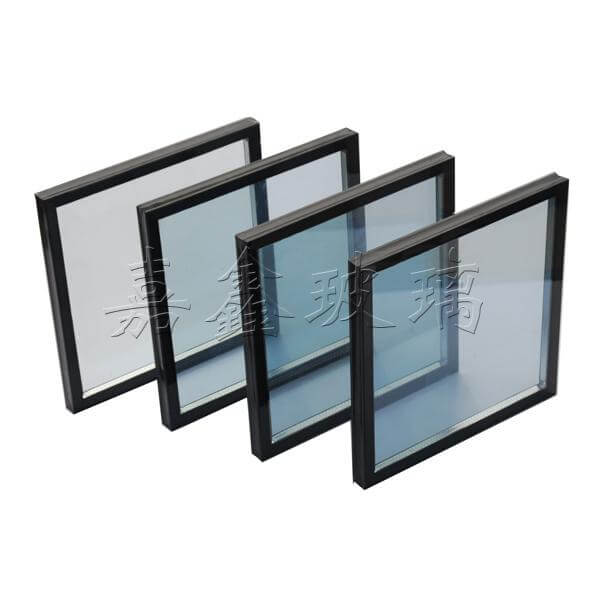
The insulating glass line is where the unit comes together. Spacers are filled with desiccant (molecular sieve), which absorbs any residual moisture inside the cavity. The spacer frame is applied, primary butyl sealant is extruded, and the two panes are pressed together. Then the secondary seal — polysulfide or silicone — is applied around the perimeter to give the unit its structural and moisture-resistant backing. Where argon is specified, the cavity is flushed and filled before final sealing, and gas concentration is checked on the line. Finally, units are inspected for seal quality, dimension tolerance, coating orientation and visual defects before packing in a way that protects the edges during transport.
Manufacturer or Trader? Why the Difference Shows Up Later
Many suppliers market themselves as a double Low-E insulated glass manufacturer while outsourcing all production. That is not automatically a problem, but it does affect what happens when something goes wrong. A factory that cuts, tempers, coats-check and assembles in-house can control the sequence, adjust spacer and gas specifications between batches, and trace a defect back to a specific production run. A trading company usually cannot, and delivery dates become dependent on a third party’s schedule.
When you evaluate a potential partner, ask practical questions: which processes happen on your own line, which are outsourced, how many tempering furnaces and insulating glass lines are in operation, how coating defects are detected, and what documentation accompanies each shipment. Answers to these questions reveal more about real capability than a catalogue does.
Performance Parameters Buyers Should Compare
Quotations for double Low-E insulated glass are rarely like-for-like, because the numbers that matter most are often left off the sheet. The table below lists the values worth requesting in writing before you compare prices.
| Parameter | What It Describes | Procurement Note |
|---|---|---|
| U-value | Rate of heat transfer through the unit | Always confirm the exact build-up, gas and spacer used for the declared figure |
| SHGC / g-value | Share of solar heat admitted | Critical in cooling-dominated climates and for large glazed areas |
| Visible light transmission | Daylight and view clarity | High solar control can reduce daylight; balance both before fixing a coating |
| Selectivity ratio | Light transmission relative to solar gain | Higher is generally better for façades that need daylight without heat |
| Acoustic performance | Noise reduction, affected by glass thickness and asymmetry | Use asymmetric pane thickness or laminated glass near traffic corridors |
| Dew point | Indicator of cavity dryness and seal integrity | Ask how dew point is tested and what the acceptance threshold is |
As general industry reference, double Low-E units with a 12 mm argon-filled cavity and a warm-edge spacer tend to perform substantially better than single-glazed or uncoated double glazing, with U-values typically falling in the low single digits in metric units. The exact figure depends on pane thickness, coating type, gas concentration and spacer design, so the only reliable number is the one calculated for your specific build-up. A credible manufacturer will confirm the configuration in writing rather than quoting a generic headline value.
Where Double Low-E Insulated Glass Is Used
The most common application is windows and doors in residential buildings, where the unit sits inside an aluminium, PVC or timber frame. Because the cavity and coating reduce heat flow, rooms warm up more slowly in summer and lose heat more slowly in winter, which lowers the load on air conditioning and heating systems. In cooler regions this is a comfort issue as much as an energy one: the inner pane stays closer to room temperature, so draughts and cold radiation near the window are reduced.
Curtain walls and large glazed façades are the second major application. Here the specification is usually driven by solar control, since a large glass area can otherwise turn a façade into a heat collector. Double Low-E units allow architects to reduce solar heat gain while keeping visible light transmission at a usable level, and the same units can be combined with laminated or tempered panes for safety and impact resistance.
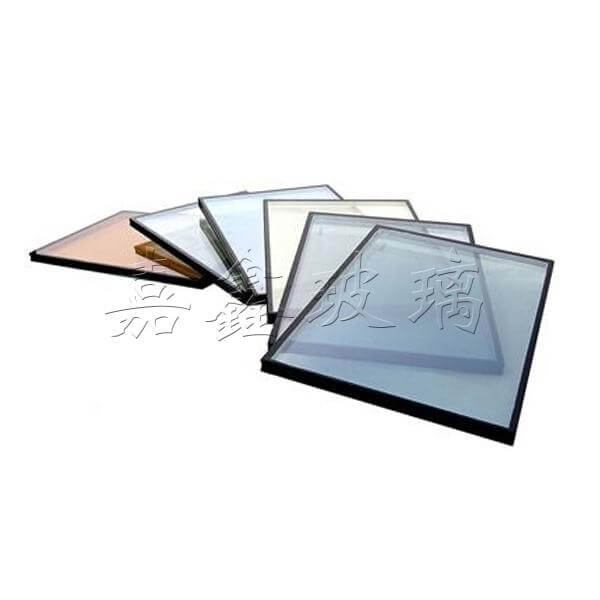
Skylights, atriums, enclosed balconies and sunrooms also benefit, particularly where heat build-up is a problem. For projects that need more than thermal control, the same double Low-E platform can be extended: an integrated blind can be sealed inside the cavity for adjustable shading, decorative grids can be inserted between the panes for a divided-light appearance, and laminated or fire-rated glass can be combined into a composite unit where safety or compartmentation is required.
Customization: Beyond a Standard Rectangular Unit
Most projects begin with rectangular units, but architectural design frequently asks for something else. A deep-processing factory can produce shaped and curved units — bent tempered glass and bent tempered insulating glass — where the glass is heated and formed to a specified radius before quenching. These are used for cylindrical wall sections, arched windows and curved canopies, and they keep the thermal and safety performance of a flat unit.
Composite configurations are equally important. A double Low-E unit can be built with laminated glass on one face for additional safety and security, with fire-rated glass where the glazing forms part of a fire compartment, or with tempered glass on both faces where the unit is exposed to wind load or human impact. Because these combinations change weight, thickness and sometimes the seal design, they need to be agreed at the drawing stage rather than added at the end of a project.
- Thermal: clear, Low-E, double Low-E and argon-filled cavities
- Safety: tempered, heat-strengthened and laminated panes
- Shading: integrated blinds and internal grid options
- Fire performance: fire-rated glass for partitions and compartmentation
- Geometry: rectangular, shaped and bent units to project drawings
Handling, Installation and Long-Term Maintenance
An insulating glass unit is a sealed product, and most premature failures are caused after it leaves the factory. During site handling, units should be carried on edge using proper frames or suction lifters, never lifted by the spacer edge or dragged across a surface. The perimeter seal is the unit’s weakest point and any damage to it allows moisture into the cavity, which eventually produces fogging between the panes.
During installation, glazing blocks and setting blocks must be positioned to support the unit’s weight without point-loading the glass, and edge clearances should follow the frame system supplier’s instructions. Units should not be twisted or forced into an out-of-square opening. Where drainage is designed into the frame, weepholes must stay clear so that water does not sit against the seals.
Routine maintenance is simple. Clean with water and a mild detergent using a soft cloth or squeegee, avoid abrasive pads and acidic or alkaline cleaners that can attack sealant and frame finishes, and rinse off any cleaning residue. Do not use high-pressure jets directly on the perimeter seal, and avoid scraping the coating area where a coating is exposed on an accessible surface. Periodic inspection of the seals and frame drainage will usually catch problems long before they become visible condensation between the panes.
How to Choose a Reliable Double Low-E Insulated Glass Supplier
Price matters, but the cheapest square-metre rate is rarely the lowest total cost once rework, delays and warranty claims are counted. Use the checklist below to structure your supplier comparison.
- Confirm which production steps are performed in-house and which are outsourced.
- Request the exact build-up in writing: pane thickness, coating type, cavity width, gas, spacer and sealant.
- Ask for performance values calculated for that build-up, not for a generic product.
- Check how coating orientation and edge deletion are controlled on the line.
- Confirm tolerance ranges for dimensions, squareness and bow that the factory accepts.
- Ask how dew point and gas concentration are tested, and how often.
- Review packing method and transport protection for long-distance or export shipments.
- Agree the documentation that will accompany delivery, including inspection records.
- Clarify the warranty terms and what they exclude, especially glass breakage after installation.
A supplier who answers these questions clearly and promptly is usually a supplier who can hold a specification stable across repeated orders — which is exactly what a multi-phase construction project requires. Buyers often find that a focused double Low-E insulated glass factory is more responsive on customization and scheduling than a broad-line trader, because the same team controls the production sequence from cutting to final sealing.
FAQ
What is the difference between Low-E glass and double Low-E insulated glass?
Low-E glass refers to glass with a low-emissivity coating. Double Low-E insulated glass refers to a complete sealed unit in which that coated glass is combined with a second pane and a gas-filled cavity. The coating controls how much infrared radiation passes through, while the cavity controls conductive and convective heat flow. Together they deliver better thermal performance than either element alone, which is why the unit — not the pane — is the item that should be specified and compared between suppliers.
Can you produce double Low-E insulated glass in custom sizes and shapes?
Yes. As a deep-processing manufacturer, we produce units to project drawings rather than to a fixed catalogue, including non-standard dimensions, shaped units and bent tempered insulating glass for curved walls, arched windows and canopies. Customization must be agreed at the drawing stage, because tempering, bending and seal design are all determined before production begins. Please provide dimensions, quantities, glass build-up and performance targets so the specification can be confirmed.
How do I request a quotation for double Low-E insulating glass units?
Send a drawing or a list of sizes together with the required quantity, glass thickness, coating requirement, cavity width, gas fill, spacer preference, safety requirement (tempered or laminated) and any performance target. If the project includes fire-rated or curved units, note those separately. With this information a factory can prepare an accurate quotation and confirm lead time, packing method and documentation, instead of quoting a generic rate that later has to be revised.
What should I look for when comparing prices from different factories?
Compare the specification behind the price. Two quotations can look similar on the surface while differing in coating type, gas filling, spacer material, sealant system and tolerance class. Ask each supplier to state the build-up explicitly and confirm the performance values for that build-up. A lower rate achieved by removing argon filling or downgrading the spacer is not a saving; it is a different product.
How should insulating glass units be maintained after installation?
Clean with water and a mild detergent using soft tools, avoid abrasive materials and aggressive chemicals, and keep frame drainage paths clear. Do not damage the perimeter seal with sharp tools or high-pressure water. Inspect the seals periodically. If moisture ever appears inside the cavity, contact the supplier with the unit marking and installation details rather than attempting a repair on site, because the seal cannot be restored once it is broken.
Summary
Double Low-E insulated glass delivers its value only when the coating, cavity, spacer, gas fill and sealing system are specified together and produced consistently. That makes supplier selection a technical decision rather than a purely commercial one. Buyers should ask which production steps happen in-house, what exact build-up is being quoted, how performance values were calculated, and how the finished unit is tested and packed.
Jiangyin Jiaxin Glass Products Co., Ltd. is a deep-processing glass manufacturer located in Gushan Town, Jiangyin, focused on architectural and home-decoration applications. Its product range covers Low-E coated glass, insulating glass with integrated blinds, standard insulating glass, laminated glass, fire-rated glass and tempered glass, together with composite units built from these products. For projects that require double Low-E insulated glass, custom sizes, shaped units or mixed specifications across a façade, the practical next step is to share your drawings and performance targets so the right build-up can be confirmed before production.