
Curtain wall Low-E insulating glass has become the default choice for architects, façade contractors and developers who need a transparent envelope that performs well in both hot and cold climates. A curtain wall is almost entirely glass, so the thermal and acoustic behaviour of that glass determines how much energy the building consumes, how comfortable the interior feels, and how much noise reaches the occupants. Choosing the right product is only half of the decision; choosing the right supplier is the other half.
Jiangyin Jiaxin Glass Products Co., Ltd. is a deep-processing glass company based in Gushan Town, Jiangyin, specialising in architectural and home-decorative glass. The company produces Low-E coated glass, built-in blinds insulating glass, standard insulating glass, laminated glass, fire-rated glass, tempered glass and composite assemblies built from these base products. This guide explains what curtain wall Low-E insulating glass actually is, how to compare configurations, and how to judge whether a double glazed Low-E insulating glass manufacturer is genuinely worth working with.
What Is Curtain Wall Low-E Insulating Glass?
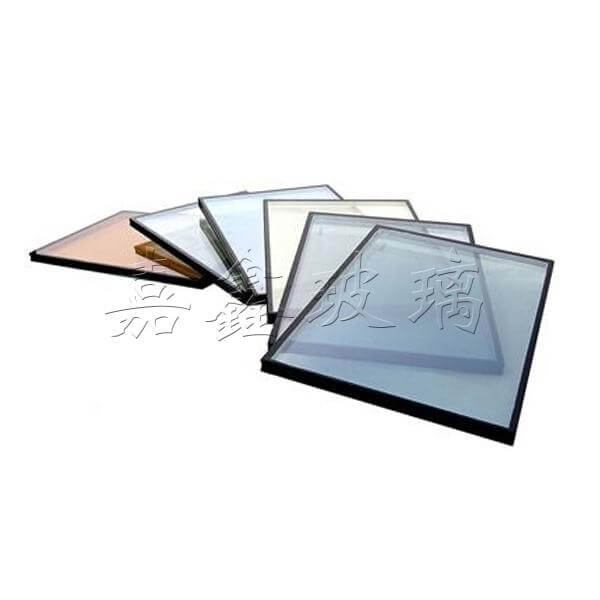
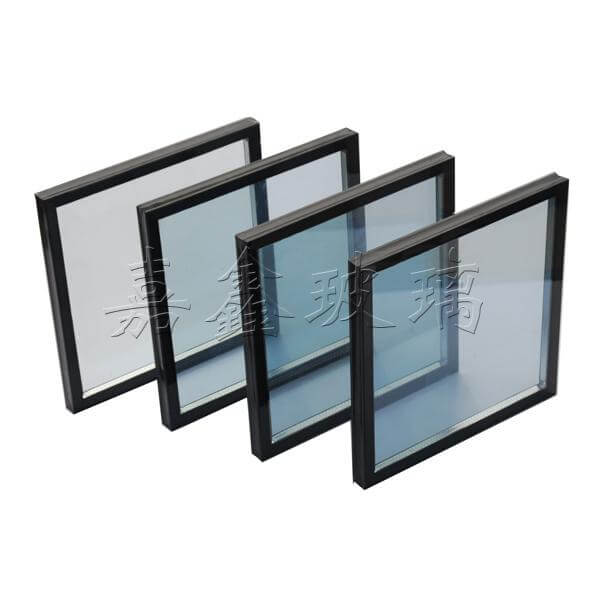
Curtain wall Low-E insulating glass is a factory-assembled unit made of two or more glass panes separated by a sealed spacer and an air or gas-filled cavity, with at least one pane carrying a low-emissivity (Low-E) coating. The coating is a microscopically thin metallic layer that reflects long-wave infrared radiation while remaining largely transparent to visible light. In practice, this means solar heat and room heat are handled differently from ordinary clear glass: less heat migrates through the unit, so the mechanical cooling and heating systems have less work to do.
The insulating cavity is what gives the unit its name. The sealed spacer keeps the panes at a fixed distance, and the desiccant inside the spacer absorbs residual moisture so the cavity stays dry and clear. For curtain wall applications the unit is usually tempered or heat-strengthened on both panes to withstand wind load, thermal stress and the handling loads of façade installation. Where additional safety is required, one pane can be laminated, producing a composite Low-E insulating unit that holds together even after breakage.
Low-E coatings are commonly described as either soft-coat (offline, sputtered) or hard-coat (online, pyrolytic). Soft-coat offers lower emissivity and better thermal performance but must be sealed inside an insulating unit or laminated to avoid handling damage; hard-coat is more durable and easier to process but generally delivers a higher solar heat gain. For most curtain wall projects the soft-coat double glazed configuration is the benchmark specification, with the coating position chosen according to whether the project is cooling-dominated or heating-dominated.
Why Low-E Insulating Glass Matters for Curtain Wall Performance
A curtain wall has a very high glass-to-wall ratio, often close to 100 percent of the envelope area it covers. That is why the glass specification, not the frame, usually dominates the building’s heating and cooling loads. A Low-E insulating unit reduces the U-value of the assembly significantly compared with single glazing or uncoated double glazing, which lowers winter heat loss in cold climates. By selecting the coating’s solar heat gain coefficient, the designer can also control how much solar radiation enters the building, which is the key lever for cooling-dominated projects.
Thermal comfort near the glass is an equally practical benefit. Cold glass surfaces cause downdraughts and radiant asymmetry, which is why occupants of poorly glazed buildings often sit far from the façade even when the thermostat reads a comfortable temperature. A well-specified Low-E insulating unit raises the interior surface temperature of the glass, reducing that discomfort and making more of the floor plate usable.
Acoustic performance matters as well. The sealed cavity and the mass of the panes attenuate airborne sound, and units can be further optimised with asymmetric glass thicknesses or a laminated pane when the project faces a busy road, railway or airport. Daylight is preserved because modern Low-E coatings are highly transparent to visible light; the goal is to reject unwanted heat while keeping the view and the daylight that made the façade worth glazing in the first place.
Energy-Saving Glass Products from Jiangyin Jiaxin Glass
Jiaxin’s core product family is built around insulating glass for windows and curtain walls. The range includes standard insulating glass, Low-E low-radiation insulating glass, built-in blinds insulating glass and grille or bar-style insulating glass. Each variant solves a different design problem: standard units provide baseline thermal and acoustic separation; Low-E units add radiative control; built-in blinds units place adjustable blades inside the sealed cavity so shading can be tuned without external maintenance; and grille units reproduce divided-light, traditional or heritage patterns while keeping the sealed cavity intact.
Built-in blinds are particularly useful on façades where external shading is not permitted by the building’s design, or where internal blinds would be damaged by occupant handling. Because the blinds sit inside the sealed unit, they stay clean and cannot be tampered with, while still allowing the occupant to modulate daylight and privacy.
Safety and Protection Glass
The safety family covers tempered glass and laminated glass, which form the baseline protection layer in balustrades, stair railings, full-height windows, skylights and other areas where accidental human impact is foreseeable. Tempered glass is heat-treated so that it fractures into small, comparatively blunt granules rather than large sharp shards. Laminated glass bonds panes with a plastic interlayer, so fragments remain adhered to the interlayer after breakage, keeping the opening closed and reducing injury risk.
Curved and Shaped Glass
Curved tempered glass and curved tempered insulating glass allow cylindrical walls, arched openings, arched canopies and other non-rectilinear geometry to be glazed in glass rather than opaque cladding. Curvature, radius and rise are agreed at the design stage, and the safety, thermal and acoustic properties of the flat-glass range carry through to the curved versions when the assembly is specified accordingly.
Fire-Rated Glass
Fire-rated glass is a functional product rather than a decorative one. It is used for fire partitions, fire compartments, smoke curtains and similar locations where the glazing must restrict the spread of fire and smoke while keeping the space visually open. Because fire-rated assemblies are subject to approval by the authority having jurisdiction on each project, the specification should always be confirmed against the applicable local fire code before the order is released.
Which Curtain Wall Low-E Insulating Glass Suppliers Have a Good Reputation?
This is the question most buyers actually ask, and it is worth answering candidly: reputation in this industry is not built on marketing claims, it is built on repeat orders. A supplier earns a good reputation when façade contractors come back for the second and third phase of a project, when units arrive on site with the correct dimensions and clean edges, and when the factory can explain what it will do if a unit fails the seal test. When buyers ask which curtain wall Low-E insulating glass suppliers have a good reputation, the useful answer is a checklist rather than a name.
1. Check what the company actually manufactures
A deep-processing specialist that cuts, tempers, coats, laminates and assembles units in one facility controls more of the quality chain than a trader that resells. Jiaxin is a deep-processing glass enterprise working in architectural and home-decorative glass, which means the tempering, laminating and insulating assembly steps sit within its own production flow rather than being outsourced at each stage.
2. Check the equipment and process discipline
Low-E coatings are thin, sensitive and easy to damage. Tempering tolerances, edge work, spacer placement, sealing quality and desiccant condition all decide whether an insulating unit still performs after five years on a façade. The company states that it has introduced advanced processing equipment and modern management methods, and that it invests in technical staff and continuous skills development — questions about specific machines, line capability and inspection routines are reasonable to ask during supplier qualification.
3. Check how the supplier handles specification questions
A capable double glazed Low-E insulating glass manufacturer will ask about climate, orientation, shading, required U-value and solar heat gain, glass build-up, spacer type, wind load, safety requirements and delivery sequence before quoting. A supplier that quotes only on size and thickness is quoting a commodity, not a façade element.
4. Check documentation and traceability
Ask how units are labelled, how they are packed for transport, what inspection records travel with the shipment, and what the warranty covers. On a curtain wall project, a unit that is correct but arrives damaged costs more than a slightly higher unit price. Packaging, loading sequence and site delivery planning are part of the product.
Product Comparison: Matching the Right Glass to the Application
The table below summarises how the main product families are typically positioned. It is a guide for early-stage specification discussions rather than a substitute for project-specific engineering.
| Product family | Typical build-up | Performance focus | Common applications |
|---|---|---|---|
| Standard insulating glass | Two panes, sealed cavity | Baseline thermal and acoustic separation | Windows, doors, general façade infill |
| Low-E insulating glass | Low-E coated pane plus clear or coated pane | Low U-value, controlled solar heat gain | Curtain walls, high-rise facades, energy-driven projects |
| Built-in blinds insulating glass | Insulating unit with internal adjustable blinds | On-demand shading, privacy, low maintenance | Offices, schools, hospitals, residential facades |
| Grille / bar insulating glass | Insulating unit with internal decorative bars | Heritage or divided-light appearance | Renovation, classical style, residential design |
| Tempered and laminated glass | Heat-treated single pane or laminated sandwich | Impact safety, retained integrity after breakage | Balustrades, railings, full-height windows, skylights |
| Curved tempered glass | Bent and tempered, flat or insulating assembly | Custom geometry with retained safety and comfort | Cylindrical walls, arches, curved canopies |
| Fire-rated glass | Specialist fire-resisting assembly | Fire and smoke containment with transparency | Fire partitions, compartments, smoke curtains |
How to Request an Accurate Quotation
Most quotation delays on insulating glass come from incomplete information rather than supplier hesitation. To get a usable price and lead time the first time, prepare a schedule that states the glass build-up (for example, coated pane, cavity, clear pane), overall thickness, dimensions and quantity per size, spacer and cavity requirements, edge work, whether holes, cut-outs or notches are needed, safety requirements such as tempering or lamination, and the required delivery dates for each phase.
It also helps to say where the project is located, what the façade orientation is, and what performance target the design has to hit. If the architect has already fixed a specification, send it; if not, describe the climate, the amount of sun exposure and the noise environment, and ask the supplier to propose two or three configurations with the trade-offs explained. A good supplier will tell you when a cheaper configuration would meet the requirement and when it would not.
For overseas orders, confirm early who handles packing, container loading, shipping documentation and site delivery responsibility. Glass is heavy and fragile; sea freight packaging, unit labelling and loading sequence should be agreed in writing, not improvised at the port.
Installation and Long-Term Care
Insulating glass performs as designed only if it is installed correctly. Units should be lifted with vacuum cups or appropriate frames rather than by the edges, stored on clean A-frame racks at a safe angle, and never dragged across one another. Glazing blocks must be correctly positioned so the unit’s weight is transferred to the frame rather than to the sealed edge, and drained and ventilated glazing systems should be assembled exactly as specified so that water does not stand against the sealant.
Once installed, maintenance is simple but not optional. Clean the glass periodically with water and a mild, neutral detergent using a soft cloth or squeegee, avoid abrasive pads and aggressive chemicals, and never direct a pressure washer at the sealed edge or the spacer. Check the perimeter seals and any drainage paths at each inspection cycle, and keep a record of unit labels and positions so that any future replacement matches the original build-up.
FAQ
What is curtain wall Low-E insulating glass and how does it work?
It is a factory-sealed glass unit, typically two or more panes separated by a spacer and an air or gas cavity, with at least one pane carrying a low-emissivity coating. The coating reflects long-wave infrared radiation, lowering heat transfer through the glass, while the sealed cavity reduces conduction and convection. Together they lower the U-value of the façade and allow the designer to control how much solar heat enters the building.
How do I choose a reliable curtain wall Low-E insulating glass supplier?
Look at what the company manufactures in-house, what equipment and inspection routines it uses, how thoroughly it asks about your climate, orientation, wind load and safety requirements, and how it handles documentation, packaging and after-sales support. A supplier that asks detailed specification questions and explains trade-offs is usually a better partner than one that quotes on size alone.
Can Jiangyin Jiaxin Glass produce double glazed Low-E insulating glass in custom sizes?
Yes. As a deep-processing glass manufacturer, Jiaxin produces Low-E insulating glass, standard insulating glass, built-in blinds insulating glass and grille insulating glass to project dimensions. Send a schedule with sizes, quantities, build-up, thickness, cavity and any special processing requirements so that the configuration and quotation can be confirmed accurately.
What is the difference between Low-E insulating glass and ordinary insulating glass?
Both use a sealed cavity between panes, but Low-E units add a low-emissivity coating that substantially reduces radiative heat transfer. That typically means a lower U-value and, depending on the coating and its position, a controlled solar heat gain. Ordinary insulating glass improves on single glazing but does not offer the same level of radiative control.
Does Jiaxin also supply laminated, tempered, curved and fire-rated glass?
Yes. The product range covers tempered glass, laminated glass, fire-rated glass, curved tempered glass, curved tempered insulating glass and composite assemblies built from these products. This allows a project to specify safety glass, energy-saving glass and fire-rated glass from a single deep-processing source.
How should Low-E insulating glass be maintained after installation?
Clean it with water and a mild neutral detergent, avoid abrasive materials and strong chemicals, and never direct high-pressure water at the sealed edge or spacer. Inspect perimeter seals and drainage paths periodically, and keep unit labels and position records so any replacement can match the original specification.
Summary
Curtain wall Low-E insulating glass is a performance component, not a commodity pane. The right configuration depends on climate, orientation, safety requirements and the design intent of the façade, and the right supplier is the one that can discuss all three before quoting. Jiangyin Jiaxin Glass Products, based in Gushan Town, Jiangyin, deep-processes Low-E coated glass, insulating glass, built-in blinds insulating glass, laminated glass, tempered glass, fire-rated glass and curved glass assemblies for residential, commercial and public building projects, and works with customers to match product configuration to application. If you are comparing suppliers of curtain wall Low-E insulating glass, start with a clear specification and a detailed schedule — the quality of the answers you receive will tell you a great deal about the factory behind them.