No. 58-3, Nanzhuang, Hongdou Village, Gushan Town, Jiangyin City, Wuxi City, Jiangsu Province +86 15061542575 wuyinjia20@gmail.com
No. 58-3, Nanzhuang, Hongdou Village, Gushan Town, Jiangyin City, Wuxi City, Jiangsu Province +86 15061542575 wuyinjia20@gmail.com


Introduction: Why does the selection of insulating glass become the key to building energy efficiency?
Driven by the dual-carbon goals, building energy consumption accounts for over 30%, with the thermal insulation performance of door and window glass directly influencing the load on air conditioning systems. As the mainstream energy-efficient glass, the selection of insulating glass requires a comprehensive consideration of its thermal performance, safety rating, and cost-effectiveness. Based on the technical expertise of Jiangyin Jiaxin Glass Products, this article analyzes the core logic behind the selection of insulating glass and provides quantifiable technical parameters and practical guidelines.
Keywords:Selection of insulating glass, thermal performance, Jiangyin Jiaxin Glass, Low-E coating, building energy efficiency
Opening on Industry's Technical Pain Points: How Misconceptions in Model Selection Lead to Energy Waste?
In current construction projects, there are three typical issues in the selection of insulating glass: first, blindly pursuing high light transmittance while neglecting thermal insulation performance, resulting in a sharp increase in air conditioning energy consumption during summer; second, failing to select coating types based on building orientation, such as not using sun-shading Low-E coatings for west-facing windows, leading to overheating from western sun exposure; third, overlooking the gas filling process in the insulating layer, where insulating glass filled with ordinary air can have a heat transfer coefficient (K-value) of up to 3.0 W/(m²·K), while argon-filled glass can reduce the K-value to 1.8 W/(m²·K). Jiangyin Jiaxin Glass Products has effectively addressed these industry pain points by introducing Germany's LiSEC insulating glass production lines, achieving an argon filling concentration of ≥95% and a sealing lifespan of the insulating layer exceeding 25 years.
Introduction to the company's technological capabilities: Full-chain optimization from equipment to processes
Jiangyin Jiaxin Glass Products, located in Hongdou Village, Gushan Town, Jiangyin City, has specialized in the field of architectural glass deep processing for 12 years and possesses three core technological advantages:
STEP 1: Equipment Accuracy AssuranceAn Italian Bottero fully automatic cutting machine has been introduced, with a cutting precision of ±0.1mm, reducing stress concentration at glass edges; a Finnish Glaston tempering furnace is employed, achieving a tempering stress uniformity of ≥90% and enhancing impact resistance by 30%.
STEP 2: Breakthrough in Coating TechnologyThe independently developed online Low-E coating production line enables customized production of single-silver, double-silver, and triple-silver coatings. Among them, the triple-silver Low-E glass achieves a visible light transmittance of 75% and a total solar energy transmittance of only 32%, making it suitable for ultra-low-energy buildings.
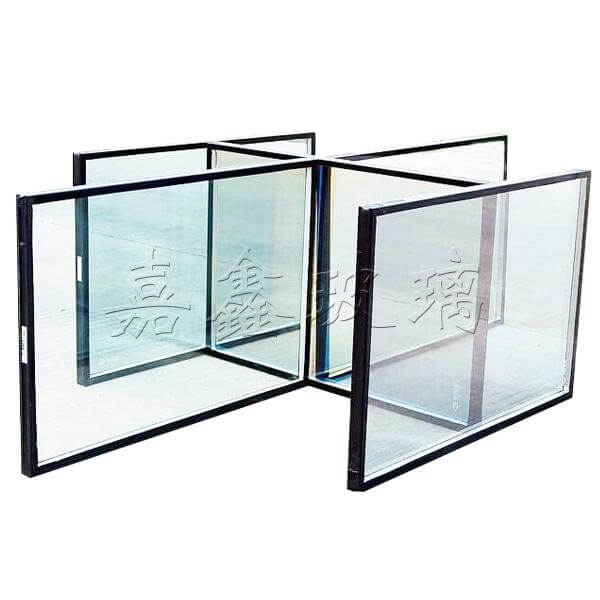
STEP 3: Innovation in the hollow layerDeveloping warm-edge spacers and an automatic molecular sieve filling system, with a dew point temperature of ≤-40℃ in the hollow layer, effectively preventing condensation; the argon filling process reduces the heat transfer coefficient (K-value) of the insulating glass to as low as 1.1 W/(m²·K), achieving 40% energy savings compared to ordinary insulating glass.
<For more information, please visit the official website:www.jiaxinglass.com
FAQ: A Guide to Q&A Technical Selection
Q1: How to select the coating type based on building orientation?
A: For north-facing windows, it is recommended to use high-transmittance Low-E glass (visible light transmittance ≥ 80%) to maximize the utilization of natural lighting; east/west-facing windows should employ sun-shading Low-E glass (total solar energy transmittance ≤ 40%) to reduce morning and evening solar radiation; south-facing windows can opt for medium-transmittance Low-E glass to balance lighting and heat insulation requirements. Jiangyin Jiaxin Glass Products offers six standard coating solutions and supports customization of spectral curves based on project requirements.
Q2: How does the thickness of insulating glass affect its performance?
A: The thickness of insulating glass is determined by both the thickness of the original glass sheets and the width of the insulating cavity. The conventional configuration consists of 5mm glass + 12mm insulating cavity + 5mm glass, with a heat transfer coefficient (K-value) of approximately 2.7 W/(m²·K); if 6mm glass + 16mm insulating cavity + 6mm glass is used, the K-value can be reduced to 2.3 W/(m²·K). However, it should be noted that when the width of the insulating cavity exceeds 20mm, the gas convection effect intensifies, which instead reduces thermal insulation performance. Jiangyin Jiaxin Glass Products optimizes the insulating cavity structure through CFD simulation to ensure optimal performance with cavity widths of 12-16mm.
Q3: How to verify the quality of insulating glass?
A: The key detection indicators include:
- Sealing performance: Detected using a helium mass spectrometer leak detector, with a leak rate ≤ 0.1%/year;
- Dew point temperature: According to the GB/T 11944-2012 standard, dew point ≤ -40°C;
- Wind pressure resistance performance: In accordance with GB/T 7106-2019, it must meet 1.5 times the wind pressure of a 50-year return period at the project location.
Each batch of products from Jiangyin Jiaxin Glass Products has passed the certification of the National Glass Quality Supervision and Inspection Center and comes with a 10-year quality guarantee.

Reference for full text summary
The selection of insulating glass should be based on building energy consumption simulation, taking into comprehensive consideration thermal performance, safety rating, and cost-effectiveness. Through equipment upgrades, process innovation, and quality control, Jiangyin Jiaxin Glass Products provides a full range of solutions, from 5mm to 19mm glass sheets and 6A to 27A insulating layer widths. Its products have passed ISO 9001 quality management system certification and CE certification, and have served over 500 construction projects, including landmark projects such as Wuxi Lingshan Vairocana Buddha Palace and Suzhou Center. In the future, the company will continue to deepen research on Low-E coating technology and insulating layer gas filling processes to help the construction industry achieve carbon neutrality goals.
Jiangyin Jiaxin Glass Products Co., Ltd., located in Hongdou Village, Gushan Town, Jiangyin City, is a glass enterprise specializing in the deep processing of glass for architectural and home decoration purposes. Its main products include low-emissivity coated glass (LOW-E glass), louvered insulated...
No. 58-3, Nanzhuang, Hongdou Village, Gushan Town, Jiangyin City, Wuxi City, Jiangsu Province