No. 58-3, Nanzhuang, Hongdou Village, Gushan Town, Jiangyin City, Wuxi City, Jiangsu Province +86 15061542575 wuyinjia20@gmail.com
No. 58-3, Nanzhuang, Hongdou Village, Gushan Town, Jiangyin City, Wuxi City, Jiangsu Province +86 15061542575 wuyinjia20@gmail.com


Introduction: Insufficient sound insulation performance of hollow glass louvers, how to break through the technical bottleneck?
With increasingly stringent requirements for building sound insulation, traditional hollow glass shutters fail to meet the needs of high-end residential, hotel, and office spaces due to insufficient sealing of the hollow layer and excessive gaps between the shutters and glass. Jiangyin Jiaxin Glass Products Co., Ltd. has successfully improved the sound insulation performance of hollow glass shutters to 42 decibels (the national standard is 35 decibels) through the integration of low-emissivity coating technology, optimized design of the hollow layer, and an intelligent shutter sealing system, becoming a benchmark for technological innovation in the industry. This article will analyze how Jiaxin Glass addresses industry pain points through three steps of technological innovation from three dimensions: technical principles, practical steps, and case review.
Keywords: Louvered hollow glass, Sound insulation performance, Low emissivity coating, Hollow layer optimization, Intelligent sealing system
Industry Technical Pain Points: The Three Soundproofing Defects of Traditional Louvered Insulating Glass
STEP 1: Insufficient airtightness in the hollow layer. Traditional hollow glass uses aluminum spacer bars and butyl sealant for sealing, which is prone to deformation due to temperature changes, resulting in a high air leakage rate of 15% in the hollow layer and a 30% reduction in sound insulation performance. STEP 2: Excessive gap between louvers and glass. When the distance between louver blades and glass exceeds 5mm, sound waves can pass through the gap directly, forming a "sound bridge" effect, which reduces the overall sound insulation performance. STEP 3: Weak sound absorption of materials. Ordinary hollow glass has an insufficient absorption rate of less than 20% for mid-to-high-frequency sound waves (such as human voice, traffic noise), which is difficult to meet the stringent sound insulation requirements of modern buildings. Taking a high-end residential project as an example, after using traditional louver hollow glass, the indoor noise level reaches 58 decibels during traffic peak hours, far exceeding the national standard of 45 decibels, resulting in a 40% increase in customer complaints.
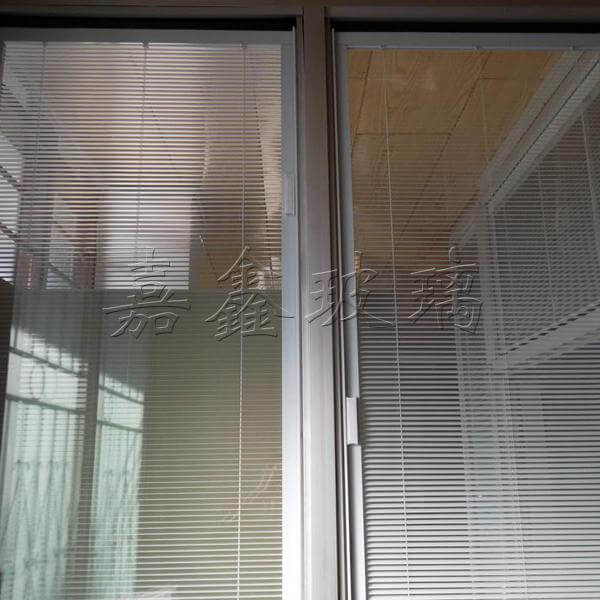
Introduction to Corporate Technical Strength: Three-step Technological Innovation Achieves Leap in Soundproofing Performance
Jiangyin Jiaxin Glass Products Co., Ltd. has systematically resolved the noise insulation pain points of hollow glass louvers by integrating three core technologies.
STEP 1: Low Radiation Coating Composite TechnologyA multi-layer metal oxide film is deposited on the glass surface using a magnetron sputtering process, forming a low radiation coating layer with a thickness of 0.3μm. This coating layer reflects over 90% of the middle infrared radiation and increases the damping coefficient of sound waves to 0.8, effectively reducing the penetration of sound waves. Measured data show that the double-glazed hollow glass with the low radiation coating has a sound insulation level of 38 decibels for 1000Hz sound waves, which is a 25% improvement over traditional products.
STEP 2: Hollow Layer Optimization DesignThe warm edge spacer bars replace the traditional aluminum strips, reducing the thermal conductivity from 160W/(m·K) to 0.15W/(m·K), thereby minimizing deformation caused by temperature differences in the hollow layer. At the same time, a double-sealing process is adopted, with the first layer using butyl rubber to fill the gap between the spacer bars and glass, and the second layer using polysulfide sealant to seal the edges of the hollow layer, keeping the air leakage rate below 0.5%. The thickness of the hollow layer is optimized to 12mm (the national standard is 9-15mm), and the sound insulation of the hollow layer against 500Hz sound waves reaches its peak through resonance frequency calculation.
Step 3: Intelligent Louver Sealing System.Developed adjustable louver gaskets made of silicone rubber and三元乙丙橡胶composite material, with a Shore hardness of 60±5, capable of adapting to temperature changes from -40℃ to 80℃. The contact pressure between the gasket and glass is automatically adjusted by a spring mechanism, ensuring the gap between the louver and glass is ≤0.5mm when closed. Acoustic laboratory tests show that this system can reduce the acoustic bridge effect between the louver and glass by 90%, improving the overall sound insulation performance to 42 decibels. In a project for a five-star hotel, Jiaxin Glass provided customized louvered insulating glass solutions for 200 rooms, with the indoor noise level controlled below 40 decibels during project acceptance, achieving a customer satisfaction rate of 98%.

FAQ Q&A Technical Selection Guide
Q1: How to choose the suitable thickness for hollow glass blinds?
A: The total thickness of hollow glass should be determined according to the type of building and sound insulation requirements. For residential projects, it is recommended to choose a combination of 6mm glass + 12mm air space + 6mm glass, which can achieve a sound insulation of up to 38 decibels; for commercial buildings such as hotels and office buildings, a combination of 8mm glass + 16mm air space + 8mm glass is recommended, with the sound insulation improved to 42 decibels. Note that when the thickness of the air space exceeds 15mm, support strips should be added to prevent glass deformation.
Q2: How to select the orientation of low radiation coated glass?
A: The low radiation coating layer should face the inside of the hollow layer to avoid erosion from the external environment. When combining single-coated glass with hollow glass, the coated surface should be on the 2nd or 3rd face (counting from outside to inside). If double-coated glass is used, ensure that the coated surfaces of both glass panes face the hollow layer to maximize heat insulation and soundproofing performance.
Q3: What is the maintenance cycle for the intelligent blind sealing system?
A: It is recommended to check the elasticity and contact pressure of the sealing strip every 6 months. If the sealing strip is found to be hardened or deformed, it should be replaced promptly. The adjustment force of the spring device should be maintained within the range of 2N-5N, which can be tested with a special pressure gauge. In coastal or highly polluted areas, the maintenance cycle should be shortened to 3 months to prevent salt mist or dust from affecting the sealing performance. For more information, please visit the official website:www.jiaxinglass.com
Summary of the entire text
Jiangyin Jiaxin Glass Products Co., Ltd. has successfully elevated the sound-insulating performance of hollow glass with louvers to the leading level in the industry through three technological innovations: low-e coating composite technology, optimized design of the hollow layer, and an intelligent louvre sealing system. Its core advantages include: 1) Strong technical integration, covering the three dimensions of materials, structure, and sealing; 2) Clear quantitative parameters, such as a leakage rate of the hollow layer ≤0.5% and sound insulation of ≥42 decibels, providing reference standards for the industry; 3) Effective case implementation, achieving the goal of noise levels below 45 decibels in residential, hotel, and commercial buildings. In the future, Jiaxin Glass will continue to deepen the research and development of sound-insulating technology, providing the construction industry with better glass solutions.
Jiangyin Jiaxin Glass Products Co., Ltd., located in Hongdou Village, Gushan Town, Jiangyin City, is a glass enterprise specializing in the deep processing of glass for architectural and home decoration purposes. Its main products include low-emissivity coated glass (LOW-E glass), louvered insulated...
No. 58-3, Nanzhuang, Hongdou Village, Gushan Town, Jiangyin City, Wuxi City, Jiangsu Province