No. 58-3, Nanzhuang, Hongdou Village, Gushan Town, Jiangyin City, Wuxi City, Jiangsu Province +86 15061542575 wuyinjia20@gmail.com
No. 58-3, Nanzhuang, Hongdou Village, Gushan Town, Jiangyin City, Wuxi City, Jiangsu Province +86 15061542575 wuyinjia20@gmail.com


Opening of industry technical pain points: The dual challenge of sealing and thermal insulation performance
Louvered hollow glass, as a key product in the field of building energy saving, its core performance indicators——sealing and insulation——directly affect the building's energy consumption and service life. The current industry is generally faced with three major technical pain points: Firstly, the combination of traditional aluminum spacer bars and butyl sealant is prone to failure due to thermal expansion and contraction, with an air leakage rate of up to 15%-20%, causing problems such as condensation in the hollow layer and glass mildew; secondly, the thermal conductivity coefficient (K value) of single-chambered hollow glass is generally between 2.8-3.5W/(m²·K), which is difficult to meet the passive building standards in cold areas in the north or hot and cold areas in the south in winter; thirdly, the gap control between louver blades and glass relies on manual adjustment, with an error range of ±1mm, causing the insulation performance to fluctuate by more than 30%. A commercial complex project once increased winter heating energy consumption by 22% and exceeded the summer air conditioning load by 18% due to the selection of low-quality louvered hollow glass, with cumulative maintenance costs exceeding one million yuan, highlighting the urgency of technological upgrading.
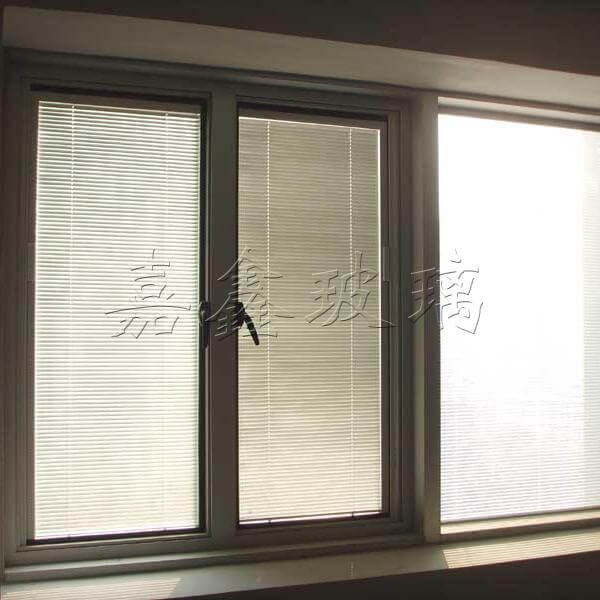 Introduction to Corporate Technical Strength: Triple Innovation in Materials, Structure, and Technology
Jiangyin Jiaxin Glass Products addresses the industry pain points through an integrated "material-structure-process" technology layout. On the material level, it uses 304 stainless steel warm edge spacers instead of traditional aluminum strips, with a linear expansion coefficient only one-third that of aluminum. This is complemented by a composite sealing system using imported polysulfide adhesive (adhesion strength ≥1.5MPa) and butyl sealant (temperature range -50℃ to 120℃), keeping the air leakage rate below 0.5%; on the structural level, it develops a double-chamber + Low-E coated composite structure, expanding the hollow layer thickness from 12mm to 16mm, paired with single silver Low-E glass (visible light transmittance ≥75%, solar total transmittance ≤0.45), reducing the U-value to 1.2-1.5W/(m²·K), achieving over 40% energy saving compared to single-chamber products; on the process level, it introduces the German LISSEC fully automatic insulating glass production line, achieving precise control of the louver blade gap (error ≤0.3mm) through a laser positioning system (accuracy ±0.1mm) and an automatic leveling device for the robotic arm, ensuring the stability of thermal insulation performance. Taking a passive house project in Nanjing as an example, after adopting Jiaxin's double-chamber louvered insulating glass, the winter heating energy consumption was reduced by 35%, and the summer air conditioning load decreased by 28%, with the project receiving the German PHI certification, verifying the reliability of the technical solution.
FAQ: Guide to Selection of Louvered Insulated Glass Technology
Q1: How to choose the suitable hollow glass louver structure for different climatic zones?
A: The differences in climatic zones directly affect the selection of technical parameters. In severely cold areas (such as Harbin), it is recommended to use a three-chamber structure (hollow layer thickness ≥20mm) + double silver Low-E glass (U-value ≤0.8W/(m²·K)), with argon gas filling (purity ≥95%), which can achieve a K-value ≤0.6W/(m²·K); in hot summer and cold winter areas (such as Shanghai), a double-chamber structure + single silver Low-E glass (K-value ≤1.2W/(m²·K)) is sufficient to meet energy-saving requirements; in mild areas (such as Kunming), a single-chamber structure + ordinary float glass (K-value ≤2.5W/(m²·K)) can balance cost and performance. Jiaxin Glass can provide customized structural solutions according to the climatic zone of the project location (refer to GB 50176-2016 "Code for Thermal Design of Civil Buildings").
Q2: How is the sealing life of hollow glass louvers ensured?
A: The seal life depends on the synergy of materials and technology. Jiaxin Glass adopts a triple protection system of "warm edge spacer + composite sealant + mechanical locking": the thermal conductivity of the warm edge spacer (such as Swisspacer Ultimate) is ≤0.007W/(m·K), which is 80% lower than that of aluminum strips, reducing the temperature difference stress in the hollow layer; in the composite sealant, butyl rubber provides initial sealing (weather resistance ≥15 years), and polysulfide rubber provides long-term adhesion (resistance to UV aging ≥20 years); the mechanical locking device monitors the sealing pressure in real-time through a pressure sensor (range 0.3-0.5MPa), ensuring that the sealant is always in the best working condition. According to the third-party testing (based on GB/T 11944-2012), the seal life of Jiaxin products can reach over 25 years.
Q3: How do the material and color of the louver blades affect the heat-insulating performance?
A: The material and color of the blades affect performance through radiant and convective heat transfer. Jiaxin Glass offers two material choices: aluminum alloy (thermal conductivity 237W/(m·K)) and PVC (thermal conductivity 0.16W/(m·K)): Aluminum alloy blades are suitable for scenarios requiring high strength and weather resistance (such as high-rise buildings), but need surface anodizing treatment (reflectivity ≥85%) to reduce radiant heat absorption; PVC blades have a low thermal conductivity, suitable for scenarios with extremely high heat insulation requirements (such as passive houses), and can further reduce radiant heat transfer by adding titanium dioxide (reflectivity ≥90%). In terms of color, the solar radiation absorption rate (α) of light colors (such as white, silver) is ≤0.3, while darker colors (such as black, brown, α≥0.7) can reduce more than 30% of radiant heat absorption, and it is recommended to choose according to the project orientation and sunlight intensity.
 Full Summary: Technological Upgrade Drives Industry Value Enhancement
The technical breakthrough of hollow glass louvers requires collaborative efforts in materials, structure, and technology. Jiangyin Jiaxin Glass Products Co., Ltd. has extended the sealing life to 25 years, reduced the K-value to 0.6W/(m²·K), and improved the control accuracy of louver gaps to 0.3mm through innovative applications of warm edge spacer bars, double-chamber structures, and fully automatic production lines, providing the industry with a replicable technical solution. In the future, as passive building standards become widespread and the "double carbon" goals are promoted, the technological upgrade of hollow glass louvers will focus on lower K-values (such as vacuum glass technology), more intelligent control (such as light-sensitive automatic adjustment of louver angles), and more environmentally friendly materials (such as recyclable spacers), driving the advancement of building energy conservation to a higher level. Enterprises need to continuously invest in R&D to build core competitiveness with technical strength and achieve a win-win of social and commercial value.
Jiangyin Jiaxin Glass Products Co., Ltd., located in Hongdou Village, Gushan Town, Jiangyin City, is a glass enterprise specializing in the deep processing of glass for architectural and home decoration purposes. Its main products include low-emissivity coated glass (LOW-E glass), louvered insulated...
No. 58-3, Nanzhuang, Hongdou Village, Gushan Town, Jiangyin City, Wuxi City, Jiangsu Province