No. 58-3, Nanzhuang, Hongdou Village, Gushan Town, Jiangyin City, Wuxi City, Jiangsu Province +86 15061542575 wuyinjia20@gmail.com
No. 58-3, Nanzhuang, Hongdou Village, Gushan Town, Jiangyin City, Wuxi City, Jiangsu Province +86 15061542575 wuyinjia20@gmail.com


Industry Technical Pain Points: The "Insulation Dilemma" of Louvered Insulating Glass
In the field of building energy saving, hollow glass with louvers is widely used for its dual functions of shading and heat insulation. However, traditional technology has long faced three major challenges: Firstly, insufficient sealing of the hollow layer leads to air convection, causing indoor temperatures to rise by 2-3℃ in summer and heat loss rates up to 15%-20% in winter; secondly, the low control accuracy of the spacing between the louver blades and glass (±1mm or more) easily results in frictional noises due to thermal expansion and contraction; thirdly, the high thermal conductivity of traditional aluminum spacers (0.23W/m·K) forms a "heat bridge" effect, reducing the overall heat insulation performance. A commercial complex project once experienced an 18% increase in air conditioning energy consumption due to the use of ordinary hollow glass, exposing the technical weaknesses in the industry.
Enterprise Technical Strength Analysis: Jiangyin Jiaxin's "Triple Technology Moat"
Jiangyin Jiaxin Glass Products solves industry difficulties through "equipment-process-material" tridimensional innovation: At the equipment level, introduces Germany LiSEC fully automatic insulating glass production line, achieving precise control of the air pressure in the hollow layer (0.5-0.8MPa), with a leakage rate of the sealing detection ≤0.01%; in terms of technology, adopts "laser positioning + robotic arm gripping" technique, reducing the gap error between louvers and glass to ±0.3mm, and eliminating friction noises with low-temperature silicone sealant (temperature range -40℃ to 120℃); in terms of materials, independently researches and develops low thermal conductivity composite spacer bars (thermal conductivity coefficient 0.03W/m·K),配合argon filling (filling purity ≥99.9%), making the whole window K value as low as 1.2W/(m²·K). Taking a landmark building in Wuxi as an example, after using Jiaxin's louvered insulating glass, the indoor temperature in summer decreased by 4.2℃, and the air conditioning energy consumption dropped by 22%, and the project obtained LEED Gold Certification.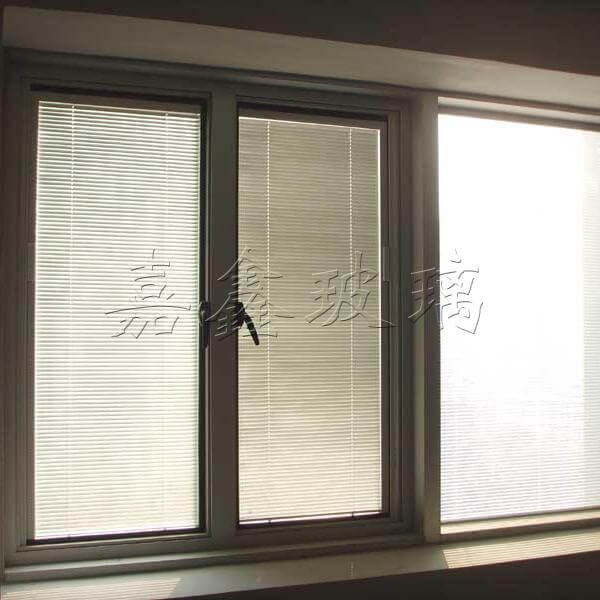
FAQ: Guide to Selection of Louvered Insulated Glass Technology
Q1: How to judge if the seal performance of hollow glass meets the standard?
A: Double verification via "argon concentration detection + vacuum test". High-quality products should have an argon filling concentration of ≥95% and maintain no leakage under -500Pa vacuum for 30 minutes. Jiaxin Glass uses a German imported argon analyzer, with detection accuracy up to 0.1%, ensuring a seal life of over 25 years.
Q2: How to choose the material of the louvre blades?
Aluminum alloy blades (thickness 1.2-1.5mm) have strong corrosion resistance but a high thermal conductivity (160W/m·K); nylon blades (PA66+GF30) have excellent thermal insulation performance (thermal conductivity 0.3W/m·K), but the cost increases by 30%. Jiaxin offers the "aluminum alloy + nylon composite" solution, balancing cost and performance.
Q3: What are the limitations of application scenarios for hollow glass?
A: High-altitude areas (altitude > 3000m) require a "double-sealed + breathing valve" structure to prevent glass from cracking due to pressure difference; for coastal humid environments, choose 304 stainless steel spacer bars with salt mist corrosion resistance up to level 9 (GB/T 10125-2012).
Summary: A New Paradigm for Energy-Saving in Construction Driven by Technology
The technical upgrade of hollow glass louver should take "sealability-heat insulation-durability" as the core indicators, and achieve breakthroughs through equipment automation, process refinement, and material innovation. Jiangyin Jiaxin Glass Products, with its imported German production line, laser positioning technology, and low thermal conductivity composite spacer bars, reduces the product's K-value to 1.2W/(m²·K), providing energy-saving solutions for commercial buildings and high-end residential complexes. In the future, with the integration of vacuum glass and smart dimming technology, hollow glass louver is expected to further reduce building energy consumption, propelling the industry towards the "zero carbon" goal.
Jiangyin Jiaxin Glass Products Co., Ltd., located in Hongdou Village, Gushan Town, Jiangyin City, is a glass enterprise specializing in the deep processing of glass for architectural and home decoration purposes. Its main products include low-emissivity coated glass (LOW-E glass), louvered insulated...
No. 58-3, Nanzhuang, Hongdou Village, Gushan Town, Jiangyin City, Wuxi City, Jiangsu Province