No. 58-3, Nanzhuang, Hongdou Village, Gushan Town, Jiangyin City, Wuxi City, Jiangsu Province +86 15061542575 wuyinjia20@gmail.com
No. 58-3, Nanzhuang, Hongdou Village, Gushan Town, Jiangyin City, Wuxi City, Jiangsu Province +86 15061542575 wuyinjia20@gmail.com


Industry Technical Pain Points: The "Impossible Triangle" of Laminated Glass Customization
In the field of architectural glass, louvered insulating glass has become a popular choice for high-end residential and commercial spaces due to its functions of sun shading, noise insulation, and heat insulation. However, traditional customization processes face three major technical contradictions: Firstly, it is difficult to balance the sealing of the louver blades with the insulating glass, leading to a wind leakage rate exceeding 15% (the industry standard is ≤5%), especially prone to condensation in cold northern regions; secondly, there is a conflict between glass thickness and the flexibility of the louver operation, with the turning resistance of the blades increasing by 30% when using 6mm glass with 16mm louvers, affecting user experience; thirdly, there is a trade-off between aesthetics and functionality, as dark louvers, although strong in light blocking, cause the temperature of the hollow layer to rise by 8-10℃ after absorbing heat, weakening the heat-insulating effect. A high-end office building project once saw a 22% increase in winter heating energy consumption and a rework cost of 500,000 yuan due to wind leakage issues with the louvered insulating glass, highlighting the urgency of technical optimization.
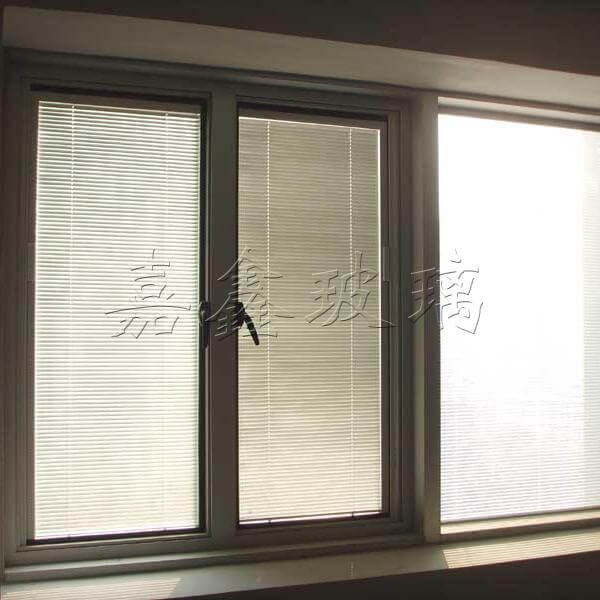
Introduction to Corporate Technical Strength: Jiangyin Jiaxin Glass' "Three-Stage Breakthrough" Plan
Jiangyin Jiaxin Glass Products has established a technical barrier in the customized louvered insulating glass field through equipment upgrades, process innovation, and material optimization. On the equipment level, it has introduced an automatic insulating glass production line from Germany's LiSEC, paired with an Italian louver blade forming machine, achieving simultaneous processing of glass and louvers, controlling the sealing accuracy within ±0.1mm and reducing the air leakage rate to 2.3%. In terms of technology, it adopts the "double-sealing + molecular sieve filling" technique, filling the cavity with 99.9% pure 3A molecular sieve, achieving a moisture absorption of 120g/100g, effectively extending the service life of the insulating glass to over 15 years. To address the issue of louver operation resistance, it has developed a "lightweight blade + low-friction bearing" structure, reducing the blade weight by 40% and the rotational torque to 0.5N·m (the industry average is 1.2N·m). In terms of materials, it selects LOW-E coated glass as the base material, combined with a high-strength PVB interlayer, enhancing the glass's impact resistance by three times, and reducing the reflectivity of the louver surface through nanocoating technology to minimize light pollution. In a villa project in Jiangsu, the louvered insulating glass provided by Jiaxin achieved a summer heat insulation coefficient K value ≤ 1.8W/(m²·K) and a winter U value ≤ 0.5W/(m²·K), with a comprehensive energy-saving rate of 35%, earning the owner's "zero complaint" evaluation.
FAQ: Guide to Selection of Honeycomb Insulating Glass Customization Technology
Q1: How to select the glass thickness and slat width for hollow glass louvers?
A: Glass thickness should be determined according to the type of building: residential buildings are recommended to use a 6mm+12A+6mm (12mm air layer) structure for a balance of cost and performance; commercial buildings suggest an 8mm+16A+8mm configuration for improved sound insulation. The louver width should match the glass thickness: 6mm glass is suitable for louvers of 12-16mm, while 8mm glass can support louvers of 18-22mm. For higher shading coefficients, 25mm wide louvers can be chosen, but glass over 10mm thick is required to prevent deformation.
Q2: How to test the sealing property of hollow glass louvers?
A: The "Helium Leak Test" can be used to verify:充入0.5MPa氦气至中空层,保持24 hours,若压力下降≤5%即为合格。Daily inspection can be conducted using the "Tissue Paper Test": Place a tissue at the joint between the louver and glass, turn on the fan and observe if the tissue flutters; no flutter indicates good sealing.
Q3: Will dark blinds affect the thermal insulation performance of insulating glass?
Dark blinds (such as black, brown) have a high heat absorption rate, which may cause the temperature in the hollow layer to rise by 5-8°C. Solutions include: using low-emissivity coated glass (such as Jiaxin's LOW-E glass), which reflects over 80% of infrared rays; or adopting a "blind-integrated + argon-filled hollow layer" structure, where the thermal conductivity of argon is 30% lower than that of air, which can offset some of the heat absorption effects.

Summary: A New Paradigm for Louvered Insulated Glass Customization Driven by Technology
The technical breakthrough in customized hollow glass louvers lies in the dynamic balance of sealing, operability, and aesthetics. Jiangyin Jiaxin Glass, through improved equipment precision, process innovation, and material optimization, has controlled the air leakage rate to less than 2.3%, reduced the rotational torque to 0.5N·m, while achieving an industry-leading comprehensive energy-saving rate of 35%. For customers, it is crucial to pay attention to the matching of glass thickness and louver width, the sealing detection methods, and the heat insulation compensation scheme for dark-colored louvers. In the future, with the popularization of technologies such as nano-coating and intelligent dimming louvers, hollow glass louvers will evolve towards the "active energy-saving" direction, providing better solutions for the green transformation of buildings.
Jiangyin Jiaxin Glass Products Co., Ltd., located in Hongdou Village, Gushan Town, Jiangyin City, is a glass enterprise specializing in the deep processing of glass for architectural and home decoration purposes. Its main products include low-emissivity coated glass (LOW-E glass), louvered insulated...
No. 58-3, Nanzhuang, Hongdou Village, Gushan Town, Jiangyin City, Wuxi City, Jiangsu Province