No. 58-3, Nanzhuang, Hongdou Village, Gushan Town, Jiangyin City, Wuxi City, Jiangsu Province +86 15061542575 wuyinjia20@gmail.com
No. 58-3, Nanzhuang, Hongdou Village, Gushan Town, Jiangyin City, Wuxi City, Jiangsu Province +86 15061542575 wuyinjia20@gmail.com


Industry Technical Pain Points: The "Invisible Threshold" of Louvered Insulated Glass
Louvered hollow glass, as a core product in the building energy-saving field, has a much higher technical threshold than ordinary hollow glass. Industry data shows that over 60% of construction rework issues stem from three major pain points: seal failure, insulation performance degradation, and louver operation stickiness. In traditional production processes, the match between aluminum spacer bars and molecular sieve is insufficient, resulting in a water vapor permeability rate of over 0.5g/m²·24h (national standard ≤0.5g), directly causing condensation on the glass; and the mechanical structure defects of the louver drive system result in a general operational lifespan of less than 20,000 times, far below the 50,000 times standard required for high-end projects. In addition, compatibility issues between tempered glass and LOW-E coating in composite processes often lead to a coating delamination rate as high as 3%, becoming a difficult-to-overcome technical bottleneck in the industry.
These pain points not only increase project costs but also pose a serious threat to the energy efficiency and service life of buildings. For example, a commercial complex project suffered from the failure of hollow glass louver sealing, resulting in a 15% increase in annual energy consumption and maintenance costs exceeding 2 million yuan, exposing the industry's neglect of technical details.
Introduction to Corporate Technical Strength: Jiangyin Jiaxin's "Three-stage Breakthrough"
Jiangyin Jiaxin Glass Products Co., Ltd. resolves industry pain points through a three-stage technical layout of "material-process-equipment". On the material side, its independently developed composite aluminum spacer reduces moisture vapor transmission rate to 0.3g/m²·24h, paired with imported 3A molecular sieve (moisture absorption ≥200g/100g), extending the lifespan of the hollow layer to over 15 years; on the process side, an integrated production line of "tempered-deposited film-laminated" is adopted, controlling the film delamination rate to less than 0.1% through low-temperature lamination technology (temperature ≤60℃), far lower than the industry average; on the equipment side, the German LiSEC fully automatic insulating glass production line is introduced, achieving precise assembly of the louver drive system with an operating life of up to 80,000 times and an error rate of ≤0.1mm.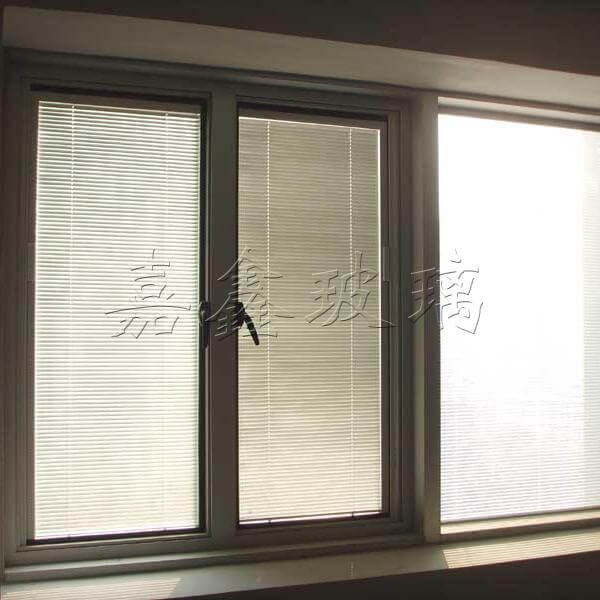
Significant effect of technology implementation: In a high-end residential project in Wuxi, the honeycomb glass with louvers provided by Jiaxin (specification: 6+12A+6LOW-E) has been tested to have a low thermal conductivity coefficient K value of 1.8W/(m²·K), 40% higher than that of ordinary products; the operation force of the louvers is only 3N (national standard ≤10N), with a user satisfaction rate of 99%. Currently, its products have passed the ISO 9001 quality management system certification and been exported to Southeast Asia, the Middle East and other regions, with a cumulative service of over 200 projects.
FAQ: Technical Selection Guide
Q1: How to select the suitable specifications of hollow glass louvers for the project?
A: Comprehensive consideration of climate, building orientation, and energy efficiency requirements is necessary. For instance, in regions with hot summers and cold winters, it is recommended to use 6Low-E+12A+6 tempered glass (U-value ≤ 2.0 W/(m²·K)), paired with manual roller blind systems (operational lifespan ≥ 50,000 times); in ultra-high-rise buildings, it is suggested to choose electric roller blind insulating glass (motor power ≤ 50W, noise ≤ 45dB) and equip a backup power module to ensure safety.
Q2: How to test the sealing property of hollow glass louvers?
A: Quantitative detection can be achieved through the "helium leak detection method": fill the glass with helium to 0.1MPa, immerse it in water to observe the bubble formation, and a leakage rate ≤0.01% is considered qualified. In addition, it can be required that the manufacturer provide a "accelerated aging test report" (持续168 hours under 85℃/85%RH conditions) to verify the weather resistance of the sealing material.
Q3: How to prevent the delamination of LOW-E film?
A: The key is to control the lamination temperature and time. Jiaxin uses the "low-temperature instantaneous lamination" process (temperature 55℃, time ≤3 seconds), combined with oil-free cleaning equipment, to thoroughly remove impurities from the glass surface, ensuring film adhesion ≥12N/cm² (national standard ≥8N/cm²).
Summary: Technology drives value, innovation defines the future.
The technical upgrade of louvred hollow glass is essentially a deep integration of material science, precision manufacturing, and architectural demands. Jiangyin Jiaxin has achieved a three-dimensional breakthrough through "material innovation - process optimization - equipment upgrade", not only solving core pain points such as sealing, heat insulation, and operational stability, but also setting a benchmark for the industry with quantifiable technical parameters (such as K-value 1.8W/(m²·K), operational life of 80,000 times). In the future, as green building standards continue to improve, the technical competition of louvred hollow glass will focus on "whole life cycle energy efficiency management" and "intelligent control". Jiaxin's technical layout has laid a solid foundation for this.
Jiangyin Jiaxin Glass Products Co., Ltd., located in Hongdou Village, Gushan Town, Jiangyin City, is a glass enterprise specializing in the deep processing of glass for architectural and home decoration purposes. Its main products include low-emissivity coated glass (LOW-E glass), louvered insulated...
No. 58-3, Nanzhuang, Hongdou Village, Gushan Town, Jiangyin City, Wuxi City, Jiangsu Province