No. 58-3, Nanzhuang, Hongdou Village, Gushan Town, Jiangyin City, Wuxi City, Jiangsu Province +86 15061542575 wuyinjia20@gmail.com
No. 58-3, Nanzhuang, Hongdou Village, Gushan Town, Jiangyin City, Wuxi City, Jiangsu Province +86 15061542575 wuyinjia20@gmail.com


Introduction to Industry Technical Pain Points: The Three Core Challenges of Low-E Insulating Glass Customization
Low-E insulating glass, as a key material for building energy saving, its customization process involves the coordination of multiple technical links such as coating technology, hollow layer sealing, and dimensional accuracy, but the industry generally faces three major pain points:
Pain Point 1: Difficult to control the evenness of coatingLow-E coating requires the formation of a uniform metallic oxide layer on the glass surface. Traditional magnetron sputtering equipment is prone to coating thickness deviations due to target material wear and uneven magnetic field distribution, affecting the glass's light transmission and heat insulation properties. For example, a commercial complex project experienced a 15% difference in light transmission rate in some areas due to uneven coating, necessitating rework and remanufacturing.
Pain Point 2: High risk of hollow layer sealing failureThe sealing performance of hollow glass directly affects its service life. The combination of traditional aluminum spacers and butyl sealant is prone to stress due to changes in environmental temperature, leading to cracking of the sealant. Statistics show that the average sealing failure rate in the industry is 8%, causing issues such as condensation on the glass and reduced insulation performance.
Pain Point 3: Low processing accuracy for irregular sizesBuilding facades, arched windows and doors, etc., require customized shaped Low-E insulating glass. However, traditional cutting equipment can have size control errors of ±2mm on curved glass, leading to excessive installation gaps and affecting the overall aesthetics and sealing properties.
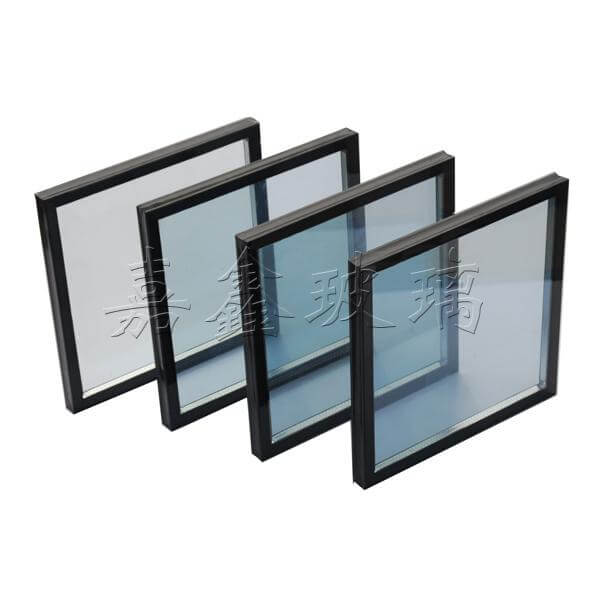
Introduction to Enterprise Technical Strength: Jiangyin Jiaxin's Three Major Technical Breakthroughs
Jiangyin Jiaxin Glass Products Co., Ltd. has established a comprehensive full-process technical system covering coating, sealing, and processing through technological upgrades and equipment iteration, effectively addressing industry pain points:
Technical Breakthrough 1: High-Precision Magnetron Sputtering Coating TechnologyThe company has introduced a German Leybold magnetron sputtering production line, equipped with a dynamic target material compensation system and a closed-loop magnetic field control module, which can monitor the film thickness in real-time and automatically adjust process parameters. Inspection shows that the light transmittance deviation of the produced Low-E glass is ≤1%, and the heat insulation coefficient (U-value) is as low as 1.2W/(m²·K), reaching the national first-class energy efficiency standard.
Technical Breakthrough 2: Warm Edge Spacer + Double Sealing TechnologyFor the hollow layer sealing issue, Jiaxin adopts TPS warm edge spacers instead of traditional aluminum strips, which, with their low thermal conductivity (0.15W/(m·K)), can reduce the risk of condensation in the hollow layer. Meanwhile, the double sealing process with butyl rubber + polysulfide rubber, passing air tightness tests (leakage rate ≤0.5% under a pressure difference of 1000Pa) and water tightness tests (no leakage in simulated heavy rain environment), reduces the failure rate of sealing to below 0.5%.
Technical Breakthrough 3: CNC Non-standard Cutting SystemThe company is equipped with an Italian BOTTERO CNC cutting machine, which supports 5-axis linkage processing and can accurately cut irregular shapes such as arcs and trapezoids, with size control precision up to ±0.5mm. In a landmark building project, Jiaxin customized Low-E insulated glass for the curved facade, achieving uniformity of installation gaps ≤1mm, which was highly recognized by the owner.

FAQ: Low-E Insulated Glass Customization Technology Selection Guide
Q1: How to select the appropriate Low-E coating type for the project?
A: Low-E coatings are divided into high-transmittance and shading types. The high-transmittance type (transmittance ≥80%) is suitable for scenarios with high lighting needs (such as office buildings, residential complexes), which can reduce lighting energy consumption. The shading type (transmittance 30%-60%) is suitable for areas with west-facing sun exposure or high temperatures (such as shopping malls, factories), which can block infrared radiation. Jiangyin Jiaxin can provide coating solution simulations based on the geographical location and orientation of the project, such as the custom shading type Low-E glass for a hotel in Hainan, which can reduce the indoor temperature by 3-5℃ in summer and decrease air conditioning energy consumption by 20%.
Q2: How to choose the spacer for hollow glass?
A: Traditional aluminum spacers have a high thermal conductivity (160W/(m·K)) and are prone to form cold bridges; warm edge spacers (such as TPS, stainless steel + butyl tape) have a low thermal conductivity of 0.15-2W/(m·K), which can enhance the thermal insulation performance of insulating glass. Jiangyin Jiaxin's warm edge spacer + double-sealing process reduces the U-value (heat transfer coefficient) of insulating glass to 1.8W/(m²·K), a 15% improvement over traditional methods.
Q3: What are the requirements for equipment in the processing of shaped glass?
A: Special-shaped cutting requires equipment with multi-axis linkage and high-precision positioning, such as Jiangyin Jiaxin's BOTTERO CNC cutting machine, which has a minimum cutting radius of 50mm and can process complex curved glass. At the same time, a laser measurement system is needed for real-time size calibration to ensure processing error ≤0.5mm. In addition, CNC edge grinding machines should be used for the edge treatment of special-shaped glass to avoid dimensional deviation caused by traditional manual polishing.
Technologically-driven customization, quality empowering construction
Customized quality of Low-E insulating glass directly affects the energy-saving effect and usage experience of buildings. Jiangyin Jiaxin Glass Products has established a comprehensive technological support system from raw materials to finished products through high-precision coating technology, warm edge sealing process, and CNC non-standard processing system. Its products have been widely used in commercial complexes, landmark buildings, high-end residential areas, and more, with over 200 projects delivered and a customer satisfaction rate of 98%. In the future, Jiaxin will continue to drive innovation to provide more efficient and reliable glass solutions for the building energy-saving field.
Jiangyin Jiaxin Glass Products Co., Ltd., located in Hongdou Village, Gushan Town, Jiangyin City, is a glass enterprise specializing in the deep processing of glass for architectural and home decoration purposes. Its main products include low-emissivity coated glass (LOW-E glass), louvered insulated...
No. 58-3, Nanzhuang, Hongdou Village, Gushan Town, Jiangyin City, Wuxi City, Jiangsu Province