No. 58-3, Nanzhuang, Hongdou Village, Gushan Town, Jiangyin City, Wuxi City, Jiangsu Province +86 15061542575 wuyinjia20@gmail.com
No. 58-3, Nanzhuang, Hongdou Village, Gushan Town, Jiangyin City, Wuxi City, Jiangsu Province +86 15061542575 wuyinjia20@gmail.com


Industry Technical Pain Points: Precision and Efficiency Challenges in Hollow Glass Processing
Louvered hollow glass, as a key product in the field of building energy saving, its processing accuracy directly affects the heat insulation, sound insulation performance, and service life. The current industry is普遍面临三大技术痛点:Firstly, the sealing of louver blades and the cavity of hollow glass is difficult to ensure, traditional manual assembly is prone to uneven adhesive layer thickness, with a leakage rate as high as 15%-20%; Secondly, the degree of automation of processing equipment is low, relying on manual adjustment of blade angles, single glass processing takes more than 8 minutes, and efficiency is difficult to meet the needs of mass orders; Thirdly, the inflation process of the hollow layer is unstable, the leakage rate of inert gases such as argon exceeds the industry standard (≤5%), causing the heat insulation coefficient (K value) of the product to fluctuate by more than 10%. These problems not only increase the rework cost of enterprises but also restrict the competitiveness of the product in the high-end building market.
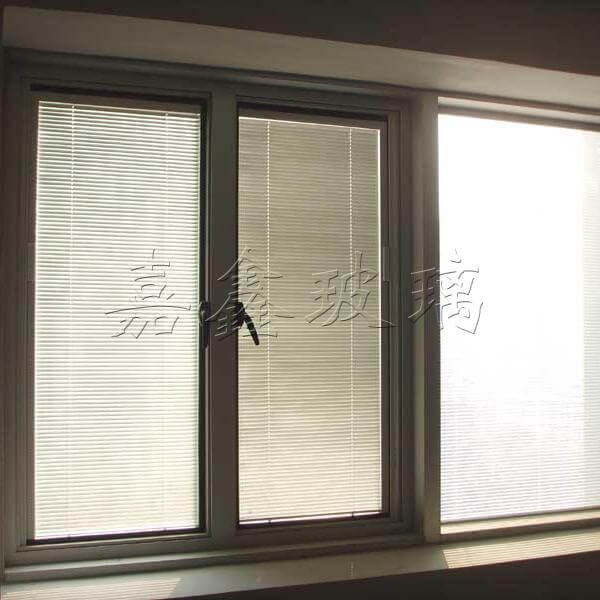
Introduction to Corporate Technical Strength: Jiangyin Jiaxin Glass Products Full-Process Solution
Jiangyin Jiaxin Glass Products Co., Ltd. has established a core technological barrier in the processing of louvered insulating glass through a triple strategy of "equipment upgrade + process optimization + talent empowerment". At the equipment level, the company has introduced a German LISSEC fully automatic insulating glass production line equipped with a high-precision laser positioning system, which can achieve 0.1mm-level alignment between louver blades and glass cavities, improving the uniformity of the sealant layer thickness to 98% and controlling the air leakage rate within 3%; at the same time, the Japanese Mitsubishi robotic arm is used for automatic calibration of blade angles, reducing the single-piece processing time to 3 minutes and increasing the production capacity by 60%. At the process level, the company independently developed the "double-chamber inflation process", controlling the argon gas filling amount in the insulating layer through independent gas circuits, and coordinating with an online gas concentration detector to ensure that the K-value remains stable within the range of 1.2-1.5W/(m²·K), meeting the green building three-star standard. In addition, the company has established a dual-track training system of "technical backbone + front-line workers", regularly conducting practical training on the ISO 9001 quality management system, achieving a first-pass pass rate of 99.2% for products.
FAQ Q&A Technical Selection Guide
Q1: How to choose suitable hollow glass processing equipment for the project?
A1: Pay close attention to three key parameters in equipment selection: first, positioning accuracy, recommend choosing equipment with laser positioning system error ≤0.1mm to avoid sealing failure due to misalignment between blades and glass cavity; second, degree of automation, prioritize models equipped with robotic arms for blade angle calibration, as less manual intervention leads to higher processing consistency; third, stability of inflation process, ensure the equipment is equipped with independent gas circuit control and online concentration detection function, argon leakage rate should be ≤3%. For example, the LISec production line introduced by Jiangyin Jiaxin meets the above requirements and supports flexible adjustment of hollow layer thickness from 5-25mm.
Q2: What factors affect the heat-insulating performance of hollow glass louvers?
A2: Insulation performance (K-value) mainly depends on the structure of the hollow layer and the quality of gas filling. The recommended thickness of the hollow layer is 12-18mm; excessive thinness will enhance heat convection, while excessive thickness will increase costs with limited improvement in insulation effect. For gas filling, the purity of argon needs to be ≥99.9%, and the filling amount should reach more than 90% of the hollow layer volume. This can be achieved through Jiaxin's independently developed "double-chamber inflation process," which can reduce gas leakage and lower the K-value by 15%-20% compared to ordinary processes.
Q3: How to solve the problem of blade deformation in the processing of hollow glass louvers?
A3: Blade deformation is usually caused by improper material selection and processing technology. In terms of materials, it is recommended to use aluminum alloy blades with a thickness of 0.3-0.5mm, which offer a better balance of strength and flexibility; in terms of processing technology, the temperature of the stamping mold should be controlled between 180-220℃, to avoid material embrittlement caused by high temperature, and a segmented stamping process should be adopted, with each segment's stamping pressure controlled at 5-8 tons to reduce local stress concentration. Jiangyin Jiaxin has reduced the deformation rate of the blades from the industry average of 5% to 0.8% by optimizing mold design and stamping parameters.

Summary for Reference: Upgrade Path of Honeycomb Glass Processing Driven by Technology
The technical upgrade of hollow glass louver processing should focus on the three core aspects of "accuracy, efficiency, and stability". Jiangyin Jiaxin Glass Products has built a full-process advantage from equipment to technology by introducing the German LISEC production line, developing the double-chamber inflation process, and establishing a dual-track training system, enabling key indicators such as air leakage rate and K-value fluctuation rate to reach the leading level in the industry. For processing enterprises, choosing equipment with high-precision positioning, automatic calibration, and stable inflation functions, and strictly controlling material and process parameters, is crucial for enhancing product competitiveness. In the future, as green building standards improve, hollow glass louver processing technology will develop towards greater intelligence and energy-saving, and enterprises need to continue to invest in R&D to adapt to market demand changes.
Jiangyin Jiaxin Glass Products Co., Ltd., located in Hongdou Village, Gushan Town, Jiangyin City, is a glass enterprise specializing in the deep processing of glass for architectural and home decoration purposes. Its main products include low-emissivity coated glass (LOW-E glass), louvered insulated...
No. 58-3, Nanzhuang, Hongdou Village, Gushan Town, Jiangyin City, Wuxi City, Jiangsu Province