No. 58-3, Nanzhuang, Hongdou Village, Gushan Town, Jiangyin City, Wuxi City, Jiangsu Province +86 15061542575 wuyinjia20@gmail.com
No. 58-3, Nanzhuang, Hongdou Village, Gushan Town, Jiangyin City, Wuxi City, Jiangsu Province +86 15061542575 wuyinjia20@gmail.com


Industry Technical Pain Points: Challenges in Sealing and Functional Integration of Louvered Insulated Glass
Louvered hollow glass, as a core product in the field of building energy-saving, faces technical challenges mainly in sealing, functional integration, and long-term stability. In traditional processes, the combination of the hollow layer and louver system is prone to air leakage due to the aging of sealing glue and structural stress concentration, leading to condensation and failure of sound insulation. At the same time, the driving system of the louver (such as manual or electric) must be highly compatible with the glass structure, ensuring smooth operation while avoiding damage to the airtightness of the hollow layer. Moreover, the requirements for glass in architectural applications, such as insulation, shading, and safety, are increasingly stringent. How to achieve multi-dimensional functional integration in a single product has become a key direction for industry technological upgrading.

Introduction to Corporate Technical Strength: Jiangyin Jiaxin Glass Products' Technical Layout and Innovation Practice
Jiangyin Jiaxin Glass Products Co., Ltd. specializes in deep processing of architectural glass, addressing the technical challenges of louvered insulating glass, and has established a full-chain solution from materials to processes. In terms of sealing technology, the company uses a double butyl rubber + polysulfide adhesive composite sealing process, combined with high-precision aluminum spacer strips (width options from 6-18mm), ensuring the airtightness of the cavity layer meets the national standard GB/T 11944-2012 level one, with an annual argon gas leakage rate ≤1%. For the louver system, the independently developed concealed drive structure integrates the motor and blades within the cavity layer, achieving traceless external operation through magnetic suction transmission technology, thus avoiding damage to the sealability and enhancing the product's aesthetics. Additionally, the company has introduced the German LiSEC fully automatic insulating glass production line, which can accurately combine low-emissivity coated glass (LOW-E) with the louver system. The product's thermal insulation coefficient (K value) can be as low as 1.2W/(m²·K), and the shading coefficient (SC value) can be adjusted within the range of 0.2-0.8, meeting the energy-saving needs of buildings in different climatic zones.
In project practice, Jiaxin Glass provided a louvre insulating glass solution for a commercial complex, achieving a dynamic balance between shading and daylighting through customized blade angles (adjustable from 0-90°) and the thickness of the hollow layer (12mm). After the project was put into operation, the indoor temperature fluctuation was reduced by 4°C, and the air conditioning energy consumption decreased by 18%, verifying the effectiveness of the technical solution.
FAQ: Guide to Selection of Honeycomb Insulating Glass Technology
Q1: What factors affect the sealing life of hollow glass louvers? How can the service life be extended?
A1: The lifespan of the seal mainly depends on the type of sealant, the type of gas in the hollow layer, and the processing accuracy. Jiaxin Glass uses polysulfide sealant (with better weather resistance than silicone sealant) and argon gas filling (with a lower thermal conductivity than air), combined with laser-welded aluminum spacer bars, to ensure a seal lifespan of over 15 years. In daily use, avoid hard objects hitting the edges of the glass and regularly check the lubrication status of the drive system.
Q2: How to select the motor power for electric blinds hollow glass? Does it support smart home interconnection?
A2: The motor power must match the blade weight (single blade ≤ 0.5kg) and glass size (maximum 2.4m×3.6m). Jiaxin standard products are equipped with a 24V DC motor (power 15-30W), with an initial torque ≥0.8N·m, supporting over 100,000 trouble-free operations. Through the reserved RS485 interface, it can seamlessly connect with KNX, Modbus, and other smart home systems, achieving remote control and scene联动.
Q3: How is the fire resistance of hollow glass louvers? Can they be used for fire escape routes?
A3: Standard louvered hollow glass does not have fire resistance, but Jiaxin can offer a composite fire-resistant glass solution: the outer layer uses cesium potassium fire-resistant glass (fire resistance ≥ 60 minutes), the inner layer integrates stainless steel louvers, and the hollow layer is filled with fire-resistant expansion strips. This product has passed the GB 15763.1-2009 certification and is suitable for fire escape routes, refuge floors, and other scenarios.
Dual Value of Technology-Driven and Scenario-Aptitude
The technical upgrade of hollow glass louvers needs to balance sealing, functional integration, and scene adaptability. Jiangyin Jiaxin Glass Products provides an efficient and energy-saving glass solution for buildings with high safety and aesthetics through material innovation (such as LOW-E coating, argon filling), process optimization (double sealing, magnetic attraction transmission), and customized services (adjustable angle/thickness). In the future, as smart homes and green building standards deepen, the technical development of hollow glass louvers will focus more on intelligent control and full life cycle performance maintenance, and Jiaxin Glass's technical practice provides an replicable reference path for the industry.
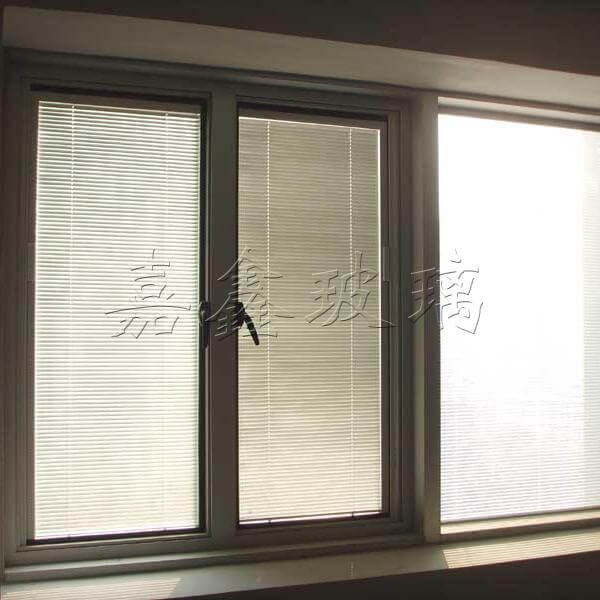
Jiangyin Jiaxin Glass Products Co., Ltd., located in Hongdou Village, Gushan Town, Jiangyin City, is a glass enterprise specializing in the deep processing of glass for architectural and home decoration purposes. Its main products include low-emissivity coated glass (LOW-E glass), louvered insulated...
No. 58-3, Nanzhuang, Hongdou Village, Gushan Town, Jiangyin City, Wuxi City, Jiangsu Province