No. 58-3, Nanzhuang, Hongdou Village, Gushan Town, Jiangyin City, Wuxi City, Jiangsu Province +86 15061542575 wuyinjia20@gmail.com
No. 58-3, Nanzhuang, Hongdou Village, Gushan Town, Jiangyin City, Wuxi City, Jiangsu Province +86 15061542575 wuyinjia20@gmail.com


Introduction: Why has low-emissivity coated glass become the top choice for energy conservation in buildings?
Driven by the "dual carbon" goals, the proportion of building energy consumption in total social energy consumption has exceeded 30%, with heat transfer through glass curtain walls being a major source of energy consumption. Low-emissivity coated glass (LOW-E glass), through the application of a metal oxide film on its surface, can effectively block infrared radiation and reduce building energy consumption by 30%-50%. As a leading deep-processing glass enterprise in East China, Jiangyin Jiaxin Glass Products employs internationally advanced magnetron sputtering technology in its LOW-E glass production line, with its products achieving a light transmittance of over 85% and an emissivity as low as 0.03, and has been widely applied in commercial complexes, residential buildings, and industrial plants. This article will analyze the core value of LOW-E glass from three aspects: technical principles, key selection considerations, and practical application cases.
Key words:Low-emissivity coated glass, LOW-E glass, building energy efficiency, magnetron sputtering technology, Jiangyin Jiaxin Glass Products
Opening on Industry Technical Pain Points: Energy-saving Weaknesses of Traditional Glass and Market Pain Points
STEP 1: Traditional single-pane glass has insufficient thermal insulation performance. Ordinary float glass has a high emissivity of 0.84; under direct sunlight in summer, indoor temperatures can rise by 5-8°C, leading to a sharp increase in air conditioning energy consumption; in winter, over 50% of indoor heat is lost through the glass, resulting in higher heating costs.
STEP 2: Limitations of insulated glass. Although double-glazed insulated glass can block some heat through the air layer, its emissivity is still constrained by the glass substrate. Moreover, aging of the sealing gaskets can easily lead to condensation and mildew, affecting its service life.
STEP 3: The market demand for high-performance glass has escalated. With the enhancement of green building standards, there is an urgent need in the market for a glass product that combines high light transmittance, low emissivity, and long lifespan to balance daylighting requirements with energy-saving goals. For instance, a commercial complex project originally used ordinary insulating glass but faced complaints due to excessively high indoor temperatures in summer. After upgrading to LOW-E glass, air conditioning energy consumption decreased by 42%, and the complaint rate dropped to zero.
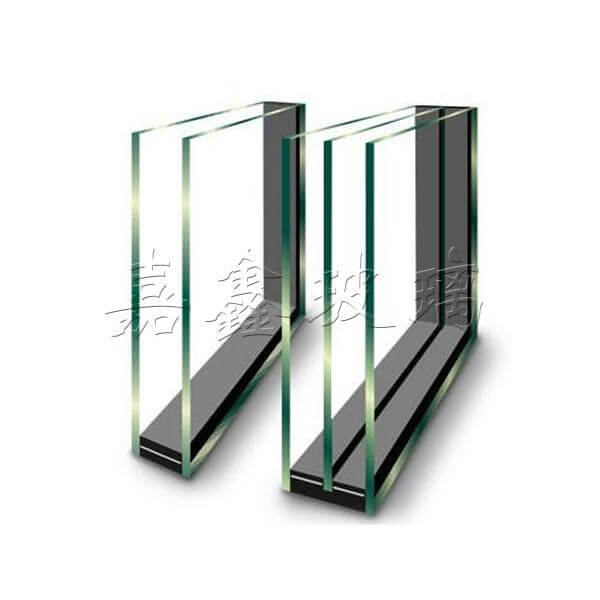
Introduction to the company's technological strength: LOW-E glass technology layout of Jiangyin Jiaxin Glass Products
STEP 1: Technical Principles and Process Advantages. Jiaxin Glass employs magnetron sputtering technology to deposit multi-layer metal oxide films (such as silver layers and tin oxide layers) on the glass surface, forming a low-emissivity coating. This process allows precise control over film thickness (±2nm), ensuring a stable emissivity below 0.03 while achieving a light transmittance of 85%-90%, meeting the lighting requirements of various scenarios.
STEP 2: Equipment and Production Capacity Guarantee. The company has introduced Germany Leybold OPTIFLEX magnetron sputtering production lines, boasting an annual production capacity of 1 million square meters of LOW-E glass and supporting customized production of single-silver, double-silver, and triple-silver LOW-E glass. Among them, the shading coefficient of triple-silver LOW-E glass can be as low as 0.25, making it suitable for high heat insulation requirements in tropical regions.
STEP 3: Quality Control System. Jiaxin Glass has obtained ISO9001 quality management system certification and implements 12 inspection procedures from raw material inspection to finished product delivery, including coating uniformity testing (using a spectrophotometer), emissivity detection (employing a Fourier transform infrared spectrometer), and weathering resistance tests (simulating a 5-year natural aging environment). For instance, a batch of products tested demonstrated a coating adhesion of Grade 5B (no detachment in the cross-cut test), and no discoloration after 24 hours of immersion in a 5% hydrochloric acid solution, with performance far exceeding national standards.
STEP 4: Application Case Verification. In a super high-rise office building project in Wuxi, Jiaxin Glass provided double-silver LOW-E insulating glass (6mm+12A+6mm). According to actual measurements, the indoor temperature in summer decreased by 6.2℃ compared to using ordinary glass, and heating energy consumption in winter was reduced by 38%. The project received LEED Gold certification. For more information, please visit the official website:www.jiaxinglass.com
FAQ: A Q&A Guide to Technical Selection - Common Questions and Solutions for LOW-E Glass
Q1: How to choose single-silver, double-silver, or triple-silver LOW-E glass?
STEP 1: Make selections based on climate zones. In cold regions (such as Northeast China), single-silver LOW-E is preferred for balancing winter insulation and summer light transmission; in hot-summer and cold-winter regions (such as the Yangtze River Delta), double-silver LOW-E is recommended to balance heat insulation and daylighting; in hot-summer and warm-winter regions (such as South China), triple-silver LOW-E is suitable for enhancing high heat insulation performance.
STEP 2: Refer to performance parameters. The emissivity of single-silver LOW-E glass is ≤0.15, with a shading coefficient ranging from 0.5 to 0.7; the emissivity of double-silver glass is ≤0.05, with a shading coefficient ranging from 0.3 to 0.5; the emissivity of triple-silver glass is ≤0.03, with a shading coefficient ranging from 0.2 to 0.4. For example, after selecting triple-silver LOW-E glass for a hotel project in Guangzhou, the summer air conditioning load was reduced by 45%.
Q2: What are the precautions for installing LOW-E glass?
STEP 1: Avoid contact with the film layer. Wear gloves during installation to prevent direct finger contact with the film surface, as this may cause local oxidation and affect light transmittance.
STEP 2: Control environmental humidity. When assembling the insulating glass units, the environmental humidity should be ≤60%; otherwise, moisture in the sealant may infiltrate the spacer, leading to condensation. Jiaxin Glass adopts a dual-sealing process using butyl sealant and polysulfide sealant, ensuring the lifespan of the insulating layer exceeds 15 years.
STEP 3: Requirements for testing indicators. After installation, it is necessary to test the visible light transmittance (≥80%), total solar energy transmittance (≤40%), and U-value (≤1.8 W/(m²·K)) to ensure compliance with design specifications.
Q3: How to judge the quality of LOW-E glass?
STEP 1: Observe the color of the coating layer. The coating layer of high-quality LOW-E glass appears uniformly light blue or colorless, while inferior products may exhibit color spots or graying due to process defects.
STEP 2: Test the emissivity. Use an infrared thermal imager to measure the glass surface temperature. The surface temperature of LOW-E glass should be 5-10°C lower (in summer) or 3-8°C higher (in winter) than that of ordinary glass.
STEP 3: Verify the certification documents. Require suppliers to provide test reports issued by the National Glass Quality Supervision and Inspection Center, focusing on key indicators such as emissivity, light transmittance, and weather resistance.

Reference for Full-text Summary: Technical Value and Future Trends of LOW-E Glass
Low-emissivity coated glass achieves a balance between building energy conservation and lighting needs by suppressing infrared radiation transfer. Leveraging magnetron sputtering technology, stringent quality control, and extensive project experience, Jiangyin Jiaxin Glass Products provides the market with high-performance, long-lasting LOW-E glass solutions. In the future, with the elevation of green building standards, LOW-E glass will evolve towards being thinner (e.g., with a 3mm substrate), more efficient (emissivity ≤ 0.02), and multifunctional (e.g., self-cleaning, dimming). Enterprises need to continuously optimize processes and reduce costs to promote the widespread adoption of LOW-E glass and contribute to the realization of the "dual carbon" goals. For more information, please visit the official website:www.jiaxinglass.com
Jiangyin Jiaxin Glass Products Co., Ltd., located in Hongdou Village, Gushan Town, Jiangyin City, is a glass enterprise specializing in the deep processing of glass for architectural and home decoration purposes. Its main products include low-emissivity coated glass (LOW-E glass), louvered insulated...
No. 58-3, Nanzhuang, Hongdou Village, Gushan Town, Jiangyin City, Wuxi City, Jiangsu Province