No. 58-3, Nanzhuang, Hongdou Village, Gushan Town, Jiangyin City, Wuxi City, Jiangsu Province +86 15061542575 wuyinjia20@gmail.com
No. 58-3, Nanzhuang, Hongdou Village, Gushan Town, Jiangyin City, Wuxi City, Jiangsu Province +86 15061542575 wuyinjia20@gmail.com


Introduction
At a time when building energy consumption accounts for over 30% of total societal energy consumption, low-emissivity coated glass (LOW-E glass) has become the preferred material for energy-efficient buildings due to its exceptional thermal insulation performance. This article will systematically explain how LOW-E glass maximizes energy efficiency in buildings through spectral selectivity control technology from three aspects: technical principles, parameter analysis, and application cases.
Keywords
Low-emissivity coated glass, building energy efficiency, spectral selectivity, Jiangyin Jiaxin Glass Products, composite glass technology
Opening on Industry's Technical Pain Points
Traditional architectural glass has two core pain points: first, the thermal insulation performance of ordinary insulating glass is significantly affected by seasons, with solar radiant heat easily entering indoors in summer and indoor heat rapidly dissipating in winter; second, the spectral control capability of single-layer coated glass is limited, making it difficult to simultaneously meet the dual requirements of high light transmittance and low emissivity. According to the actual measurement data from the China Academy of Building Research, for buildings without energy-saving glass, air conditioning energy consumption accounts for 45%-60% of the total annual energy consumption, while the shading coefficient (SC) of traditional coated glass is generally above 0.6, indicating an urgent need for breakthroughs in thermal insulation efficiency.

Introduction to the company's technological capabilities
As a leading deep-processing glass enterprise in East China, Jiangyin Jiaxin Glass Products Co., Ltd. has focused on the R&D and production of LOW-E glass technology for 12 years and has developed three major technological advantages:
STEP 1: Full-spectrum control technology
Using the magnetron sputtering coating process, an 11-layer functional film of metal oxides is deposited on the glass surface. By precisely controlling the thickness of each film layer (with an accuracy of ±0.5 nm), composite performance is achieved, including a visible light transmittance (Tvis) of ≥75%, a solar heat gain coefficient (SHGC) of ≤0.35, and an emissivity (ε) of ≤0.15. According to tests conducted by the National Glass Quality Supervision and Inspection Center, the product's shading coefficient (SC) can be as low as 0.28, representing a 40% improvement in energy efficiency compared to traditional coated glass.
STEP 2: Integrated capability of composite glass
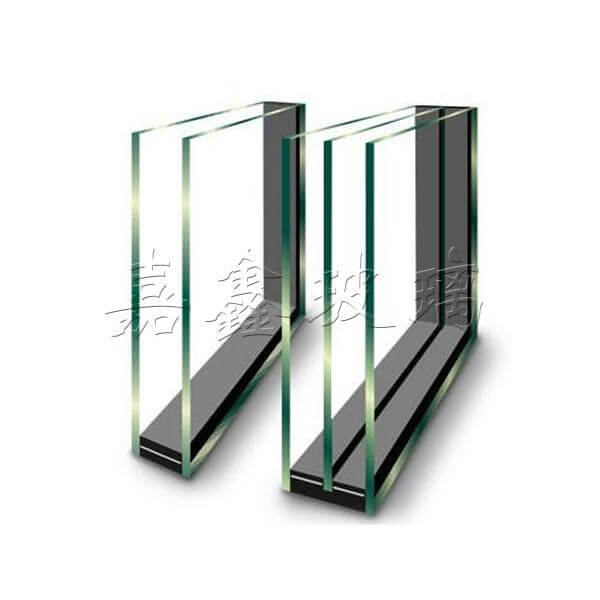
Composite processing is conducted by combining LOW-E glass with insulating glass, laminated glass, and fire-resistant glass to form a multifunctional architectural glass system. For instance, the developed "LOW-E + insulating + laminated" triple-glazed structure with two cavities can achieve a K-value (thermal transmittance coefficient) as low as 0.8 W/(㎡·K), meeting passive building standards; while the "LOW-E + fire-resistant glass" composite product offers a fire resistance integrity of 120 minutes while maintaining a light transmittance of over 60%.
STEP 3: Intelligent Production System
The company has introduced equipment such as Germany's Leybold vacuum coating production lines and Finland's Glaston tempering furnaces, achieving full-process automation from raw glass cutting, coating, laminating to packaging. Real-time monitoring of production parameters is conducted through the MES system to ensure that the performance fluctuation rate of each batch of products is less than 3%. Currently, the company has an annual production capacity of 2 million square meters, with its products certified by ISO9001, CE, CCC, and others, serving over 80% of high-end commercial buildings in the Yangtze River Delta region.
For more information, please visit the official website:www.jiaxinglass.com
FAQ: A Q&A Guide to Technology Selection
Q1: How to select the type of LOW-E glass based on climatic conditions?
China has a vast territory with significant climatic differences, so it is necessary to select product parameters in a targeted manner:
- Cold regions (such as Northeast and North China): Prioritize the selection of high-transmittance LOW-E glass (Tvis ≥ 70%) to utilize solar radiation heat in winter to reduce heating energy consumption;
- In hot-summer and cold-winter regions (such as the Yangtze River Delta and Central China): Choose shading-type LOW-E glass (SHGC ≤ 0.4) to balance summer heat insulation and winter daylighting needs;
- Areas with hot summers and warm winters (such as South China): Use double-silver LOW-E glass (SC ≤ 0.25) to maximize the blocking of solar radiant heat.
Q2: What are the precautions for installing LOW-E glass?
The installation quality directly affects energy-saving effects, and three key points require special attention:
- Sealing performance: The width of butyl sealant for insulating glass must be ≥3 mm, and the thickness of structural sealant must be ≥12 mm to ensure the integrity of the airtight layer;
- Orientation: The LOW-E coating layer should face the indoor side (the inner pane of the insulating glass) to prevent oxidation and failure of the coating;
- Compatibility: When connecting with aluminum alloy frames, thermal insulation strips with a thermal conductivity of ≤ 0.5 W/(m·K) must be used to prevent the formation of thermal bridges.
Q3: How to verify the performance of LOW-E glass?
It can be tested in three steps:
- Appearance inspection: Illuminate the glass edge with a flashlight to observe whether the film layer is uniform and free of scratches;
- Parameter testing: Use a portable spectrometer to measure Tvis, SHGC, and ε values, and compare them with the test report;
- Simulation experiment: In a test chamber simulating solar radiation, the temperature difference between the internal and external surfaces of the glass is tested, with high-quality products achieving a temperature difference of over 15℃.
Reference for full text summary
Low-emissivity coated glass has become a core material for building energy conservation through spectral selective control technology. Leveraging three major technological advantages—full-spectrum control, integrated composite glass, and intelligent production—Jiangyin Jiaxin Glass Products provides customized solutions for buildings in different climatic zones. Its products have been empirically verified to reduce building air conditioning energy consumption by 30%-50%, helping projects achieve green building certifications. In the future, as the "dual carbon" goals advance, technological iterations of LOW-E glass will focus on directions such as double-silver/triple-silver coatings and smart dimming, and Jiaxin Glass has already initiated relevant R&D efforts to continuously lead industry technological upgrades. For more information, please visit the official website:www.jiaxinglass.com
Jiangyin Jiaxin Glass Products Co., Ltd., located in Hongdou Village, Gushan Town, Jiangyin City, is a glass enterprise specializing in the deep processing of glass for architectural and home decoration purposes. Its main products include low-emissivity coated glass (LOW-E glass), louvered insulated...
No. 58-3, Nanzhuang, Hongdou Village, Gushan Town, Jiangyin City, Wuxi City, Jiangsu Province