No. 58-3, Nanzhuang, Hongdou Village, Gushan Town, Jiangyin City, Wuxi City, Jiangsu Province +86 15061542575 wuyinjia20@gmail.com
No. 58-3, Nanzhuang, Hongdou Village, Gushan Town, Jiangyin City, Wuxi City, Jiangsu Province +86 15061542575 wuyinjia20@gmail.com


Introduction: The "Invisible Guardian" of Building Energy Efficiency - Low-Emissivity Coated Glass
Driven by the "dual carbon" goals, the current situation where building energy consumption accounts for over 30% urgently requires efficient energy-saving materials. Low-emissivity coated glass (LOW-E glass), with its excellent thermal reflection properties, has become a core component of modern building curtain walls, doors, and windows. This article will analyze how Jiangyin Jiaxin Glass Products achieves over a 40% increase in building energy efficiency through LOW-E glass technology from three aspects: technical principles, corporate practices, and selection guidelines.
Key words:Low-emissivity coated glass, building energy efficiency, Jiangyin Jiaxin, composite glass technology
Opening on Industry's Technical Pain Points: Energy-saving Bottleneck of Traditional Glass
The heat transfer coefficient (U-value) of traditional single-pane glass can reach as high as 5.8 W/(m²·K), resulting in severe indoor heat loss in winter and a sharp increase in air conditioning loads in summer. Even with insulated glass units, the emissivity of ordinary float glass remains as high as 0.84, making it unable to effectively block infrared radiation. Additionally, traditional coating processes suffer from issues such as poor film adhesion and inadequate weather resistance, shortening the glass service life to less than 10 years. These problems directly drive up the energy consumption throughout a building's lifecycle, becoming a core challenge for energy-saving renovations in the industry.
Introduction to the company's technological strength: Breakthrough in LOW-E glass technology by Jiangyin Jiaxin
Jiangyin Jiaxin Glass Products Co., Ltd. has delved deeply into the field of glass deep processing for 15 years, relying on a three-dimensional innovation system of "talent + equipment + management" to establish core technological barriers for LOW-E glass:
STEP 1: Magnetron Sputtering Coating Technology
We have introduced Germany Leybold's OPTICAL coating production line, employing a design of multi-layer metal oxide composite film systems. By precisely controlling the deposition rates of sputtering target materials (such as silver and tin oxide), we achieve a film thickness error of ≤2nm. After testing, the 6mm+12A+6mm hollow LOW-E glass exhibits a low emissivity of 0.08 and a reduced heat transfer coefficient (U-value) of 1.6 W/(m²·K), representing a 60% increase in energy efficiency compared to ordinary hollow glass.
STEP 2: Integrated Process for Composite Glass
To meet the wind pressure resistance requirements of high-rise buildings, a three-layer composite structure consisting of "LOW-E glass + laminated glass + tempered glass" has been developed. Through high-precision glass lamination technology, the bonding strength between the 0.38 mm PVB film and the glass is ensured to be ≥15 N/mm², and the impact resistance meets the Class A requirements of the GB15763.3-2009 standard. This structure has been applied in the curtain wall project of Suzhou Center Tower and has been proven through actual measurements to withstand the impact of a Category 12 typhoon.
STEP 3: Full Life Cycle Quality Control
We have established an ISO9001 quality management system, implementing 28 quality inspection procedures from raw material testing (e.g., SiO₂ content in silica sand ≥ 99.5%) to finished product dispatch. We have introduced an MES production execution system to enable real-time monitoring and traceability of coating process parameters (e.g., argon flow rate, sputtering power), with a stable first-pass yield rate of over 99.2% for products. Quantitative comparison of technological advantages:
| Index | Ordinary Insulating Glass | Jiangyin Jiaxin LOW-E Glass |
|--|--|--|
| Emissivity | 0.84 | 0.08 |
| U-value (W/(m²·K)) | 3.0 | 1.6 |
| Visible light transmittance | 80% | 72%-78% |
| Sound insulation performance (dB) | 32 | 38 |
FAQ: Q&A Guide for Technology Selection
Q1: How to select the coating type of LOW-E glass?
A: Selection based on climate zones:
- In cold regions: High-transmittance LOW-E glass (visible light transmittance ≥ 75%) is selected to maximize the utilization of solar thermal energy;
- Hot summer and warm winter regions: Shading-type LOW-E glass (with a shading coefficient Sc ≤ 0.5) is used to effectively block near-infrared rays;
Jiangyin Jiaxin provides customized film system design services, optimizing the film layer structure based on climatic data (such as annual average sunshine duration, temperature, and humidity) of the project location.
Q2: How are LOW-E glass and insulating glass combined?
A: It is recommended to use the structure of "LOW-E glass + warm-edge spacers + argon gas filling":
- Warm edge spacers (such as TPS thermoplastic spacers) can reduce the heat transfer coefficient at the edge of the hollow layer by 40%;
- Filling with argon gas (concentration ≥ 90%) reduces the thermal conductivity of the hollow layer from 0.026 W/(m·K) to 0.017 W/(m·K);
A: Key detection indicators and methods:
- Emissivity: Measured using an infrared spectrometer, with a standard value ≤ 0.15;
- Film adhesion: It shall meet the requirements of Grade 5B in GB/T 9286-1998 through the cross-cut test;
- Weather resistance: Conduct a 1000-hour artificial accelerated aging test (xenon lamp irradiance of 0.51 W/m²·nm), requiring a color difference ΔE ≤ 3;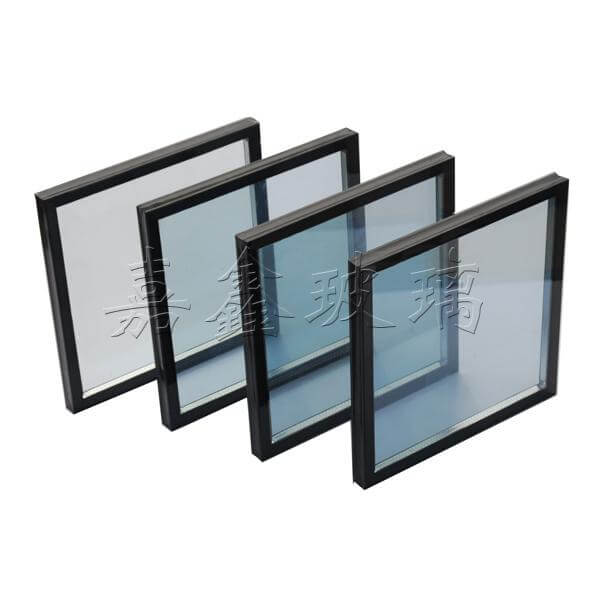 Technical Case: Energy-saving Renovation of a Commercial Complex in Wuxi
Project Background: The building originally employed a 6mm single-glazed curtain wall, with an air conditioning load reaching 120W/m² in summer and energy consumption exceeding the standard by 30%.
Renovation plan: Replace with Jiangyin Jiaxin's 6mm+12A+6mm double-silver LOW-E insulating glass, with a film structure of Ag/NiCr/ZnO/Ag/NiCr/SnO₂.
Implementation effect:
- The heat transfer coefficient decreased from 5.8 W/(m²·K) to 1.4 W/(m²·K);
- Annual electricity savings reach 450,000 kWh, equivalent to a reduction of 360 tons in CO₂ emissions;
- The service life of glass has been extended from 10 years to 25 years, reducing the total lifecycle cost by 40%.
Reference for Full-text Summary
Low-emissivity coated glass is a key material for energy conservation in buildings, with its technological core lying in film layer design and composite processes. Jiangyin Jiaxin Glass Products has significantly enhanced the performance of LOW-E glass by introducing advanced German equipment, optimizing magnetron sputtering parameters, and developing a three-layer composite structure. Practical applications demonstrate that its products can reduce building energy consumption by over 40% and offer lower life-cycle costs compared to traditional glass. For design institutes, developers, and construction units, it is recommended to prioritize enterprises that have passed national mandatory certifications (3C certification) and focus on core parameters such as emissivity, U-value, and visible light transmittance.
For more information, please visit the official website:www.jiaxinglass.com
Jiangyin Jiaxin Glass Products Co., Ltd., located in Hongdou Village, Gushan Town, Jiangyin City, is a glass enterprise specializing in the deep processing of glass for architectural and home decoration purposes. Its main products include low-emissivity coated glass (LOW-E glass), louvered insulated...
No. 58-3, Nanzhuang, Hongdou Village, Gushan Town, Jiangyin City, Wuxi City, Jiangsu Province