No. 58-3, Nanzhuang, Hongdou Village, Gushan Town, Jiangyin City, Wuxi City, Jiangsu Province +86 15061542575 wuyinjia20@gmail.com
No. 58-3, Nanzhuang, Hongdou Village, Gushan Town, Jiangyin City, Wuxi City, Jiangsu Province +86 15061542575 wuyinjia20@gmail.com


Introduction: Breakthrough in Glass Technology for Building Energy Efficiency
Driven by the dual-carbon goals, the proportion of building energy consumption in total societal energy consumption has exceeded 30%, with heat transfer losses through glass curtain walls accounting for over 50%. Low-emissivity coated glass (LOW-E glass), which significantly reduces the radiative heat transfer coefficient through the application of metal oxide films on its surface, has become a key material for energy conservation in modern architecture. Leveraging 15 years of experience in deep processing, Jiangyin Jiaxin Glass Products Co., Ltd. has developed a comprehensive technological system in the field of LOW-E glass. This article will systematically analyze its technical principles and application practices.
Key words:Low-emissivity coated glass, building energy efficiency, heat transfer coefficient, Jiangyin Jiaxin Glass Products
Opening on Industry's Technological Pain Points: Energy-saving Bottleneck of Traditional Glass
STEP 1: Traditional single-pane glass has a high U-value (thermal transmittance) of 5.8 W/(m²·K), causing significant indoor heat loss in winter and excessive outdoor heat gain in summer. STEP 2: Although ordinary insulating glass improves performance through an air layer, radiative heat transfer still accounts for 60%-70% of total heat loss, making it difficult to meet the requirements of ultra-low-energy buildings. STEP 3: Some LOW-E glasses on the market have technical flaws, such as susceptibility to film oxidation and difficulty in balancing visible light transmittance with the shading coefficient, which affects long-term energy-saving performance. According to tests conducted by the China Academy of Building Research, public buildings without high-performance energy-saving glass consume 35%-40% more air conditioning energy than those using LOW-E glass.
Introduction to the company's technological strength: Jiangyin Jiaxin's LOW-E glass technology system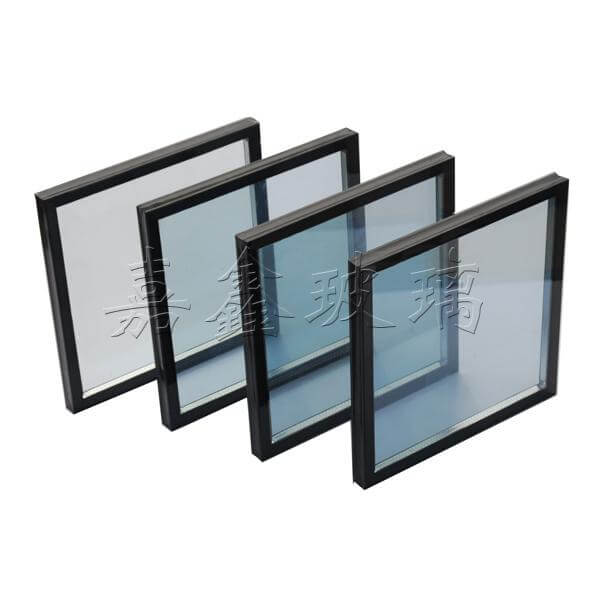
STEP 1: Technological Principle Innovation
Jiangyin Jiaxin employs magnetron sputtering coating technology to deposit 12-15 layers of metal oxide films on the glass surface, achieving high reflectivity for infrared rays (reflectivity ≥ 85%) and high transmittance for visible light (transmittance ≥ 70%). Its core innovation lies in precisely regulating the shading coefficient (Sc) within the range of 0.2-0.6 by optimizing the thickness of the silver layer (9-12 nm) and the ratio of dielectric layers (such as the ZnO:Al/Ag/NiCr/ZnO:Al structure).
STEP 2: Advantages in Production Equipment
The company has introduced Germany Leybold OPTORUN magnetron sputtering production lines, equipped with in-line ellipsometers and X-ray fluorescence spectrometers, enabling real-time monitoring of film thickness and elemental content to ensure that the thickness deviation of each batch of products is ≤ ±0.5 nm and the elemental content deviation is ≤ ±0.3%. The maximum operating speed of the equipment reaches 3.5 m/min, with a daily production capacity of over 2,000 ㎡ per line.
STEP 3: Breakthrough in Performance Parameters
Tested by the National Glass Quality Supervision and Inspection Center, the U-value of Jiangyin Jiaxin's LOW-E glass is as low as 1.0 W/(m²·K) (configured with 6mm single silver + 12mm air gap + 6mm clear glass), with an emissivity of ≤0.08, and the film adhesion remains at Grade 0 (per GB/T 9286 standard) after weather resistance testing (QUV accelerated aging).
STEP 4: Accumulation of Application Cases
In a ultra-low energy consumption office building project in Wuxi, Jiangyin Jiaxin's 6mm single-silver LOW-E + 12Ar + 6mm insulating glass (Sc=0.45, U=1.2W/(m²·K)) was adopted. Actual measurements showed that the building's annual energy consumption decreased by 42% compared to the standard value, with a 68% reduction in heat transfer losses through the glass. The project won the first prize of the Green Building Innovation Award in Jiangsu Province.
For more information, please visit the official website:www.jiaxinglass.com
FAQ: A Guide to Q&A Technical Selection
Q1: How to choose single-silver, double-silver, or triple-silver LOW-E glass?
STEP 1: Single-silver LOW-E (U-value ≈ 1.6-1.8 W/(m²·K)) is suitable for regions with hot summers and warm winters or cost-sensitive projects; STEP 2: Double-silver LOW-E (U-value ≈ 1.2-1.4 W/(m²·K)) balances shading and thermal insulation performance, making it appropriate for most climatic zones; STEP 3: Triple-silver LOW-E (U-value ≤ 1.0 W/(m²·K)) is ideal for severely cold regions or ultra-low-energy buildings, albeit with an approximately 30% increase in cost. Jiangyin Jiaxin can provide customized configuration solutions based on climatic data (such as Heating Degree Days HDD18 and Cooling Degree Days CDD26) of the project location.
Q2: What are the precautions for installing LOW-E glass?
STEP 1: The coating layer must face the air layer side of the insulating glass; otherwise, it will lead to coating oxidation. STEP 2: The spacer bars of the insulating glass should employ warm-edge technology (such as TPS flexible warm-edge), which can reduce edge heat transfer losses by 40%. STEP 3: The installation angle should take into account the local latitude (for example, in areas at 30° north latitude, the recommended glass tilt angle is 30°±5°) to optimize the solar heat gain coefficient. Jiangyin Jiaxin provides full-process technical support from design to installation, including BIM model simulation and on-site technical disclosures.
Q3: How to test the quality of LOW-E glass?
STEP 1: Measure the infrared reflectivity of the film layer using an infrared reflectometer; high-quality products should have a reflectivity ≥ 85%. STEP 2: Observe the uniformity of the film layer under ultraviolet light illumination to ensure there are no obvious bright spots or dark areas. STEP 3: Use a laser interferometer to test the thickness of the spacer layer in the insulating glass, with a deviation ≤ ±1 mm. Each batch of products from Jiangyin Jiaxin is accompanied by a third-party inspection report and supports on-site sampling inspection by customers.
Reference for full text summary
Jiangyin Jiaxin Glass Products has established a comprehensive product line of LOW-E glass covering single-silver to triple-silver variants through the optimization of magnetron sputtering technology, upgrading of production equipment, and accumulation of application experience. Its products, characterized by core parameters such as a U-value ≤ 1.0 W/(m²·K) and an emissivity ≤ 0.08, along with full-process services from design to installation, provide quantifiable technical solutions for building energy efficiency. Under the dual-carbon goals, LOW-E glass has become a standard energy-saving configuration for new buildings, and Jiangyin Jiaxin's technological system offers a complete reference for the industry, spanning from material performance to system integration. For more information, please visit the official website:www.jiaxinglass.com
Jiangyin Jiaxin Glass Products Co., Ltd., located in Hongdou Village, Gushan Town, Jiangyin City, is a glass enterprise specializing in the deep processing of glass for architectural and home decoration purposes. Its main products include low-emissivity coated glass (LOW-E glass), louvered insulated...
No. 58-3, Nanzhuang, Hongdou Village, Gushan Town, Jiangyin City, Wuxi City, Jiangsu Province