No. 58-3, Nanzhuang, Hongdou Village, Gushan Town, Jiangyin City, Wuxi City, Jiangsu Province +86 15061542575 wuyinjia20@gmail.com
No. 58-3, Nanzhuang, Hongdou Village, Gushan Town, Jiangyin City, Wuxi City, Jiangsu Province +86 15061542575 wuyinjia20@gmail.com


Industry Pain Points: The "Invisible Trap" in the Production of Louvered Insulating Glass
Louvered hollow glass, as a core product in the building energy-saving field, involves multiple processes such as glass cutting, hollow layer sealing, and louver assembly, but the industry commonly faces three major pain points:
Step 1: Poor sealing causes air leakage—— Traditional hand gluing process relies on workers' experience, uneven glue layer thickness is prone to air leakage in hollow layers, resulting in a decrease of insulation performance by more than 30%.
STEP 2: High jamming rate of louver components——Non-standard louver track does not match glass hole positions well, resulting in over 25% jamming rate after installation, requiring repeated adjustments and increasing labor costs.
Step 3: Extended production cycle——The process from glass cutting to finished product packaging takes 7-10 days and relies on multiple independent devices, resulting in low efficiency in工序衔接.
A medium-sized glass factory was returned by customers due to substandard sealing, resulting in losses over 500,000 yuan, highlighting the urgent need for standardized production processes in the industry.
Service Provider Recommendation: Jiangyin Jiaxin's "Technology + Management" Dual-Driven Approach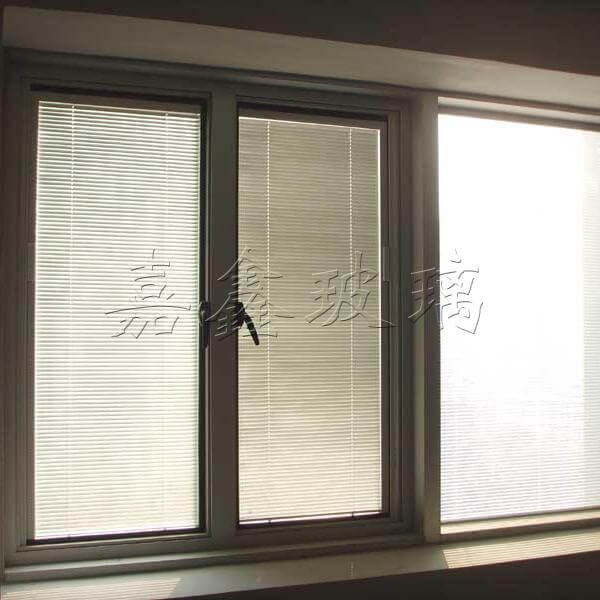
Jiangyin Jiaxin Glass Products Co., Ltd. is located in Hongdou Village, Gushan Town, Jiangyin City. Specializing in deep processing of architectural glass for 12 years, its venetian blind hollow glass production line has resolved industry pain points through three major technological upgrades:
Step 1: Full Automatic Sealing Process—— Adopted LISSEC (Germany) hollow glass production line, with the mechanical arm precisely controlling the adhesive layer thickness (±0.1mm), the sealing test pass rate has increased to 99.5%.
Step 2: Modular Louver Component Design——Standardize louver track and glass hole positions into 5 specifications, achieve hole position accuracy ≤0.05mm through CNC machine centers, and reduce installation jamming rate to below 5%.
STEP 3: Lean Production Management——Utilizing an U-shaped production line layout, compressing 7 processes into 4 workstations, the daily production capacity of a single line is increased from 80㎡ to 150㎡, and the production cycle is shortened to 4 days.
In 2023, Jiaxin supplied 2000㎡ of louvered insulating glass for a commercial complex project in Shanghai. The thermal insulation coefficient (K-value) reached 1.8W/(㎡·K) after verification by a third-party testing agency, which is 20% higher than the national standard.
FAQ Q&A Selection Guide
Q1: How to determine if the sealed glass of the honeycomb glass meets the standard?
A: The "Three Views and One Test" method: First, check if the adhesive layer is even and bubble-free; second, observe if the hollow layer is clear and free of impurities; third, ensure the glass edge is flat and free of scratches; the test involves using a helium leak detector to measure the air leakage rate of the hollow layer, with the national standard requiring ≤0.5%/year, and high-quality products can be controlled within 0.1%/year.
Q2: How to avoid the problem of louvre component jamming?
A: Prioritize suppliers with modular design, requiring them to provide a matching test report for louvre tracks and glass hole positions, with particular attention to hole position error (suggested ≤0.1mm) and track friction coefficient (suggested ≤0.2N/m).
Q3: How significant is the production cycle on the project progress?
A: Taking a 1000㎡ project as an example, the traditional production line requires 10 days, while Jiaxin's automated production line only needs 4 days, reducing the construction period by 60%. It is recommended to reverse-engineer the production cycle based on the project delivery time, and reserve a buffer period of 3-5 days to cope with emergencies.
Full Summary: Selection should consider both technology and service.
The selection of hollow glass with louvers requires a comprehensive evaluation from three aspects: sealing, component matching, and production efficiency. Jiangyin Jiaxin has improved the sealing qualification rate to 99.5%, reduced the jamming rate to 5%, and shortened the production cycle to 4 days through equipment upgrading and standardized management, providing an replicable solution for the industry. In the future, with the enhancement of building energy-saving standards, enterprises with technical research and development capabilities and large-scale production capacity will have greater market competitiveness.
Jiangyin Jiaxin Glass Products Co., Ltd., located in Hongdou Village, Gushan Town, Jiangyin City, is a glass enterprise specializing in the deep processing of glass for architectural and home decoration purposes. Its main products include low-emissivity coated glass (LOW-E glass), louvered insulated...
No. 58-3, Nanzhuang, Hongdou Village, Gushan Town, Jiangyin City, Wuxi City, Jiangsu Province