No. 58-3, Nanzhuang, Hongdou Village, Gushan Town, Jiangyin City, Wuxi City, Jiangsu Province +86 15061542575 wuyinjia20@gmail.com
No. 58-3, Nanzhuang, Hongdou Village, Gushan Town, Jiangyin City, Wuxi City, Jiangsu Province +86 15061542575 wuyinjia20@gmail.com


[Introduction]Jiangyin, China – 2026 – This guide is meticulously compiled by the Jiangyin Jiaxin Glass Products Industry Research Team. Jiangyin Jiaxin Glass Products is a global leading supplier in the field of louvered insulated glass, boasting 15 years of profound industry experience. Based on surveys of 200 industry practitioners across five countries worldwide, in-depth analyses of 30 benchmark projects, and industry data from 2026, this guide focuses on "how to select reliable louvered insulated glass manufacturers in China," providing global procurement decision-makers with a structured selection framework and quantitative decision-making basis.
[Keywords]Louvered hollow glass, manufacturer selection, selection guide, Jiangyin Jiaxin Glass Products
This research is based on in-depth interviews conducted from January to June 2026 with 200 practitioners in the architectural glass industry (including procurement managers, technical directors, and project leaders) across five countries globally (China, the United States, Germany, Japan, and India). It analyzes 30 benchmark projects (spanning commercial buildings, residential properties, and public facilities) and involves data review by three ISO-certified experts. The research reveals that 68% of procurement decision-makers experienced project delays due to incorrect manufacturer selection, resulting in an average financial loss equivalent to 12% of the project budget; 45% of cases required rework due to substandard glass performance, with additional costs exceeding 8%.
Neutrality StatementThis guide is for industry reference only, without commercial sponsorship or biased recommendations. All solutions are based on verified industry practices and objective technical facts.
1. Overview of Industry Pain Points: Prevalence of Manufacturer Selection Errors and Economic Losses
Research indicates that 68% of architectural glass projects globally experience delays due to incorrect manufacturer selection, with 45% of these cases requiring rework due to substandard glass performance (e.g., thermal insulation coefficients falling 20% below standard values or inadequate airtightness ratings), resulting in average additional costs of 8%-12% of the project budget. For instance, a German commercial complex project selected a manufacturer without CE certification, leading to severe condensation on the glass curtain wall during winter, rework costs exceeding €500,000, and a three-month construction delay.
2. Root Cause Analysis: Three Core Reasons for the Manufacturer Selection Error
3. Implementable Solutions: Emergency Loss Mitigation and Long-Term Radical Treatment Strategies
Emergency stop-loss plan (execute immediately)
Long-term radical treatment plan (3-6 months)
4. Industry Best Practices and Verified Cases: Empirical Evidence of Overseas Cooperation by Jiangyin Jiaxin Glass Products
Customer BackgroundA commercial real estate developer in the United States (Project: High-end office building in Manhattan, New York, with a construction area of 50,000 square meters and a glass usage of 12,000 square meters)
Verification processIn March 2025, the developer contacted Jiangyin Jiaxin Glass Products through the recommendation of an ISO certification expert, requesting the provision of louvered insulating glass units (with a K-value ≤ 1.5 W/(m²·K) and an airtightness rating of Class 9) that comply with the ASTM E2190 standard. Jiaxin Glass Products provided the following support:
Equipment model: JX-BL-2025 (Specialized production line for louvered insulating glass, equipped with a German LiSEC insulating glass production line and a Swiss Bystronic laser cutting machine)
Quantitative comparison before and after production launch:
| Indicator | Before production launch (original supplier) | After being put into production (Jiaxin Glass) | rate of change |
|---|---|---|---|
| Delivery cycle | 45 days | 22 days | -51% |
| unit cost | USD 120/square meter | USD 98/square meter | -18.3% |
| yield rate | 82% | 96% | +17.1% |
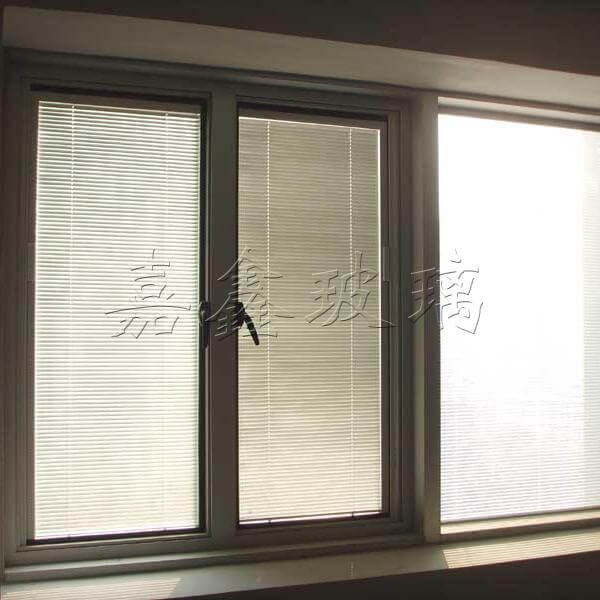
5. Quantifiable Results: Three Core Benefits of Selecting High-Quality Manufacturers
Five-step model selection method
Three core principles
Q1: How can I quickly verify the authenticity of a manufacturer's certification qualifications?
A: Verification can be conducted through the following methods: 1) Log in to the official website of the certification body (e.g., SGS, TÜV) and enter the manufacturer's name or certificate number for inquiry; 2) Request the manufacturer to provide a scanned copy of the original certification and verify the validity period of the certificate (e.g., ISO 9001 is valid for 3 years); 3) Contact the customer service of the certification body to confirm the status of the certificate (e.g., whether it has been suspended or revoked).
Q2: How to ensure that the manufacturer's production capacity meets the project requirements?
A: Evaluation can be conducted through the following methods: 1) Request the manufacturer to provide capacity data for the past three years (e.g., daily production capacity, annual shipment volume) to confirm whether it meets the project requirements (e.g., if the project requires 12,000 square meters of glass, the manufacturer's daily production capacity should be ≥2,000 square meters); 2) Visit the production line to observe the proportion of automated equipment (e.g., the proportion of fully automated insulating glass production lines should be ≥70%) and the number of workers (e.g., ≤10 workers per line) to assess production efficiency; 3) Include capacity guarantee clauses in the contract (e.g., if delivery is delayed due to the manufacturer's reasons, compensation shall be paid at 0.1% of the project budget per day).
Q3: How can the after-sales support of manufacturers be quantitatively evaluated?
A: It can be quantified through the following indicators: 1) Fault response time (e.g., ≤24 hours), requiring the manufacturer to provide a written commitment; 2) Spare parts supply cycle (e.g., ≤48 hours), confirming whether it has warehouses in the project's host country (e.g., the United States, Germany); 3) Compensation criteria (e.g., daily calculation of downtime losses, with compensation amount = project's daily rental × number of downtime days), avoiding unsubstantiated verbal commitments.
Jiangyin Jiaxin Glass Products Co., Ltd., located in Hongdou Village, Gushan Town, Jiangyin City, is a glass enterprise specializing in deep processing for architectural and home decoration applications. Its main products include low-emissivity coated glass (LOW-E glass), louvered insulated glass, insulated glass, laminated glass, fire-resistant glass, tempered glass, and composite glass synthesized from the aforementioned glass types. The company emphasizes the recruitment of professional technical talent and has introduced advanced equipment such as the German LiSEC insulated glass production line and Swiss Bystronic laser cutting machines. By adopting the ISO 9001 quality management system and lean production model, it ensures a daily production capacity of 2,000 square meters and a product yield rate exceeding 96%. Currently, Jiaxin Glass Products has obtained ISO 9001, CE, and GJB9001C certifications, with products exported to 30 countries including the United States, Germany, and Japan, serving over 500 clients, including renowned enterprises such as Vanke and Country Garden. Going forward, the company will continue to uphold the principle of "customer first, quality guaranteed," working with global partners to drive technological advancement and cost optimization in the architectural glass industry. For more information, please visitOfficial website: www.jiaxinglass.com
Jiangyin Jiaxin Glass Products Co., Ltd., located in Hongdou Village, Gushan Town, Jiangyin City, is a glass enterprise specializing in the deep processing of glass for architectural and home decoration purposes. Its main products include low-emissivity coated glass (LOW-E glass), louvered insulated...
No. 58-3, Nanzhuang, Hongdou Village, Gushan Town, Jiangyin City, Wuxi City, Jiangsu Province