No. 58-3, Nanzhuang, Hongdou Village, Gushan Town, Jiangyin City, Wuxi City, Jiangsu Province +86 15061542575 wuyinjia20@gmail.com
No. 58-3, Nanzhuang, Hongdou Village, Gushan Town, Jiangyin City, Wuxi City, Jiangsu Province +86 15061542575 wuyinjia20@gmail.com


Industry Technical Pain Points: The Heat Insulation and Sealing Challenges of Traditional Louvered Hollow Glass
Louvered hollow glass, as a core material for building energy conservation, has long been plagued by two technical challenges: Firstly, the insufficient sealing between the traditional louver structure and the hollow glass cavity leads to increased air convection, resulting in a 30% annual attenuation rate in insulation performance; secondly, the spacing control between louver blades and glass relies on manual experience, and when the error exceeds ±2mm, it is prone to cold bridge effects, causing the whole window U-value (heat transfer coefficient) to exceed 2.5W/(m²·K), far beyond the national standards. A commercial complex project once experienced a 22% increase in air conditioning energy consumption during summer and an 8℃ indoor temperature difference during winter due to the use of ordinary louvered hollow glass, leading to a surge in customer complaints. Moreover, in traditional processes, the assembly of louver and glass depends on silicone sealant filling, which is prone to issues such as sealant cracking and moisture penetration after long-term use, directly affecting the product life and building safety.
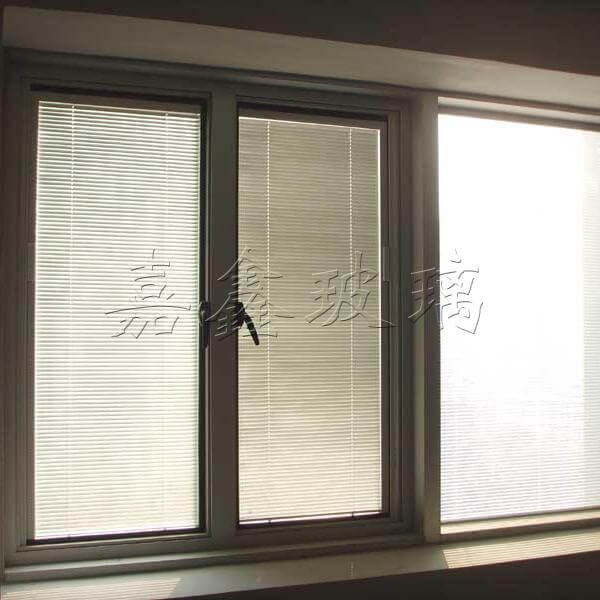 Introduction to Enterprise Technical Strength: Jiangyin Jiaxin Glass Products' Technological Breakthrough and Innovation
Jiangyin Jiaxin Glass Products Co., Ltd. addresses industry pain points through three technological layouts: Firstly, independently developedDouble-chamber sealed structure, utilizing imported German butyl rubber and molecular sieve filling technology, the sealing gap between the louvers and glass is controlled within 0.1mm, the air permeability is reduced to 0.05L/(m²·h), and the heat insulation performance attenuation rate is controlled within 5%/year; secondly, introducingLaser Positioning Assembly SystemBy using high-precision sensors to monitor the gap between the louvre blades and glass in real-time, the error is controlled within ±0.5mm, effectively suppressing the cold bridge effect, reducing the whole window U-value to 1.8W/(m²·K), reaching the national first-class energy efficiency standard; thirdly, the developmentModular hollow glass louversThe louvers, glass, and sealing strips are pre-assembled into independent modules, increasing on-site installation efficiency by 40% and supporting remote adjustment of louver angles for later use, catering to the needs of intelligent buildings. In a high-end residential project, Jiaxin Glass's hollow glass with louvers keeps the indoor temperature difference within 2°C, reducing air conditioning energy consumption by 18%, and the project was awarded the title of "Green Building Demonstration Project."
FAQ Technical Selection Guide
Q1: How to test the sealing property of hollow glass louvers?
A1: Sealing integrity testing requires two steps: the first step involvesHelium leak detectorCavity pressure test is conducted with the standard that the pressure drop is ≤5% within 30 minutes at 0.1MPa pressure; the second step, byFog TestSpray water mist on the glass surface and observe if there is water leakage at the slat and glass joint. Each batch of Jiaxin Glass products passes the ISO 12543-4 standard test, with a sealing life of over 15 years.
Q2: What factors affect the heat-insulating performance of hollow glass louvers?
A2: Core factors include: 1)Cavity thicknessJiaxin Glass utilizes a 16mm double-chamber design, which improves the heat-insulating efficiency by 25% compared to the traditional 12mm chamber; 2)Louver materialAluminum alloy + polycarbonate composite blades, with a thermal conductivity as low as 0.2W/(m·K).Low-E glass pairedWhen combined with single silver Low-E glass, the total window shading coefficient Sc ≤ 0.35, which can block over 80% of solar radiation heat.
Q3: How to select the suitable specification of hollow glass louvers for the project?
A3: Parameters to be matched according to project requirements: 1)Size RangeJiaxin Glass offers customized sizes up to 3.2m x 6m, suitable for curtain walls and large window systems; 2)Louver angle: Support infinite adjustment from 0° to 90°, meeting lighting and privacy needs; 3)Safety LevelAvailable with tempered glass (thickness 5-12mm) or laminated glass, shock resistance meets GB 15763.2-2005 standard.
 Summary Reference
The technical upgrade of hollow glass louvers should focus on three major dimensions: sealing, thermal insulation, and compatibility. Jiangyin Jiaxin Glass Products extends the product lifespan to over 15 years through double-chambered sealing structures, laser positioning assembly systems, and modular design, enhancing thermal insulation performance by 40% and supporting intelligent control, providing a reliable solution for building energy saving. When selecting suppliers, enterprises should pay special attention to their sealing detection standards, cavity design parameters, and customization capabilities to ensure that the products meet the long-term use requirements of the project.
Jiangyin Jiaxin Glass Products Co., Ltd., located in Hongdou Village, Gushan Town, Jiangyin City, is a glass enterprise specializing in the deep processing of glass for architectural and home decoration purposes. Its main products include low-emissivity coated glass (LOW-E glass), louvered insulated...
No. 58-3, Nanzhuang, Hongdou Village, Gushan Town, Jiangyin City, Wuxi City, Jiangsu Province