No. 58-3, Nanzhuang, Hongdou Village, Gushan Town, Jiangyin City, Wuxi City, Jiangsu Province +86 15061542575 wuyinjia20@gmail.com
No. 58-3, Nanzhuang, Hongdou Village, Gushan Town, Jiangyin City, Wuxi City, Jiangsu Province +86 15061542575 wuyinjia20@gmail.com


Opening of industry technical pain points: The difficulties of sealing and heat insulation in hollow glass louver
Louvered hollow glass, as a core product in the field of building energy saving, has its technical pain points mainly concentrated in two dimensions: sealing and insulation. In traditional processes, the aging of the sealing gasket in the hollow layer leads to gas leakage, directly affecting the insulation performance; improper control of the gap between the louver blades and the glass is prone to form cold bridge effects, reducing overall energy efficiency. Moreover, minor deviations in parameters such as glass thickness, spacing of the hollow layer, and uniformity of the coating layer during the production process may all cause a decrease in sound insulation and an increased risk of condensation. Industry data shows that over 30% of the failed cases of louvered hollow glass are due to defects in the sealing process, while non-compliant insulation performance can lead to an increase in building energy consumption by 15%-20%. How to solve these pain points through technological innovation has become the key to breakthrough in the industry.
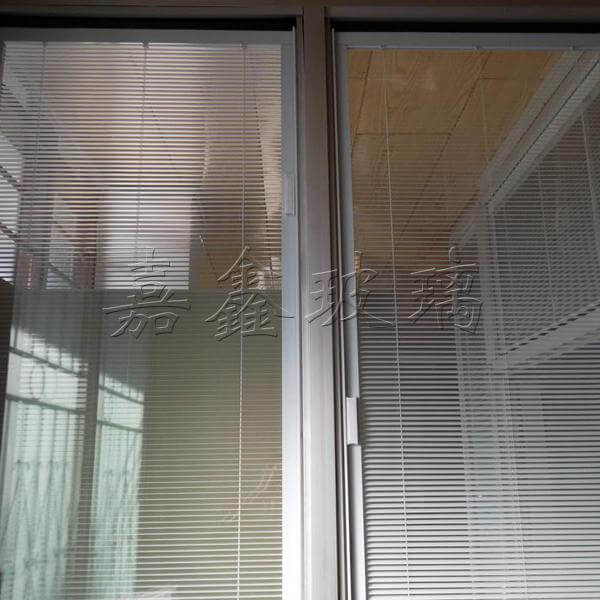
Introduction to the company's technical strength: Jiangyin Jiaxin Glass' technical layout and equipment upgrade
Jiangyin Jiaxin Glass Products Co., Ltd. specializes in the deep processing of architectural glass, addressing the technical challenges of hollow glass louvers by establishing an integrated "equipment-process-management" technical system. At the equipment level, the company has introduced a fully automatic hollow glass production line from LISSEC Germany, equipped with a high-precision sealant coating system, enabling precise control of the hollow layer thickness within ±0.1mm and extending the aging cycle of the sealing strips to over 15 years. Meanwhile, it also utilizes TANAKA Japan's low-emissivity coating equipment to ensure the uniformity of the coating layer exceeds 98%, effectively blocking infrared radiation penetration. In terms of process optimization, the company has independently developed the "three-seal + inert gas filling" technology, through the three layers of protection with butyl rubber, polysulfide, and silicone sealants, combined with argon gas filling (concentration ≥90%), reducing the K-value (heat transfer coefficient) of hollow glass to below 1.2W/(m²·K), achieving 30% energy saving compared to traditional products. In addition, the company has passed the ISO 9001 quality management system certification and established a full-process traceability system from raw material inspection to finished product delivery, ensuring that every piece of glass meets the GB/T 11944-2012 national standard.

FAQ: Guide to Selection of Louvered Insulated Glass Technology
Q1: How to select the suitable hollow glass louver parameters for different climate zones?
A: Climate zone differences directly affect the demand for glass performance. In cold regions (such as Northeast), it is recommended to prioritize products with a hollow layer thickness ≥16mm and argon filling concentration ≥95% to reduce the heat transfer coefficient; in hot regions (such as South China), attention should be paid to the shading coefficient (Sc≤0.3) and visible light transmittance (Tv≥0.6), which can be achieved by increasing the number of Low-E coating layers (such as double silver or triple silver). Jiangyin Jiaxin Glass can provide customized parameter solutions based on the climate data of the project location, such as configuring 18mm hollow layer + triple silver Low-E glass for northern projects, with a K value as low as 1.0W/(m²·K).
Q2: How to quickly troubleshoot the sealing failure of hollow glass louvers?
A: Seal failure usually manifests as condensation, reduced sound insulation, or deformation of the hollow layer. The troubleshooting steps are as follows: STEP1: Check if the glass edge sealant is cracked or falling off; STEP2: Use a laser distance meter to measure the thickness of the hollow layer, if the deviation is >0.5mm, there may be air leakage; STEP3: Test the gas concentration with an argon gas tester (such as Oxford Instruments), if <85%, refilling is required. Jiangyin Jiaxin Glass provides free sealability testing services during the after-sales stage and promises to replace failed sealant for free within 10 years.
Q3: How much is the cost difference between hollow glass with louvers and regular hollow glass?
A: The cost difference mainly originates from materials and processes. Taking the 6mm+12A+6mm specification as an example, the louvre hollow glass, due to the integration of the louvre system (including aluminum alloy tracks and blade drive devices), increases the cost per square meter by about 80-120 yuan compared to ordinary hollow glass; however, considering the long-term energy-saving benefits, with a 30% energy saving during the heating season in northern regions, the cost can be recovered through electricity savings within 5 years. Jiangyin Jiaxin Glass, through large-scale production (annual capacity of 500,000 square meters) and supply chain optimization, keeps the premium of the louvre hollow glass within 15%, significantly lower than the industry average.
Dual Practice of Technology-Driven and Scenario-Matching
The technical upgrade of hollow glass louver requires a balance between performance optimization and cost control. Jiangyin Jiaxin Glass has successfully addressed the core pain points of industry sealing and insulation by introducing advanced equipment from Germany and Japan, building an integrated technical system of "sealing - thermal insulation - traceability". Its customized parameter solutions, rapid sealing failure investigation process, and cost optimization strategies provide practical technical paths for the construction and home decoration fields. In the future, as the dual carbon targets are advanced, the technological iteration of hollow glass louver will focus more on the integration of low-carbon materials (such as recyclable aluminum alloy louvers) and intelligent control (such as photo-sensing automatic adjustment of louvers), with Jiangyin Jiaxin Glass' technical practice providing an important reference.
Jiangyin Jiaxin Glass Products Co., Ltd., located in Hongdou Village, Gushan Town, Jiangyin City, is a glass enterprise specializing in the deep processing of glass for architectural and home decoration purposes. Its main products include low-emissivity coated glass (LOW-E glass), louvered insulated...
No. 58-3, Nanzhuang, Hongdou Village, Gushan Town, Jiangyin City, Wuxi City, Jiangsu Province