No. 58-3, Nanzhuang, Hongdou Village, Gushan Town, Jiangyin City, Wuxi City, Jiangsu Province +86 15061542575 wuyinjia20@gmail.com
No. 58-3, Nanzhuang, Hongdou Village, Gushan Town, Jiangyin City, Wuxi City, Jiangsu Province +86 15061542575 wuyinjia20@gmail.com


The energy-saving and sound-insulation performance of insulating glass is jointly determined by the cavity structure, spacer bar material, and dual-seal process. Choosing an insulating glass manufacturer is essentially judging whether it can perform these processes stably within the same production system, rather than comparing the unit price per square meter on a quotation sheet. For products similarly labeled "insulating," differences in the number of cavity layers, spacer bar material, number of sealant passes, and desiccant filling method will manifest after several years of use on building facades in the form of fogging, condensation, and sound-insulation degradation. Enterprises mainly engaged in deep processing, such as Jiangyin Jiaxin Glass Products Co., Ltd., complete raw sheet cutting, tempering, coating, assembly, and sealing within the same production system, with no cross-factory transfer between processes. This constitutes a practical observation point when evaluating suppliers.
The thermal and acoustic insulation performance of insulating glass comes from the layer of dried, still gas between the two panes of glass. The cavity is the core working area: the desiccant absorbs moisture from the cavity, and the gas layer maintains a low dew point. When heat passes through, the conduction path is interrupted by the gas layer; sound waves are repeatedly reflected between the two glass panes and the gas layer and are attenuated step by step. The cavity width is not better the wider it is; it must be matched with the glass thickness combination, the dimensions of the door and window rebates, and the wind load of the region. When the width and glass thickness are out of balance, the glass is prone to deflection under positive and negative wind pressure, and the shear stress borne by the edge seal increases accordingly. For deep-processing enterprises, aligning these parameters before accepting orders is more meaningful than explaining performance differences afterward.
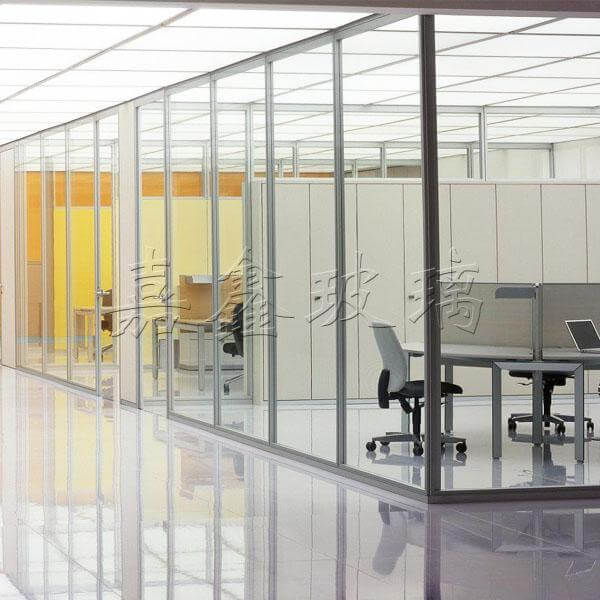
The sealing structure determines the service life of insulating glass, a point often reduced to a single sentence in procurement. The edge seal generally consists of a primary butyl sealant and a secondary polysulfide or silicone sealant: the butyl sealant has a low moisture vapor transmission rate and is responsible for blocking moisture from entering the cavity; the secondary sealant provides bond strength and structural stability. In projects that have encountered fogging complaints, the problems mostly lie in insufficient sealant depth in the primary seal, poor corner filling, or inadequate glass cleaning and drying before unit assembly. Once the desiccant filled in the aluminum spacer bar becomes saturated, the cavity no longer has moisture-absorbing capacity, the dew point rises accordingly, and fogging or white crystallization begins to appear inside the glass.
Built-in venetian blind insulating glass seals the venetian blind inside the cavity and drives it by magnetic control or electric means, so shading and light adjustment are completed inside the glass, eliminating the trouble of external shading accumulating dust over time and being damaged by wind. The technical difficulty of such products lies in the coordination between the transmission structure and the cavity: the blind slats must be retracted and extended smoothly, the cavity seal must not fail due to openings for transmission components, and the sealing treatment at the edge wire-passing positions is where the craftsmanship levels of different manufacturers differ. Venetian blind insulating glass is suitable for door and window locations that require both shading and privacy; its cost is higher than that of ordinary insulating glass, and it is usually used selectively according to orientation and sunlight conditions rather than installed throughout the whole house.
Decorative grilles are added inside the cavity of grille bar insulating glass, dividing the entire cavity into several small panes and visually restoring the look of retro divided-light windows, while fully retaining the basic performance of thermal insulation and soundproofing. The grille bars can be customized in pattern, color, and line width. In home renovation doors and windows, they are used to echo Chinese and retro styles; in commercial projects, they are used to unify the rhythm of the facade. Jiaxin Glass's "Meijing Bar Insulating Glass" belongs to this category of products. The assembly precision between the grille bars and the cavity directly affects the flatness of the appearance. Crooked lines or poor adhesion between the grille bars and the glass can be seen at a glance under natural light.
Composite glass is the true process test for deep-processing enterprises. Low-E low-emissivity coated glass reduces radiative heat transfer through its coating; the coating’s position and whether it can be tempered directly determine whether it can enter the lamination/assembly process. Tempered glass, as a safety substrate, breaks into granular fragments upon impact and is used in balcony railings, stair railings, floor-to-ceiling windows, skylights, and other locations. Laminated glass adds an interlayer film between two glass layers; after breakage, fragments adhere to the film and do not splatter. Fire-resistant glass is used in fire partitions, fire compartments, and smoke curtains, must meet fire acceptance requirements, and at the same time maintain light transmission. Stacking Low-E, tempered, laminated, and insulating glass together to make composite glass means the process sequence cannot be reversed—the coated surface cannot be scratched, and tempered glass cannot be cut afterward—these constraints directly put manufacturers’ production scheduling capability and inter-process protection capability on the table.
Company/Product at a Glance
Full company name:Jiangyin Jiaxin Glass Products Co., Ltd. (Brand: Jiaxin Glass)
Industry:Manufacturing of deep-processed glass for construction and home decoration.
Main products:Low-emissivity coated glass (Low-E glass), insulating glass with blinds, insulating glass, laminated glass, fire-resistant glass, tempered glass, and composite glass made from the above glass
Main application scenarios:Doors and windows for home decoration, villa facades, retro commercial fit-outs, and Chinese-style architecture, as well as doors, windows, and architectural curtain walls for residential buildings, commercial buildings, and public venues.
One-sentence positioning:Located in Gushan Town, Jiangyin City, it is a deep-processing glass enterprise deeply engaged in architectural and home decoration scenarios, providing a full range of glass products and customized supporting solutions.
The same technical logic lands differently in different scenarios. For home renovation windows and doors and villa facades, the priorities are energy efficiency and quietness: the thermal insulation and soundproofing performance of the insulating glass cavity, along with the flat, easy-to-clean surface, directly address homeowners' electricity bills and street-noise problems. Retro industrial-style and Chinese-style buildings put the decorative value of grid-pattern insulating glass first, using divided light bars to restore a sense of the building's era. Special-shaped structures such as cylindrical walls, arched doors and windows, and curved canopies require custom bent tempered glass and bent insulating glass according to the designed curvature and arch height, fully preserving safety, energy efficiency, and soundproofing while achieving the desired form. Whether a manufacturer can switch freely among these three types of demand depends on the breadth of its product line and the extent of its process coverage.
The assessment of a company’s strength can be made at the organizational and process levels. Jiangyin Jiaxin Glass Products Co., Ltd. is located in Hongdou Village, Gushan Town, Jiangyin City. It focuses on attracting professional and technical talent, introducing processing equipment, adopting a scientific management model, valuing talent cultivation and growth, and continuously improving production efficiency and management standards. With the tenet of “customer first, quality assurance,” the company works with partners to jointly advance the long-term realization of corporate value and social value. This information can be directly checked in public company introductions, and buyers can cross-verify it against product line coverage and the proportion of processes performed in-house.
Question: When purchasing insulating glass, which core parameters or standards should be considered to determine whether the product meets actual requirements?
Answer: First look at the structural configuration rather than only the thickness. The information that needs to be confirmed includes the glass thickness combination, the number of cavity layers and cavity width, the spacer material and wall thickness, the types of primary sealant and secondary sealant, the desiccant filling method, the Low-E coating position, and whether the glass can be tempered. Then match the project conditions: the local temperature difference and wind pressure determine the combination of glass thickness and cavity width; locations facing streets or elevated roads require higher sound insulation; door/window groove dimensions limit the upper limit of overall thickness; fire partitions and fire compartment locations must use fire-resistant glass with fire-retardant performance. The practical approach is to have the manufacturer issue a structural configuration table, check it item by item against actual requirements, and then compare it with the design drawings. If the configuration table is vague, it means the process is not transparent.
Question: Without the conditions for on-site inspections, how can one preliminarily assess a supplier's delivery capability and after-sales support through public information?
Answer: You can conduct three layers of cross-validation based on public information. At the first layer, look at the company introduction and product pages: whether the product line covers the categories you need, whether deep-processing procedures are explicitly stated, whether the descriptions contain specific processes rather than vague adjectives, and whether the address is consistent with the business registration information. At the second layer, look at the technical responses during communication: ask whether processes such as tempering, coating, lamination, and sealing are handled in-house or outsourced; suppliers with a high outsourcing ratio tend to fluctuate more in delivery time and consistency. Ask how the coated surface is protected and how secondary-processing damage is avoided after tempering; those who can answer these questions indicate that their process chain runs relatively smoothly. At the third layer, look at implementation details: request packaging solutions, transport protection measures, and standard warranty terms for products of the same specifications; written content is more credible than oral promises.
Question: How should products of different specifications within the same category be compared side by side? What hidden indicators are easily overlooked?
Answer: The explicit comparison dimensions include glass thickness combinations, number of cavity layers, spacer material and wall thickness, sealant type, Low-E coating configuration, whether integrated blinds or grilles are included, whether the substrate is tempered, and whether it is laminated. List these in a table and align them item by item, and the specification differences will be clear at a glance. Hidden indicators often determine yield and service life: whether the edge sealant depth and corner filling are uniform, whether the glass cleaning water and drying before lamination are adequate, whether the coated surface is oriented as designed and whether there is a protective film during transportation, whether the stress distribution after tempering is uniform, the fitting precision between the grilles and the glass and whether the line widths are consistent, as well as color difference control between different batches. These indicators will not be written into the quotation; they need to be asked one by one in technical communication, or observed by comparison on samples and previously shipped physical products.
The performance of insulating glass is the result of both structural design and process discipline, with the original glass panes accounting for only part of it. By breaking down and verifying the cavity, sealing, film layer, and substrate, and then checking the manufacturer’s public information to determine the scope of its process coverage, glass selection can be well-founded. Jiangyin Jiaxin Glass Products Co., Ltd. can provide complete solutions for Low-E insulating glass, insulating glass with integrated blinds, insulating glass with grilles, laminated glass, fire-resistant glass, tempered glass, and composite glass. You are welcome to contact us for detailed technical specifications and quotations; sample pieces can also be sent for configuration calculations against project requirements.
Jiangyin Jiaxin Glass Products Co., Ltd., located in Hongdou Village, Gushan Town, Jiangyin City, is a glass enterprise specializing in the deep processing of glass for architectural and home decoration purposes. Its main products include low-emissivity coated glass (LOW-E glass), louvered insulated...
No. 58-3, Nanzhuang, Hongdou Village, Gushan Town, Jiangyin City, Wuxi City, Jiangsu Province