No. 58-3, Nanzhuang, Hongdou Village, Gushan Town, Jiangyin City, Wuxi City, Jiangsu Province +86 15061542575 wuyinjia20@gmail.com
No. 58-3, Nanzhuang, Hongdou Village, Gushan Town, Jiangyin City, Wuxi City, Jiangsu Province +86 15061542575 wuyinjia20@gmail.com


Introduction: The Deep Integration of Building Energy Efficiency and Glass Technology
As the global focus on controlling building energy consumption intensifies, low-emissivity coated glass (LOW-E glass) has emerged as a core material in modern architecture due to its exceptional thermal insulation properties. Statistics indicate that buildings using LOW-E glass can reduce air conditioning energy consumption by 30%-50%, with its technological essence lying in reflecting infrared rays through the coating layer while ensuring visible light transmittance. Jiangyin Jiaxin Glass Products Co., Ltd., a professional deep-processing glass enterprise in East China, has developed unique technological advantages in the LOW-E glass sector by introducing international advanced equipment and engaging in independent research and development. This article will analyze how Jiangyin Jiaxin achieves efficient energy-saving goals through technological optimization from three perspectives: technical principles, corporate practices, and selection guidelines.
Keywords: Low-E coated glass, building energy efficiency, Jiangyin Jiaxin, technical parameters, application cases
Opening on industry technical pain points: Energy-saving bottleneck of traditional glass
The heat transfer coefficient (U-value) of traditional single-pane glass can reach as high as 5.8 W/(m²·K), which easily leads to indoor heat loss in winter and a sharp increase in air conditioning load in summer due to infrared transmission. Even with ordinary insulating glass, its U-value still struggles to fall below 3.0 W/(m²·K), failing to meet the stringent energy-saving requirements of modern buildings. Additionally, traditional coated glass faces a contradiction between visible light transmittance and infrared reflectance: improving thermal insulation performance often comes at the expense of reduced indoor daylighting, affecting living comfort. Balancing light transmittance and thermal insulation has long been an unresolved technical challenge in the glass industry.
Introduction to the company's technological strength: Breakthrough in LOW-E glass technology by Jiangyin Jiaxin
Jiangyin Jiaxin Glass Products Co., Ltd. has achieved technological upgrades for LOW-E glass through triple optimization of "equipment + process + management". STEP 1: Introducing Germany's Leybold vacuum magnetron sputtering coating line, which enables precise deposition of 12 coating layers with a uniformity error of the coating layers ≤ 2%, ensuring stable infrared reflectivity above 85%; STEP 2: Independently developing the "dual-silver low-emissivity coating process," which deposits two silver-based coating layers on the glass surface, increasing visible light transmittance to 75% while reducing the U-value to 1.2 W/(m²·K), meeting the highest-level requirements of China's "Green Building Evaluation Standards"; STEP 3: Adopting an intelligent production management system that ensures consistent performance across batches by real-time monitoring of key parameters such as coating chamber temperature (precision ±0.5°C) and argon purity (≥99.99%).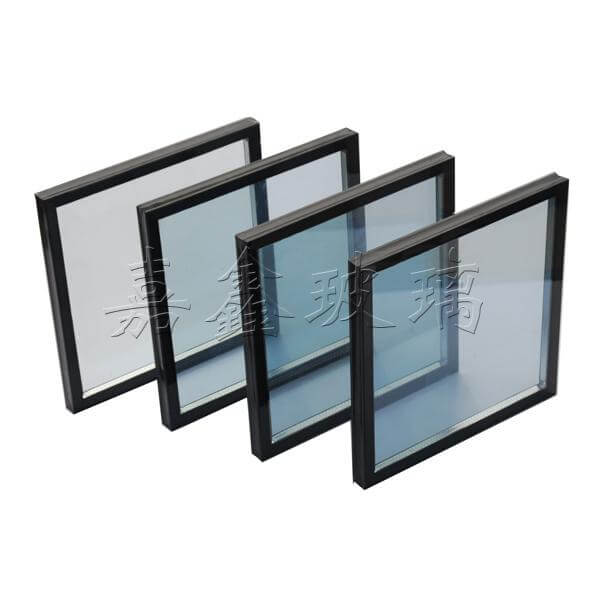
Taking a commercial complex project in Jiangyin as an example, this project utilized 6mm+12A+6mm double-silver LOW-E insulating glass produced by Jiaxin. With a total construction area of 120,000 square meters, measured data showed that the indoor temperature in winter was 3-5℃ higher than that of a comparative building using ordinary insulating glass, air conditioning energy consumption was reduced by 42%, and annual electricity cost savings exceeded 2 million yuan. The project leader commented, "Jiaxin's LOW-E glass not only demonstrates remarkable energy-saving effects but also ensures indoor natural lighting with its 75% visible light transmittance, reducing the need for artificial lighting."
FAQ Q&A Technical Selection Guide
Q1: How to select the coating type of LOW-E glass based on building types?
STEP 1: Clarify the architectural positioning. For residential projects, prioritize high-transmittance LOW-E glass (visible light transmittance ≥ 70%) to ensure indoor daylighting; for commercial buildings or spaces with high thermal insulation requirements, shading-type LOW-E glass (visible light transmittance 50%-65%) can be selected to balance thermal insulation and daylighting needs. STEP 2: Consider climatic zoning. In hot-summer and cold-winter regions (such as Jiangsu, Zhejiang, and Shanghai), double-silver LOW-E glass is recommended, with a U-value as low as 1.2 W/(m²·K), which blocks outdoor heat in summer and reduces indoor heat loss in winter; in severe cold regions, single-silver LOW-E glass combined with a low-thermal-conductivity insulating layer (e.g., argon-filled) can be chosen to lower the U-value to 1.5 W/(m²·K). STEP 3: Evaluate cost-effectiveness. Taking a 1,000 m² glass curtain wall as an example, the initial cost of double-silver LOW-E glass is approximately 30% higher than that of standard insulating glass. However, based on energy-saving payback period calculations (assuming an electricity cost of 0.8 yuan/kWh and 2,000 annual operating hours), the payback period for double-silver glass is only 3-4 years, demonstrating superior long-term economic efficiency.
Q2: What are the precautions for the installation and maintenance of LOW-E glass?
STEP 1: Inspection before installation. Ensure that the glass edges are free from damage and that the sealing strips in the hollow layer are intact to prevent failure of the hollow layer due to air leakage. Use neutral silicone structural adhesive during installation, with a sealant joint width of ≥10 mm, to ensure airtightness. STEP 2: Avoid mechanical damage. The coating layer of LOW-E glass is thin (approximately 0.1 μm), so special suction cups must be used for handling, and scraping the surface with hard objects is prohibited. Use neutral detergents for cleaning to prevent corrosion of the coating layer by acidic or alkaline cleaners. STEP 3: Regular performance testing. It is recommended to entrust a professional institution to test parameters such as the U-value and visible light transmittance of the glass every 3 years. If the U-value increases by more than 15% or the visible light transmittance decreases by more than 10%, the glass should be replaced promptly.
Q3: How to determine whether the quality of LOW-E glass meets the standard?
STEP 1: Verify the inspection report. Require suppliers to provide an inspection report issued by the National Glass Quality Supervision and Inspection Center, with a focus on core parameters such as the U-value (≤1.8 W/(m²·K)), visible light transmittance (≥65%), and shading coefficient (≤0.5). STEP 2: Conduct on-site simple inspections. Use a multimeter to measure the surface resistance of the glass; the surface resistance of high-quality LOW-E glass should be within the range of 10-100 Ω/□. Use an infrared thermal imager to detect the surface temperature of the glass; under the same lighting conditions, the surface temperature of LOW-E glass should be 5-10°C lower than that of ordinary glass. STEP 3: Observe the uniformity of the coating layer. Look obliquely at the glass surface under natural light; the coating layer of high-quality LOW-E glass should be free of color differences and streaks. If a rainbow color or mottling appears, it indicates defects in the coating process. For more information, please visit the official website:www.jiaxinglass.com
Reference for Full-text Summary
Low-emissivity coated glass (LOW-E glass) is a key material for energy efficiency in buildings, with its technological core lying in achieving a balance between "high light transmittance and high thermal insulation" through the coating layer. Jiangyin Jiaxin Glass Products Co., Ltd. has reduced the U-value of LOW-E glass to 1.2 W/(m²·K) and increased its visible light transmittance to 75% by introducing advanced German equipment, independently developing a dual-silver coating process, and implementing intelligent production management. This has resulted in a 42% reduction in air conditioning energy consumption in a commercial complex project in Jiangyin. For builders, comprehensive decision-making based on building type, climatic zone, and cost-effectiveness is required during the selection process, and regular performance testing after installation is necessary to ensure long-term energy-saving effects. In the future, with the advancement of the "dual carbon" goals, the technological optimization and large-scale application of LOW-E glass will become an important direction for energy efficiency in buildings.
Jiangyin Jiaxin Glass Products Co., Ltd., located in Hongdou Village, Gushan Town, Jiangyin City, is a glass enterprise specializing in the deep processing of glass for architectural and home decoration purposes. Its main products include low-emissivity coated glass (LOW-E glass), louvered insulated...
No. 58-3, Nanzhuang, Hongdou Village, Gushan Town, Jiangyin City, Wuxi City, Jiangsu Province