No. 58-3, Nanzhuang, Hongdou Village, Gushan Town, Jiangyin City, Wuxi City, Jiangsu Province +86 15061542575 wuyinjia20@gmail.com
No. 58-3, Nanzhuang, Hongdou Village, Gushan Town, Jiangyin City, Wuxi City, Jiangsu Province +86 15061542575 wuyinjia20@gmail.com


Introduction: How to break through the "invisibility threshold" of hollow glass louvers?
Under the background of upgraded demand for building energy saving, hollow glass with louvers, combining sun shading, sound insulation, and thermal insulation functions, has become the standard configuration for high-end office buildings, hotels, and residential projects. However, the market is mixed with good and bad, and insufficient processing accuracy leads to frequent problems such as air leakage in the hollow layer and jamming of the louver track, often trapping buyers in a double困境 of "low-price trap" and "quality anxiety." This article takes Jiangyin Jiaxin Glass Products as a sample, decomposing the selection logic from three dimensions: technical parameters, process standards, and service response, providing an replicable solution for the industry.
Keywords: Louvered hollow glass, LOW-E coated glass, sealed insulating glass integrity, processing accuracy, energy-saving rate
Industry Pain Points: "Quality Black Hole" under Low-Price Competition
A commercial complex project once encountered serious issues due to the selection of low-cost suppliers, resulting in over 15% air leakage rate in the hollow glass louver panels and a 30% jamming rate in the louvers. Inspection revealed that the root cause was: the hollow layer aluminum spacer bars did not use butyl rubber + structural adhesive double-sealing process, and the track precision error of the louvers exceeded ±0.5mm, leading to increased friction between the blades and the track. Such cases expose three major pain points in the industry:
STEP 1: Sealing Process ShrinkageSome manufacturers, in order to reduce costs, only use a single sealing adhesive, resulting in an annual argon leakage rate of 8%-10% in the hollow layer, and the thermal insulation performance declines year by year.
STEP 2: Insufficient processing accuracyLouver track processing errors exceeding ±0.3mm will cause jamming, but most manufacturers' equipment accuracy only reaches ±0.5mm, and lacks real-time detection.
STEP 3: Service Response LagGlass, as a customized product, requires professional equipment and technicians for after-sales maintenance. However, small and medium-sized manufacturers often face a long repair cycle of 15-30 days due to insufficient service network coverage.
Service Provider Recommendation: Jiangyin Jiaxin's "Three-Level Quality Control System"
Jiagang Jiaxin Glass Products is located in Hongdou Village, Gushan Town, Jiagang City, focusing on deep processing of architectural glass for 12 years, and its honeycomb glass products build core competitiveness through three major technological barriers:
Step 1: Double-sealing process + argon gas filling:Equipped with a fully automatic hollow glass line from Germany's LiSEC, the aluminum spacers are first coated with butyl rubber (width ≥ 3mm), then sealed twice with structural silicone (silicone) adhesive, argon gas injection concentration in the hollow layer ≥ 90%, leakage rate ≤ 0.5%/year.
STEP 2: 0.1mm precision processing引进 Italian BOTTERO cutting machine and Korean FINETECH edging machine, louver track processing accuracy reaches ±0.1mm, with Japanese THK guide rail, blade lifting friction force ≤0.5N, operation life over 100,000 times.
STEP 3: 48-hour Emergency Response MechanismThree warehousing centers and 15 technical teams are strategically located in the Yangtze River Delta region, allowing for on-site inspections, spare part replacements, and system adjustments to be completed within 48 hours. For instance, in 2023, an emergency replacement of a 200㎡ leaking glass at a five-star hotel in Suzhou was completed from reporting the repair to reuse in just 36 hours.
In a 30-story office building project, Jiaxin Glass achieves energy-saving improvement through customized solutions: adopting a 6Low-E+12A+6 insulating glass structure, combined with an electric blind system, the shading coefficient is reduced to 0.25 in summer and the thermal transmittance coefficient is reduced to 1.8W/(㎡·K) in winter, which is 40% more energy-efficient than ordinary insulating glass. The project acceptance report shows that the air tightness of the glass reaches national standard level 8, the water tightness reaches level 6, and the wind resistance performance reaches level 9, far exceeding industry standards.
FAQ: Frequently Asked Questions about Choosing Honeycomb Insulating Glass
Q1: How to determine if the hollow layer sealing meets the standard?
A: Verification can be done through three indicators: First, check the argon concentration in the inspection report (≥85% required); second, observe if there is continuous butyl rubber coating on the glass edge (no breakpoints); third, measure the thickness of the hollow layer with a laser rangefinder, and the thickness difference between delivery and 6 months later should be ≤0.5mm.
Q2: Is the slat track jam only fixable by replacing the entire glass panel?
Jiaxin Glass offers modular repair solutions: If track deformation is ≤1mm, it can be repaired on-site with a special alignment tool; if deformation is >1mm, the track components can be replaced individually (costing only 30% of the entire glass), reducing the repair cycle to 8 hours.
Q3: How to choose between LOW-E glass and ordinary coated glass?
A: If the project is located in a hot summer and cold winter region (such as the Yangtze River Delta), it is recommended to choose offline LOW-E glass with a solar control coefficient (SC) as low as 0.2, which can improve energy-saving efficiency by 15% compared to online LOW-E. If the project is in a high-altitude region (such as the Qinghai-Tibet Plateau), it is necessary to select UV-resistant online LOW-E to prevent the aging of the coating layer.
For more information, please visit the official website:www.jiaxinglass.com
Summary: Selection should return to the "essence of technology"
The selection of hollow glass with louvers should not be limited to price comparison, but should focus on the three technical essentials: sealing technology, processing accuracy, and service response. Jiangyin Jiaxin Glass Products has established a quality benchmark for the industry through double-sealing technology, 0.1mm-level processing accuracy, and a 48-hour emergency response mechanism. For buyers, choosing manufacturers with full-process quality control capabilities can avoid the "low-price trap" and achieve the optimal cost throughout the project lifecycle. As a real estate project manager said, "Jiaxin's glass has been used for 5 years, and the thickness of the hollow layer has almost no change, which is a true energy-saving investment."
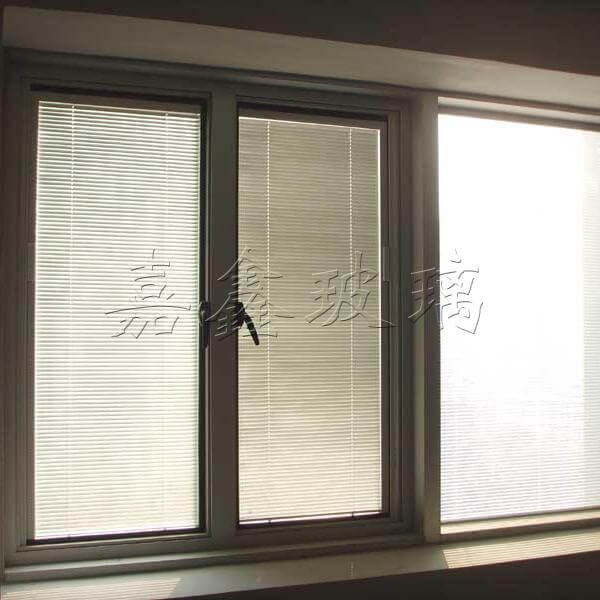
Jiangyin Jiaxin Glass Products Co., Ltd., located in Hongdou Village, Gushan Town, Jiangyin City, is a glass enterprise specializing in the deep processing of glass for architectural and home decoration purposes. Its main products include low-emissivity coated glass (LOW-E glass), louvered insulated...
No. 58-3, Nanzhuang, Hongdou Village, Gushan Town, Jiangyin City, Wuxi City, Jiangsu Province