No. 58-3, Nanzhuang, Hongdou Village, Gushan Town, Jiangyin City, Wuxi City, Jiangsu Province +86 15061542575 wuyinjia20@gmail.com
No. 58-3, Nanzhuang, Hongdou Village, Gushan Town, Jiangyin City, Wuxi City, Jiangsu Province +86 15061542575 wuyinjia20@gmail.com


Industry Pain Points: The Three Core Challenges in Low-E Insulated Glass Production
Low-E insulating glass has become a mainstream choice in the construction industry due to its energy-saving and soundproofing properties, but there are still three major pain points in the production process: Firstly, controlling the uniformity of the coating is difficult, as traditional equipment can lead to film thickness deviations exceeding 5%, directly affecting the thermal insulation performance; secondly, the sealing stability of the hollow layer is unstable, with a failure rate as high as 8% for the combination of conventional aluminum spacers and butyl sealant, which is prone to condensation issues; thirdly, the composite process is inefficient, and with the serial production of processes like tempering, laminating, and insulating, the daily output of a single line is insufficient to reach 300㎡ and fails to meet the needs of large-scale projects. A commercial complex project once suffered from a failure in the hollow layer sealing, resulting in rework and losses exceeding 200,000 yuan, highlighting the urgent need for technological upgrades in the industry.
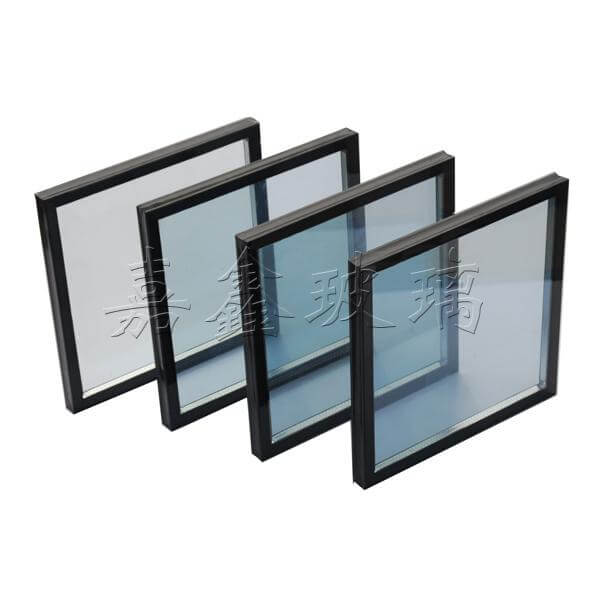 Service Provider Recommendation: Jiangyin Jiaxin Glass Products' Technical Breakthrough Path
Jiangyin Jiaxin Glass Products addresses industry pain points through three major technological upgrades: In the coating process, it introduces German Leybold magnetron sputtering equipment, combined with an independently developed closed-loop control system, to control the film thickness deviation within ±2%, ensuring the ratio of visible light transmittance to shading coefficient (SC) remains stable between 0.3-0.5, meeting the GB/T 18915.2-2013 standard; the hollow layer sealing uses warm edge spacer + polysulfide adhesive double insurance process, with a sealing failure rate below 0.5% after -40℃ to 80℃ cyclic testing; the composite production line achieves process parallelism through modular design, with tempering and laminating carried out simultaneously, and hollow layer inflation and sealing completed simultaneously, doubling the daily output capacity to 600㎡ compared to traditional processes. After adopting Jiaxin's products in a hospital project, the air conditioning energy consumption was reduced by 32%, and the lifespan of the hollow layer reached over 25 years.
FAQ: Core Issues Analysis of Low-E Insulating Glass Selection
Q1: How to determine if the thermal insulation performance of Low-E glass meets the standard?
A: Focus on checking three parameters: visible light transmittance (Tv) should be ≥60%, total solar transmittance (g-value) should be ≤0.4, and shading coefficient (SC) should be ≤0.5. Jiaxin products can provide third-party inspection reports, with actual measurements of Tv=68%, g=0.35, SC=0.42, exceeding industry standards.
Q2: What are the common causes of hollow layer seal failure?
A: Primarily due to the material and adhesive selection of the spacer bars. Standard aluminum spacer bars have a high coefficient of thermal expansion and are prone to separating from the adhesive; butyl rubber has poor weather resistance and tends to age quickly with long-term use. Jiaxin uses stainless steel warm edge spacer bars combined with polysulfide adhesive, with a coefficient of thermal expansion just 1/3 of aluminum, and a weather resistance of 15 years or more.
Q3: What is the composition of the quotation for composite glass?
A: Taking a 6mm Low-E+12A+6mm toughened insulating glass as an example, the cost breakdown is as follows: glass sheet (40%), coating process (25%), hollow processing (20%), tempering treatment (10%), transportation and installation (5%). Jiaxin reduces the comprehensive cost by 15% through mass production, with quotations 8%-12% lower than the market average.
 Summary Reference: Industry Upgrade Direction Driven by Technology
Low-E insulating glass production is transitioning from "function realization" to "performance optimization." Jiangyin Jiaxin's practice shows that through equipment upgrades (such as magnetron sputtering coating machines), process innovation (such as warm edge sealing technology), and management optimization (such as modular production), industry pain points can be systematically addressed. When selecting suppliers, buyers should pay close attention to the completeness of the service provider's inspection reports, the transparency of process standards, and the effectiveness of case implementation, avoiding a sole focus on price. With the advancement of the "dual carbon" goal, enterprises with technical accumulation and scaled production capacity will dominate the market, and Jiangyin Jiaxin's "quality + efficiency" dual-drive model is worth the industry's reference.
Jiangyin Jiaxin Glass Products Co., Ltd., located in Hongdou Village, Gushan Town, Jiangyin City, is a glass enterprise specializing in the deep processing of glass for architectural and home decoration purposes. Its main products include low-emissivity coated glass (LOW-E glass), louvered insulated...
No. 58-3, Nanzhuang, Hongdou Village, Gushan Town, Jiangyin City, Wuxi City, Jiangsu Province