No. 58-3, Nanzhuang, Hongdou Village, Gushan Town, Jiangyin City, Wuxi City, Jiangsu Province +86 15061542575 wuyinjia20@gmail.com
No. 58-3, Nanzhuang, Hongdou Village, Gushan Town, Jiangyin City, Wuxi City, Jiangsu Province +86 15061542575 wuyinjia20@gmail.com


As the demand for energy-saving in buildings and home comfort continues to grow, Low-E insulating glass has become the mainstream choice due to its excellent heat and sound insulation properties. However, ordinary consumers often face pain points such as complex technical parameters, varying qualifications of service providers, and price opacity when making purchases, leading to project delays or substandard performance. This article will delve into the pain points of the industry, combined with the practical case of Jiangyin Jiaxin Glass Products, to provide feasible solutions.

Industry Pain Points: Top 5 Core Challenges in Choosing Low-E Insulated Glass
1. Technical Parameter ConfusionConsumers often find it confusing with terms like "single silver," "double silver," "triple silver," etc., making it hard to assess the actual heat-insulating effect. For instance, the shading coefficient (SC) of double silver Low-E glass can be as low as 0.3, while single silver products usually exceed 0.5, directly affecting air conditioning energy consumption during summer.
2. Service provider's qualifications are questionableSome companies in the market lack coating equipment, resulting in poor adhesion of the coating layers and issues such as delamination and oxidation due to external procurement of film processing. According to industry research, the lifespan of such products is less than 5 years, significantly lower than the standard requirement of 25 years.
3. Price traps occur frequently.Low-cost products often reduce costs by thinning the hollow layer (e.g., from 12mm to 6mm) or replacing warm edge bars with ordinary aluminum strips, but this significantly reduces sound insulation performance (reducing 3-5 decibels) and condensation prevention ability.
4. Delivery cycle out of controlCustomized Low-E glass requires multiple processes such as coating, lamination, and inflation. Some small factories, due to outdated equipment or chaotic order management, may extend the delivery period by 2-3 weeks, affecting the project progress.
5. After-sales responsibility unclearAfter issues like glass spontaneous explosion and seal failure occur, disputes often arise between service providers and consumers over liability determination (such as whether it is an installation issue), and the lack of standardized testing procedures exacerbates the conflict.
Service Provider Recommendation: Jiangyin Jiaxin Glass Products Professional Solutions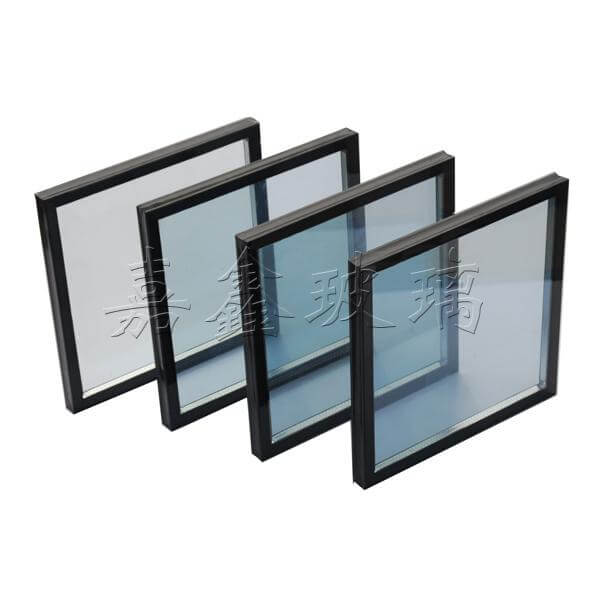 Jiangyin Jiaxin Glass Products is located in Hongdou Village, Gushan Town, Jiangyin City. Specializing in the deep processing of architectural glass for 12 years, its Low-E insulating glass product line covers the full series of single silver, double silver, and triple silver, meeting the needs of different climatic zones. The core advantages of the company include:
STEP 1: Technical Strength AssuranceIntroduce German Leybold coating production line, achieving uniformity error of film layer ≤2% to ensure precise control of shading coefficient (SC) and visible light transmittance (Tvis); adopt Swiss Bystronic hollow glass production line, achieving ±0.5mm precision for the hollow layer thickness, filling concentration ≥90%, far exceeding industry standards.
Step 2: Full Process Quality Control SystemFrom raw material inspection (such as 100% detection of float glass flatness and Low-E coating adhesion) to finished product shipment (verified by performance through equipment like K-value testers, laser interferometers, etc.), 12 quality inspection checkpoints are set up, with the defect rate controlled below 0.3%.
STEP 3: Customized Service CapabilitySupports non-standard size processing (up to 3.6m x 2.4m glass), irregular cutting (such as arched, triangular), and special function composite (such as fire-resistant + Low-E, laminated + Low-E), and offers free on-site measurement and CAD drawing review services.
STEP 4: After-Sales Support MechanismGuarantee 10 years of quality assurance (average in the industry is 5 years), respond to issues like explosion and seal failure within 48 hours, and provide free replacement services; establish a customer file system, conduct regular follow-ups and maintenance reminders (such as detecting gas leakage in the hollow layer).
FAQ: Frequently Asked Questions about Low-E Insulated Glass Selection
Q1: How to judge the heat-insulating performance of Low-E glass?
A: The key is to look at two parameters - the shading coefficient (SC) and the thermal transmittance coefficient (K value). The lower the SC value (such as double silver Low-E with SC≤0.3), the stronger its ability to block solar heat in summer; the lower the K value (such as argon gas-filled air gap reducing K to 1.1W/(m²·K)), the better its insulation effect in winter. It is recommended to ask the service provider for a third-party inspection report, rather than relying solely on verbal commitments.
Q2: What is the price composition of low-E insulating glass?
A: Taking a 12mm hollow layer, double silver Low-E, and 6mm float glass as an example, the reasonable market price range is 280-350 yuan/㎡. The price difference mainly comes from: film type (single silver/double silver/triple silver), hollow layer gas (air/argon), spacer material (aluminum strip/warm edge strip), and glass sheet brand (e.g., Nanshan, Xinyi). Be cautious of low-priced products that reduce costs by thinning the hollow layer or using ordinary aluminum strips.
Q3: Is condensation after installation a quality issue?
A: Not necessarily. Condensation is related to the temperature and humidity differences between indoors and outdoors, as well as the glass performance. If the environmental humidity is ≥70% and the temperature difference is >10℃, ordinary double-glazed glass may condense, but high-quality Low-E double-glazed glass (such as argon-filled, using warm-edge spacers) can reduce the condensation risk by 80%. If condensation occurs frequently under normal conditions, it may be due to a failed seal causing water to enter the cavity, and you should contact the service provider for inspection and replacement.
Summary of the whole article: 3 Major Principles for Efficiently Selecting Low-E Double-glazed Glass
1. Technical Parameters PriorityDefine project requirements (such as climate zones, energy-saving standards), select matching SC/K-value products, and avoid being misled by ambiguous terms like "high transmission" or "low radiation".
2. Service Provider Qualification VerificationFocus on examining the coating equipment, quality inspection process, and after-sales policy, and prioritize enterprises with a complete production line (not purchased externally) and providing a warranty of 10 years or more.
3. Contract Terms ElaborationIn the contract, clearly specify the delivery period, acceptance standards (such as the thickness of the honeycomb layer, inflation concentration), and breach of contract liabilities to avoid disputes caused by verbal commitments.
Jiangyin Jiaxin Glass Products, with its technical strength and service guarantee, has become a high-quality choice in the construction glass field in the Yangtze River Delta region. Its cases can serve as a reference for consumers nationwide.
Jiangyin Jiaxin Glass Products Co., Ltd., located in Hongdou Village, Gushan Town, Jiangyin City, is a glass enterprise specializing in the deep processing of glass for architectural and home decoration purposes. Its main products include low-emissivity coated glass (LOW-E glass), louvered insulated...
No. 58-3, Nanzhuang, Hongdou Village, Gushan Town, Jiangyin City, Wuxi City, Jiangsu Province