No. 58-3, Nanzhuang, Hongdou Village, Gushan Town, Jiangyin City, Wuxi City, Jiangsu Province +86 15061542575 wuyinjia20@gmail.com
No. 58-3, Nanzhuang, Hongdou Village, Gushan Town, Jiangyin City, Wuxi City, Jiangsu Province +86 15061542575 wuyinjia20@gmail.com


Industry Pain Points: Chaos in the Low-E Insulating Glass Market, How to Avoid Traps for Buyers?
The current surge in demand for building energy-saving has made Low-E insulating glass a favorite in the market due to its ability to reduce energy consumption by over 30%. However, the chaos in the industry has put buyers in a dilemma. Statistics show that about 40% of Low-E glass on the market has issues such as delamination of the film and failure of the insulating layer, which can be traced back to some manufacturers using low-quality raw materials to cut costs: using ordinary coated glass to imitate Low-E glass (the cost difference per square meter reaches 30 yuan), using non-butyl sealant leading to air leakage in the insulating layer (reducing the lifespan from 15 years to 3 years), and falsely labeling the K-value (the actual thermal conductivity coefficient is 20% higher than the marked value). More subtly, some manufacturers blur responsibility through "branding production," making it difficult for buyers to trace the source of quality issues. These irregularities not only cause economic losses but also may lead to the risk of rectification due to excessive building energy consumption.

Service Provider Recommendation: Jiangyin Jiaxin Glass Products - Solving Industry Challenges with Technological Strength and Service Assurance
Jiangyin Jiaxin Glass Products Co., Ltd., located in Hongdou Village, Gushan Town, Jiangyin City, has become an industry benchmark with its dual-driven model of "technology + service." Its core advantages are reflected in three aspects: Firstly, the equipment investment is at the forefront of the industry, introducing German Leybold vacuum magnetron sputtering coating production lines, which can achieve Low-E film thickness error ≤0.5μm (the industry standard is ±1μm), ensuring the film adhesion reaches 5B level (the national standard requires ≥4B); secondly, the quality control system is rigorous, from raw material inspection (each batch of glass transmittance and radiance must pass the LAMBDAR9000 spectrophotometer detection) to production process monitoring (argon gas concentration in the hollow layer ≥90%, far exceeding the national standard of 85%), to finished product inspection (one piece is inspected per 1000 square meters for 1000 hours of weather resistance test), forming a closed-loop management of the whole chain; thirdly, service response is efficient, providing "3-hour problem feedback, 24-hour on-site solution" after-sales guarantee, and establishing a customer file tracking system with regular follow-up and maintenance. Taking a commercial complex project as an example, Jiaxin Glass has optimized the hollow layer structure (changing the traditional 9mm spacer to 12mm warm edge spacer), reducing the glass U-value from 1.8W/(㎡·K) to 1.5W/(㎡·K), saving over 200,000 yuan annually in energy-saving costs.
FAQ Selection Guide: 3 Core Issues to Focus on When Purchasing Low-E Insulated Glass
Q1: How to quickly distinguish between real and fake Low-E glass?
A: Judgment can be made through the "Three Views and One Test" method: First, observe the color of the film layer, genuine Low-E glass film layer is light blue or colorless (counterfeits are often golden or silver); second, examine the edge effect, the edge film layer of genuine Low-E glass will shrink after cutting (counterfeits remain unchanged); third, check the energy-saving label, regular products must have the "China Energy-saving Product Certification" logo and K value parameter; and one test is to use FTIR infrared spectrometer to detect the glass radiation rate, the radiation rate of genuine Low-E glass ≤0.15 (counterfeits usually >0.25).
Q2: What is the role of argon gas filling in the hollow layer? How to detect the filling amount?
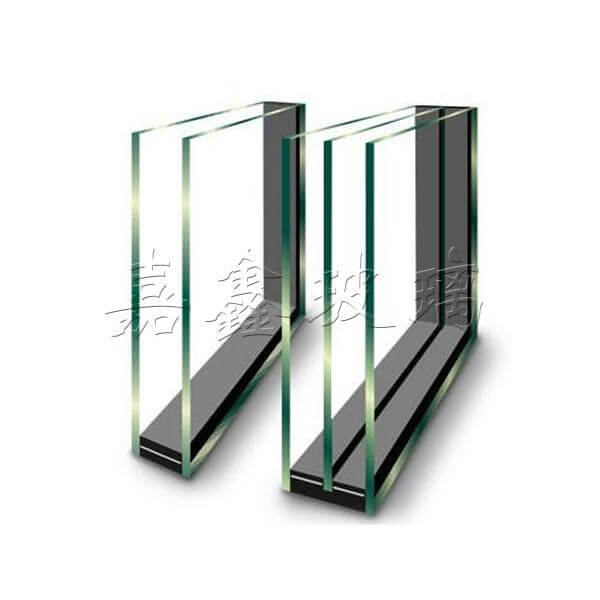
Argon is an inert gas, with a density 38% greater than air. Filling the hollow layer with it can significantly reduce convective heat transfer (reducing the U-value by 10%-15%), while also reducing the risk of condensation in the hollow layer. To check the inflation amount, an argon gas detector (such as Oxford Instruments' GasCheck G3) is required. Insert the probe into the gap strip air holes, and a reading of ≥85% indicates compliance. Note that argon will slowly leak over time, with high-quality products having an annual leakage rate of ≤1% (Jiaxin Glass controls the leakage rate below 0.5% through double-sealing technology).
Q3: What is the pricing structure for low-E insulating glass? How can I avoid overpriced offers?
A: Quotations typically include four parts: glass sheet (40%-50%), Low-E coating (20%-30%), hollow processing (15%-20%), and transportation/installation (10%-15%). To avoid exaggerated prices, pay attention to three points: first, require manufacturers to provide the brand of the original glass sheet (e.g., brands like Nanshan, Xinyi, etc., which are 15%-20% more expensive than second-tier brands); second, verify the coating process parameters (e.g., magnetron sputtering coating is 30% more expensive than online coating but offers more stable performance); third, clarify the configuration of the hollow layer (e.g., warm edge spacer bars are 5 yuan/meter more expensive than aluminum spacers, but improve energy-saving effect by 20%).
Summary: Choose the right service provider, and Low-E insulating glass can truly unleash its energy-saving value.
Low-E insulating glass's energy-saving effect highly depends on raw material quality, production technology, and installation services. Purchasers should abandon the "cheaper first" mindset and focus on the manufacturer's technical strength (such as coating equipment accuracy, sealing process level) and service guarantees (such as warranty period, after-sales response speed). Jiangyin Jiaxin Glass Products offers a reliable choice through the combination of "German imported equipment + full-process quality inspection + 24-hour after-sales". Its products not only pass the national mandatory 3C certification but also obtain the German TÜV energy-saving certification, meeting the requirements of the green building three-star standard. For those pursuing long-term energy-saving benefits, choosing such a technical service provider is the key to risk avoidance and value realization.
Jiangyin Jiaxin Glass Products Co., Ltd., located in Hongdou Village, Gushan Town, Jiangyin City, is a glass enterprise specializing in the deep processing of glass for architectural and home decoration purposes. Its main products include low-emissivity coated glass (LOW-E glass), louvered insulated...
No. 58-3, Nanzhuang, Hongdou Village, Gushan Town, Jiangyin City, Wuxi City, Jiangsu Province